Recovery of Unpaid Dues for My Business
Enforce delayed B2B payments, unfreeze commercial cash flows, and compel corporate debtors to settle outstanding invoices through statutory legal notices, MSME Samadhaan, and Summary Suits.
Table of Contents
Swipe →Direct Legal Answer: Recovery of Unpaid Dues for My Business
Businesses in India achieve the recovery of unpaid dues for my business by issuing a formal advocate legal notice under Section 80 and relevant commercial provisions, initiating delayed payment conciliation under Section 18 of the Micro, Small and Medium Enterprises Development Act, 2006, or filing a summary suit under Order XXXVII of the Code of Civil Procedure, 1908. A statutory demand notice establishes a binding 15-day ultimatum that compels corporate defaulters, clients, and commercial vendors to settle outstanding invoices before facing commercial court litigation, three times the RBI bank rate compounded monthly interest, or corporate insolvency applications under the Insolvency and Bankruptcy Code, 2016.
1. Legal Framework for Business Debt Recovery in India
Commercial non-payment threatens working capital, disrupts vendor supply chains, and stalls business expansion. In Indian corporate jurisprudence, business debt recovery is governed by a multi-layered framework combining statutory contract law, specialized commercial tribunals, and rapid summary adjudication. Commercial transactions between enterprises, distributors, service providers, and vendors operate under the binding force of the Indian Contract Act, 1872. Under Section 73 of the Indian Contract Act, 1872, an aggrieved enterprise is entitled to receive compensation for any loss or damage caused by a party who breaches a contractual obligation, including delayed payments for delivered goods or completed services.
Beyond foundational contract principles, the Indian Parliament enacted specialized statutory regimes to address persistent business defaults. For enterprises holding Udyam registrations, Sections 15 through 24 of the Micro, Small and Medium Enterprises Development (MSMED) Act, 2006, establish a strict statutory liability upon buyers. Buyers are legally mandated to pay suppliers within 45 days, subjecting defaulting purchasers to compound interest penalties at three times the Reserve Bank of India’s notified bank rate.
For higher-value commercial transactions, the Commercial Courts Act, 2015, established dedicated commercial benches in district and high courts to adjudicate commercial disputes exceeding the statutory pecuniary threshold of ₹3 Lakhs. Concurrently, Order XXXVII of the Code of Civil Procedure, 1908, provides summary adjudication for liquidated debts arising from written contracts, negotiable instruments, and formal acknowledgments. Where a corporate debtor defaults on an admitted operational debt exceeding ₹1 Crore, Section 9 of the Insolvency and Bankruptcy Code (IBC), 2016, permits an operational creditor to petition the National Company Law Tribunal (NCLT) for corporate insolvency resolution.
2. Commercial Evidentiary Audit Checklist
The success of any legal recovery effort hinges entirely upon the robustness of the supporting evidentiary audit. Defaulting corporate debtors routinely attempt to fabricate spurious disputes regarding quality, delivery timelines, or invoice discrepancies once legal demand is served. Gathering contemporaneous commercial records prior to issuing an advocate legal notice neutralizes these defenses.
Core Documentary Evidence Required for Commercial Debt Recovery:
- Purchase Orders (PO) & Master Service Agreements (MSA): Executed contracts, work orders, service level agreements, or purchase orders specifying scope, payment credit periods, milestone deliverables, and agreed interest terms.
- Itemized GST Tax Invoices: Digitally generated tax invoices containing explicit invoice dates, due dates, GST numbers (GSTIN) of both supplier and buyer, HSN/SAC codes, and printed dispute resolution clauses.
- Proof of Delivery & Performance: Signed delivery challans, transport bilty (consignment notes), electronic Way Bills (E-Way Bills), courier acknowledgments, or client sign-off acceptance certificates confirming defect-free receipt.
- Mutual Ledger Statements & Balance Confirmations: Running accounts from accounting software (such as Tally or Zoho) detailing invoice debits and bank credit entries, paired with signed end-of-year balance confirmation letters or audit balance confirmations.
- TDS Form 26AS / AIS Records: Proof that the debtor deducted Tax Deducted at Source (TDS) under Section 194C, 194J, or 194Q of the Income Tax Act, 1961, which serves as conclusive judicial admission of the underlying invoice value.
- Electronic Communications & Section 65B Certificate: Email threads acknowledging pending balances, WhatsApp conversation exports confirming payment commitments, accompanied by an electronic certificate under Section 65B of the Indian Evidence Act, 1872 (or Section 63 of the Bharatiya Sakshya Adhiniyam, 2023).
- Dishonoured Negotiable Instruments: Returned cheques with bank return memos citing "funds insufficient" or "stop payment", forming the basis for immediate Section 138 Negotiable Instruments Act action.
3. Legal Remedies Comparison Matrix
Selecting the correct judicial forum depends on debtor entity type, claims value, presence of negotiable instruments, and registration under the MSMED Act. The comparison matrix below outlines the primary legal avenues available to Indian business owners.
| Legal Remedy | Applicability | Statutory Timeline | Pecuniary Threshold | Key Advantage |
|---|---|---|---|---|
| Advocate Legal Notice | All business dues, invoices, and contracts | 15 to 30 Days compliance | No minimum threshold | 82% out-of-court settlement rate; minimal cost and immediate impact. |
| MSME Samadhaan (MSEFC) | Suppliers registered under Udyam / MSMED Act | 90 Days statutory target | No minimum limit | Statutory 3x RBI bank rate compound interest; overrides arbitration clauses. |
| Summary Suit (Order 37 CPC) | Liquidated debts on written contracts, bills, notes | 6 to 12 Months | Determined by court jurisdiction | Defendant cannot defend without court leave; swift decree upon failure to deposit dues. |
| Section 138 NI Act | Dishonoured business payment cheques | 15-day notice, complaint in 30 days | Face value of cheque | Criminal prosecution, imprisonment up to 2 years, fine up to double cheque amount. |
| IBC Section 9 (NCLT) | Operational debt against corporate entities (Pvt/Ltd) | 10-day Form 3 notice | ₹1 Crore minimum default | Threat of company liquidation and board removal forces immediate settlement. |
4. Step-by-Step Procedure to Recover Unpaid Business Dues
A disciplined chronological protocol ensures that evidentiary integrity is preserved while escalating pressure on the defaulting counterparty:
Issue Written Friendly Reminders & Ledger Reconciliations
Transmit statement of accounts and payment reminders via registered corporate email. Establish a clear paper trail confirming that deliverables were inspected and accepted without objection.
Dispatch Advocate Legal Notice on Formal Letterhead
Engage a panel commercial advocate to draft and dispatch a formal legal notice under advocate seal. The notice details invoice numbers, delivery dates, penal interest calculations, and provides a strict 15-day ultimatum for complete payment.
Dual Service via Registered Post (RPAD) & Digital Channels
Serve physical notices via Registered Post with Acknowledgment Due (RPAD) and speed post to the registered corporate office and directors. Simultaneously transmit an authentic digital copy via email and WhatsApp, preserving delivery tracking reports.
Invoke MSME Facilitation Council or Section 12A Mediation
If the debtor fails to remit funds within the 15-day window, immediately file a petition on the MSME Samadhaan portal or apply for pre-institution mediation before the District Legal Services Authority (DLSA) under the Commercial Courts Act, 2015.
Execute Summary Suit (Order 37) or Commercial Plaint
Where mediation produces a non-starter report or fails, institute a Summary Suit under Order XXXVII CPC or file an insolvency application under Section 9 IBC. Upon obtaining a judgment decree, initiate asset attachment proceedings under Order XXI of the CPC.
5. Essential Elements of a Commercial Legal Notice
A poorly drafted notice invites frivolous defenses and weakens subsequent court submissions. An authoritative commercial notice drafted by Legal Recovery incorporates the following eight non-negotiable clauses:
- Advocate Letterhead & Enrolment Details: Issued under official Bar Council registration number, confirming legal representation and intent to initiate litigation.
- Corporate Identification of Parties: Precise corporate names, Corporate Identification Numbers (CIN), registered offices, and directors’ personal addresses.
- Chronological Transaction History: Exact purchase order dates, work milestone deliveries, and consignment dispatch references.
- Tabular Invoice Breakdown: A structured schedule detailing invoice number, invoice date, base amount, GST component, due date, and elapsed days of default.
- Statutory Interest Computation Clause: Explicit claim of commercial interest (contractual rate or 3x RBI bank rate under Section 16 of the MSMED Act).
- Rebuttal of Oral or Fictitious Disputes: Explicit notation that goods/services were accepted without notice of defect within statutory inspection windows.
- Statutory Ultimatum Window: A definitive 15-day timeline from notice delivery for unconditional wire transfer remittance into the creditor’s designated bank account.
- Litigation Warning & Legal Costs Clause: Reservation of rights to initiate Summary Suit, Section 138 NI Act, or Section 9 IBC proceedings, holding the debtor liable for all advocate fees and court charges.
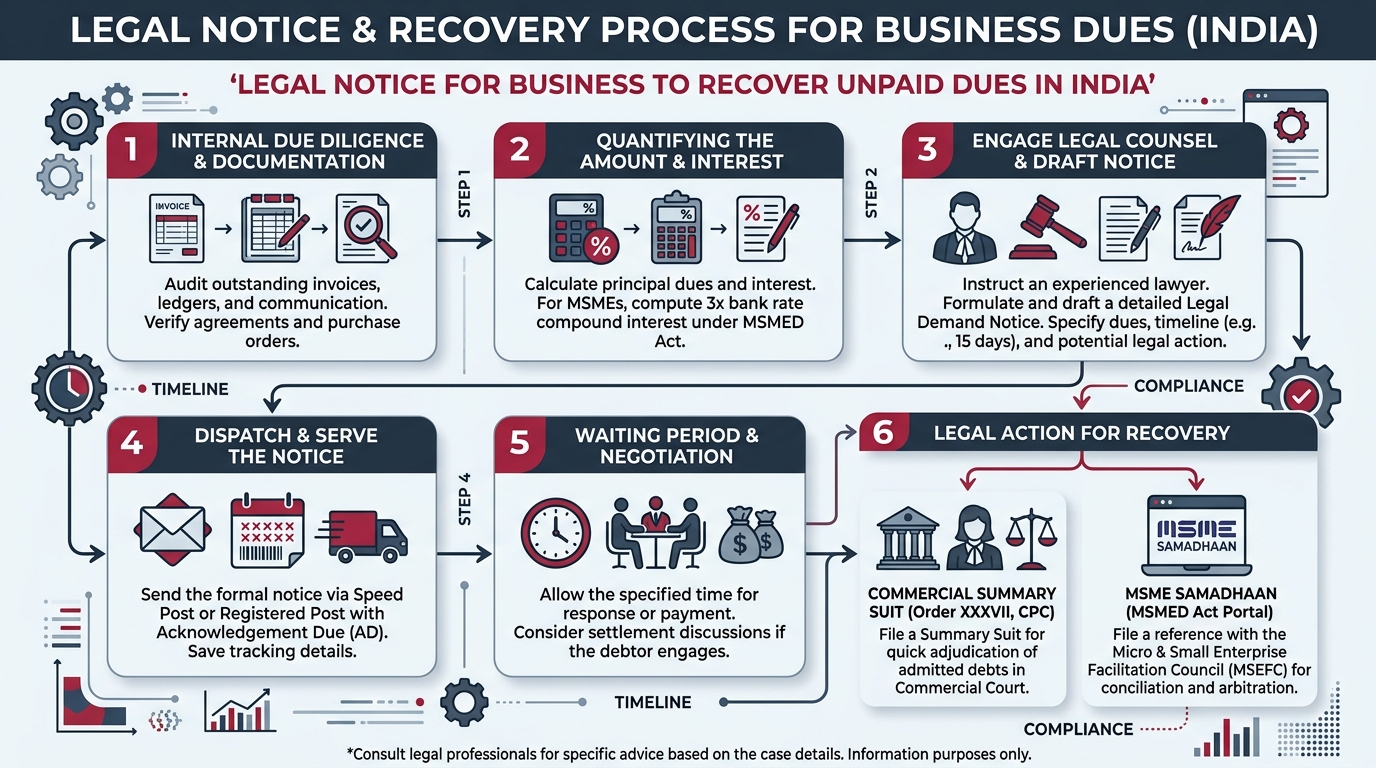
6. Business Recovery Roadmap Infographic
The visual framework below summarizes the strategic escalation roadmap for recovering unpaid commercial dues in India, highlighting the transition from pre-litigation advocate demands to judicial decrees:
7. Commercial Courts Act & Section 12A Mediation
The enactment of the Commercial Courts Act, 2015, fundamentally reformed how Indian courts handle business debt recovery. The legislation introduced specialized procedures designed to prevent deliberate judicial delays often weaponized by commercial debtors. Under Section 2(1)(c) of the Act, disputes arising out of ordinary transactions of merchants, bankers, financiers, and traders, including export or import of merchandise, carriage of goods, and construction and infrastructure contracts, fall strictly within commercial court jurisdiction.
A vital feature of this legislation is Section 12A, which mandates pre-institution mediation. The Supreme Court of India in Patil Automation Pvt. Ltd. v. Rakheja Engineers Pvt. Ltd. held that Section 12A is mandatory, meaning that any commercial suit filed without exhausting pre-institution mediation through the District Legal Services Authority (DLSA) will be summarily rejected, unless urgent interim relief (such as freezing debtor bank accounts or attaching assets under Order XXXVIII Rule 5 CPC) is sought.
Pre-institution mediation provides a fast, confidential, three-month window where a judicial mediator facilitates a settlement agreement. Once executed, the settlement carries the same legal weight as a court decree under Section 74 of the Arbitration and Conciliation Act, 1996. Serving an advocate legal notice prior to invoking Section 12A demonstrates that the creditor acted in good faith, substantially accelerating resolution before the DLSA.
8. Limitation Periods, Interest & Escalation Matrix
Time is of the essence in business debt recovery. Under the Limitation Act, 1963, legal proceedings must be initiated within strictly defined statutory windows, otherwise the debt becomes legally time-barred and unenforceable in a court of law.
The Three-Year Rule: Under Articles 14 and 15 of the Limitation Act, 1963, the limitation period for recovering the price of goods sold and delivered or services rendered is 3 years from the date of invoice maturity or delivery.
Revival via Written Acknowledgment: Under Section 18 of the Limitation Act, any written acknowledgment of debt signed by the debtor—including balance confirmation emails, WhatsApp acknowledgments, or TDS certificates—resets the 3-year clock from the date of acknowledgment.
Cheque Dishonour Clock: Under Section 138 of the Negotiable Instruments Act, 1881, the legal notice must be dispatched within 30 days of receiving the bank memo, giving the debtor 15 days to pay, failing which a criminal complaint must be filed within 30 days thereafter.
9. Frequently Asked Questions
Statutory Authorities & Legal Citations:
[1] Micro, Small and Medium Enterprises Development Act, 2006 (Sections 15–18): Full legislative text and statutory interest mechanisms available at the Ministry of Micro, Small & Medium Enterprises (msme.gov.in).
[2] Commercial Courts Act, 2015 (Sections 2(1)(c) & 12A Mandatory Pre-Institution Mediation): Verified statutory codes accessed at India Code Legislative Portal (indiacode.nic.in).
[3] Code of Civil Procedure, 1908 (Order XXXVII Summary Suits & Order XXI Execution): Authoritative legal texts curated via the eCourts Portal of India (ecourts.gov.in).
[4] Insolvency and Bankruptcy Code, 2016 (Section 8 Demand Notice & Section 9 Operational Creditor Application): Regulatory guidelines provided by the Insolvency and Bankruptcy Board of India (ibbi.gov.in).
[5] Limitation Act, 1963 (Articles 14, 15, and Section 18 Debt Acknowledgment): Complete statute index hosted on Legislative Department, Ministry of Law & Justice (legislative.gov.in).
Send Legal Notice
We match your business with experienced commercial advocates, draft airtight statutory demand notices, physically dispatch via RPAD, and provide real-time postal tracking.
Client Reviews
"We recovered ₹18.4 Lakhs in pending B2B dues within 14 days of serving the advocate legal notice to a defaulting corporate vendor. The statutory precision and MSME interest calculation left them no room to delay payment."
More Business Recovery & Dispute Guides
MSME Samadhaan vs. Legal Notice
Compare statutory MSME delayed payment portals against immediate advocate legal notice drafting for B2B invoice collection.
Civil Suit for Money Recovery
Explore procedural rules, court fees, jurisdiction, and execution steps under the Code of Civil Procedure, 1908.
Time Limit for Recovery Cases
Understand the strict 3-year limitation window under the Limitation Act and how debt acknowledgments reset the timeline.
Section 138 Cheque Bounce Notice
Crucial 30-day notice timeline, banker memo requirements, and criminal prosecution steps for bounced business cheques.
Legal Notice for Money Recovery
Master the essential drafting elements, statutory clauses, and delivery methods to enforce recovery of outstanding dues.
All Legal Notice Services
Discover our complete spectrum of advocate notice drafting services covering commercial, consumer, and financial claims.

Legal Recovery is India's trusted commercial debt resolution and legal tech platform. Founded in 2022 and headquartered in New Delhi, Legal Recovery has counselled 15,000+ businesses and entrepreneurs on B2B unpaid dues, delayed vendor invoices, MSME claims, and commercial contract enforcement. Legal Recovery prioritizes rapid pre-litigation settlements and connects enterprises directly with vetted commercial panel advocates.