Legal Notice to Agency for Unpaid Creator Payment
Recover unpaid influencer fees, UGC campaign invoices, video production retainers, and 18% statutory interest from defaulting marketing agencies under the Indian Contract Act, Copyright Act, and MSMED Act.
Table of Contents
Swipe →Quick Answer
A digital content creator, influencer, or video producer can serve an advocate-vetted statutory legal notice to an advertising or talent management agency under Section 70 and Section 73 of the Indian Contract Act, 1872 and Section 19 of the Copyright Act, 1957, demanding immediate disbursement of unpaid campaign invoices, late payment interest, and revoking commercial licensing rights within 15 days. Under Indian contract jurisprudence, an agency remains strictly liable to compensate the creator once deliverables are approved and published, regardless of whether the third-party brand client has cleared the agency’s internal invoice. If the agency fails to settle the dues within the stipulated 15-day window, the creator can initiate fast-track recovery through the MSME Samadhaan MSEFC Portal (yielding 3× RBI compound interest under the MSMED Act, 2006), institute a summary suit under Order 37 of the Code of Civil Procedure, 1908, or file a criminal complaint for criminal breach of trust under Section 316 and Section 318 of the Bharatiya Nyaya Sanhita, 2023 (BNS).
1. Statutory Framework: Indian Contract, Copyright & MSME Laws Protecting Creators
The rapid expansion of India's digital creator economy has witnessed thousands of lifestyle influencers, YouTube filmmakers, podcast hosts, and user-generated content (UGC) specialists executing high-value brand endorsements through intermediary influencer marketing and media buying agencies. However, payment defaults, indefinite credit extensions (Net-90, Net-120 days), and arbitrary fee deductions have become systemic issues. Under Indian jurisprudence, digital creators are not defenseless freelance workers; they are specialized commercial service providers protected by a robust statutory framework spanning the Indian Contract Act, the Copyright Act, and the Micro, Small and Medium Enterprises Development (MSMED) Act.
When an agency engages a creator via a formal Scope of Work (SOW), master service agreement, digital contract, or even written WhatsApp/email communication, a legally binding contract is established. When the agency withholds payment after accepting and commercializing the creator's output, multiple legal grounds are triggered simultaneously:
Section 70: Obligation of person enjoying benefit of non-gratuitous act. As affirmed by the Supreme Court in State of West Bengal v. B.K. Mondal & Sons (AIR 1962 SC 779), where a party receives and retains the benefit of creative work, they are legally bound to pay compensation. Furthermore, Section 73 grants right to liquidated damages and loss of commercial earnings.
Section 14 & Section 19(3): The author is the first owner of copyright in artistic and cinematographic works. Any commercial assignment or broadcasting license is statutorily conditional upon payment of agreed consideration. Non-payment automatically invalidates the license, transforming ongoing usage into actionable copyright infringement under Section 51 of the Copyright Act, 1957.
Section 15 & Section 16: Mandates payment within 45 days maximum. Delayed settlement attracts mandatory compound interest with monthly rests at 3× the RBI bank rate. Creators registered on Udyam can file direct recovery claims through the MSME Samadhaan Portal.
Section 316 & Section 318:Replaces IPC 406 & 420. If an agency collected brand sponsorship payments specifically ear-marked for the creator but diverted or siphoned those funds for internal operational cash flow, agency founders face criminal liability for criminal breach of trust and cheating.
2. The "Client Hasn't Paid Us" Fallacy: Why Agencies Remain Strictly Liable
The single most prevalent defense raised by influencer marketing agencies and media buying houses is: "We are waiting for the brand client to clear our master campaign invoice. As soon as the brand pays us, we will disburse your creator fees."
Under Indian commercial contract law, this justification is legally invalid and legally unenforceable unless an express, explicit "pay-when-paid" or "contingent contract" clause (under Section 31 of the Indian Contract Act) was mutually drafted, understood, and signed prior to the execution of the deliverables. Here is why the agency remains strictly and independently liable:
A. Doctrine of Privity of Contract
The legal contract exists strictly between the creator and the agency. The creator has no direct contractual privity with the end-brand. Therefore, third-party operational bottlenecks, vendor billing delays, or commercial disputes between the agency and the corporate brand cannot be transferred onto the creator as an excuse for non-payment.
B. Acceptance of Unconditional Deliverables
Once the agency reviews the creator's draft script, approves the video reel, instructs the creator to publish the content, or takes delivery of raw video footage, the contract transitions from executory to executed on the creator's part. The agency has enjoyed the full economic utility of the creator's work and cannot withhold remuneration on unstated contingencies.
C. Unilateral Credit Term Expansion Is an Actionable Breach
Agencies frequently issue purchase orders with Net-30 or Net-45 credit terms but unilaterally drag payouts to 120 or 180 days. Such arbitrary delays constitute a material breach under Section 73 of the Indian Contract Act, 1872, entitling the creator to sue for the principal amount plus commercial interest from the exact date of default.
3. Intellectual Property Leverage: Revoking Commercial Licenses & Cease-and-Desist Actions
One of the most potent legal levers available to creators against recalcitrant agencies is intellectual property revocation under the Copyright Act, 1957. Under Indian intellectual property laws, the creator is the author and first owner of the copyright in their original creative work (scripts, voiceovers, video recordings, graphics, photographs, and performance).
When a brand campaign is launched, the creator merely grants a limited commercial usage license (or conditional assignment) to the agency and brand to publish, broadcast, boost, or whitelist the content. This grant of rights is legally dependent upon full payment of the agreed consideration:
The Three-Pronged IP Enforcement Mechanism in Legal Notices:
- Statutory Revocation under Section 19(3):The notice explicitly declares that due to the agency's total failure of consideration, all commercial broadcasting licenses, whitelisting permissions, and digital distribution rights are immediately terminated and revoked.
- Cease-and-Desist Injunction Notice to Agency and End-Brand:The notice notifies both the marketing agency and the ultimate corporate advertiser that any continued streaming, performance, paid ad boosting (Meta Ads, Google Ads), or archiving of the creator's likeness constitutes willful copyright infringement under Section 51 of the Copyright Act.
- Civil Damages & Injunctions under Section 55: The notice warns of immediate proceedings before the High Court or Commercial District Court for interim ex-parte injunctions, statutory damages, and rendition of accounts for all commercial profits generated during the unauthorized broadcast period.
*Note: Copying the end-brand's legal and compliance team on the statutory notice creates immediate urgency. Major corporate brands will instantly pressure the agency to liquidate the creator's invoice to prevent public copyright litigation or brand reputational damage.*
4. Pre-Notice Evidentiary Checklist & Electronic Records under Section 63 BSA
Under modern Indian evidence law, electronic communications are fully admissible in court. The Bharatiya Sakshya Adhiniyam, 2023 (BSA) under Section 63 (which replaces Section 65B of the Indian Evidence Act, 1872) governs the admissibility of digital records. Prior to drafting a statutory legal notice, creators must consolidate and preserve the following evidentiary chain:
5. Anatomy of an Advocate-Vetted Legal Notice & Key Clauses for Marketing Agencies
A boilerplate or amateur demand letter is routinely disregarded by agency legal desks. An effective statutory legal notice must be issued on an advocate's official legal stationery, citing precise statutory enactments, quantifying exact principal and interest liabilities, and setting an uncompromised 15-day compliance deadline.
Clause 1: Parties & Contractual Engagement Details
Establishes the identity of the digital creator and the marketing agency, detailing the exact campaign name, brand represented, date of engagement, agreed deliverables (e.g., 2 Instagram Reels, 1 YouTube Integration), and contracted commercial remuneration.
Clause 2: Complete Performance & Acceptance by Agency
Explicitly records that the creator fulfilled all creative milestones strictly per specifications, secured written pre-approval, published the content on scheduled dates, and delivered verified viewership numbers without any defect or delay.
Clause 3: Invoice Delivery & Unlawful Withholding
Itemizes the formal invoice numbers, amounts, due dates, and cites repeated dishonored reminders. Emphasizes that third-party client payment delays cannot legally discharge or suspend the agency's direct obligation under Section 70 and 73 of the Contract Act.
Clause 4: Intellectual Property & License Revocation Notice
Formally revokes all copyright licenses granted under Section 19 of the Copyright Act, 1957. Commands the agency and its corporate brand client to forthwith cease and desist from broadcasting, running paid advertisements, or using the creator's likeness.
Clause 5: Statutory Peremptory Demand & Multi-Forum Warning
Grants a strict 15-day window from receipt of notice to transfer the entire principal sum plus 18% p.a. interest and legal drafting fees. Warns of immediate filing before the MSEFC Samadhaan council, Order 37 summary recovery, and Section 316/318 BNS criminal proceedings.
6. Multi-Forum Legal Remedies: Comparison of Legal Options for Creators
If the marketing agency ignores or fails to comply with the statutory legal demand notice within the 15-day period, the creator can initiate legal action across various specialized forums depending on the claim amount and registration status:
| Legal Forum / Remedy | Statutory Basis | Interest & Penalty | Resolution Timeline | Suitability |
|---|---|---|---|---|
| MSME Samadhaan (MSEFC) | MSMED Act, 2006 (Sec 15–18) | Compound interest at 3× RBI bank rate | 90 – 180 Days | Udyam-registered creators & small media production firms. |
| Summary Suit (Order 37 CPC) | Code of Civil Procedure, 1908 | Court-awarded interest (6%–18% p.a.) + costs | 6 – 12 Months | Claims based on signed contracts, admitted invoices, or written debt admissions. |
| Commercial Court Suit | Commercial Courts Act, 2015 (Sec 2(1)(c)) | Full commercial damages + loss of revenue | 6 – 14 Months | High-value agency retainer disputes exceeding ₹3 Lakhs. |
| Copyright Infringement Action | Copyright Act, 1957 (Sec 51, 55) | Statutory damages, profits disgorgement & ad injunction | Immediate (Interim Order in 15–30 Days) | Cases where agency/brand continues running creator video ads without payment. |
| Criminal Complaint (BNS 316/318) | Bharatiya Nyaya Sanhita, 2023 | Non-bailable warrant risk & director prosecution | Immediate Police Intimation | Agencies that collected brand funds and misappropriated or ghosted creator. |
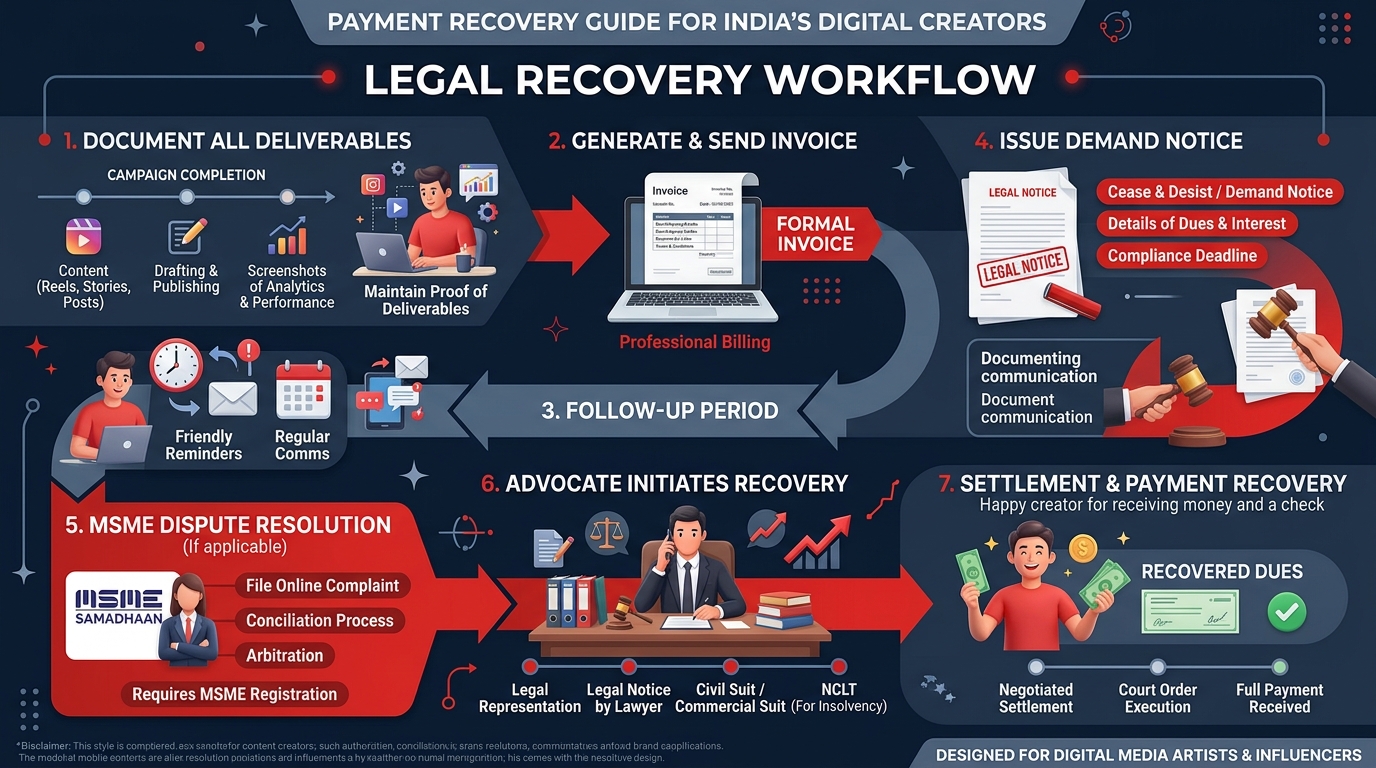
7. Step-by-Step Legal Action Roadmap to Recover Unpaid Creator Money
Executing a systematic legal recovery strategy ensures maximum recovery rate while minimizing procedural delays. Here is the exact five-stage process followed by Legal Recovery advocates:
Stage 1: Complete Case Audit & Electronic Evidence Collation
Consolidate all digital communications including campaign agreements, SOWs, brief decks, WhatsApp chat logs, script approvals, live social media links, and unpaid invoices into an immutable evidentiary folder supported by Section 63 BSA compliance.
Stage 2: Formal Advocate Legal Notice Drafting
A seasoned panel advocate drafts a customized statutory legal demand notice itemizing every breach under the Indian Contract Act, invoking copyright license revocation under Section 19 of the Copyright Act, calculating 18% p.a. interest, and establishing a strict 15-day peremptory ultimatum.
Stage 3: Multi-Channel Statutory Dispatch & Tracking
The notice is dispatched simultaneously via India Post Speed Post with Acknowledgment Due (AD) to the agency's registered corporate address, and electronically served via tracked email and WhatsApp to agency directors and accounts heads, creating undisputed proof of delivery.
Stage 4: Advocate-Led Out-of-Court Settlement Negotiation
Over 78% of marketing agencies settle the full principal amount within the 15-day notice period to protect their agency reputation, avoid copyright take-down notices to end-clients, and escape compounding MSME statutory interest.
Stage 5: Judicial Escalation & Enforcement
If the agency fails to settle within 15 days, our advocates initiate immediate escalation by filing an MSEFC Samadhaan petition, an Order 37 summary recovery suit, an intellectual property injunction application, or a Section 316/318 BNS criminal complaint.
8. Frequently Asked Questions
Statutory Authorities & Legal Citations:
More Payment & Freelancer Protection Guides

Legal Recovery
India's Trusted Recovery Platform
Legal Recovery is India's trusted online legal notice and dispute resolution platform, connecting content creators, influencers, media professionals, and digital agencies with seasoned panel advocates for rapid, advocate-vetted statutory demand notices at transparent flat fees. With ₹100 Crore+ recovered and 10,000+ cases resolved across India, Legal Recovery delivers verified legal impact without the delays and unpredictability of traditional law firms.
Agency Withholding Your Creator Payment?
Send an advocate-vetted statutory notice today. Over 78% of marketing agencies settle unpaid campaign invoices within 15 days of notice service.
Flat fee • Advocate-drafted • Sent same day
Client Reviews
Ananya Deshmukh
"When a prominent digital marketing agency hired me for a 4-deliverable festive tech campaign across Instagram and YouTube with a total invoice value of ₹4,85,000, they went completely silent after the content went live and delivered 1.2M+ organic impressions. For over four months, the agency repeatedly gave excuses like "client payment is pending" and refused to honor the Net-30 credit terms in our Scope of Work. Legal Recovery drafted a formidable statutory legal notice under Section 70 and Section 73 of the Indian Contract Act, Section 19 of the Copyright Act, and the MSMED Act, giving them 15 days to settle the dues or face copyright revocation and MSEFC recovery. Within 10 days of service via Speed Post and email, the agency directors panicked about the copyright infringement claim and disbursed the entire ₹4,85,000 plus 18% p.a. interest. Outstanding legal support for digital creators!"