Legal Notice for Business to Recover Their Unpaid Dues
Recover overdue B2B invoices, delayed client retainers, contractor balances, and supply chain dues with an advocate-drafted statutory legal notice backed by MSMED Act, Order 37 CPC, and Section 138 NI Act.
Table of Contents
Swipe →Quick Answer
A legal notice for a business to recover unpaid dues is an advocate-drafted statutory demand letter served on defaulting buyers, corporate clients, or commercial debtors who fail to pay for supplied goods or rendered services. The legal notice formally sets out the contractual transaction history, itemizes overdue GST invoices and statutory compound interest, and grants the debtor a mandatory 15-day cure window to discharge the outstanding liability in full. Failure to settle the dues within the notice period enables the creditor business to initiate an expedited Commercial Summary Suit under Order XXXVII of the Code of Civil Procedure, file for statutory recovery under Section 18 of the MSMED Act, 2006, prosecute dishonored cheques under Section 138 of the Negotiable Instruments Act, or trigger Corporate Insolvency Resolution under the Insolvency and Bankruptcy Code.
1. Statutory & Legal Architecture for Business Debt Recovery
Commercial cash flows represent the lifeblood of Indian enterprises, manufacturing firms, MSMEs, IT agencies, and professional service providers. When corporate buyers or commercial clients default on invoiced credit terms, Indian statutory law provides robust pre-litigation and judicial remedies to enforce prompt payment and deter bad-faith withholding of operational funds.
For registered micro, small, and medium enterprises holding a valid Udyam Registration, the primary statutory shield is the Micro, Small and Medium Enterprises Development (MSMED) Act, 2006. Under Section 15 of the MSMED Act, buyers are bound by a statutory mandate to clear payments within the agreed credit window, which cannot exceed 45 days under any circumstances. In the event of default, Section 16 imposes a mandatory penal interest rate calculated as compound interest with monthly rests at three times the Reserve Bank of India (RBI) Bank Rate. Creditors can file statutory recovery references before the Micro and Small Enterprise Facilitation Council (MSEFC) through the MSME Samadhaan Portal, where council arbitral awards hold the executable force of a civil court decree.
For corporate and general commercial debts, creditors utilize the fast-track mechanism of a Commercial Summary Suit under Order XXXVII of the Code of Civil Procedure, 1908 (CPC). Governed by the Commercial Courts Act, 2015, summary suits apply to liquidated debts arising from written contracts, purchase orders, bills of exchange, or unpaid invoices. Under Order XXXVII, the defendant debtor does not possess an automatic right to defend the suit; they must obtain leave to defend from the court by demonstrating a bona fide, non-frivolous triable defense. If the court denies leave or the debtor defaults, the court enters an immediate money decree in favor of the creditor business.
Where defaulting buyers attempt to discharge commercial debts through negotiable instruments that subsequent bounce, Section 138 of the Negotiable Instruments Act, 1881 and Section 25 of the Payment and Settlement Systems Act, 2007 establish strict criminal liability. In cases of corporate debtor default exceeding ₹1 Crore, operational creditors can serve a mandatory Form 3 or Form 4 demand notice under Section 8 of the Insolvency and Bankruptcy Code, 2016 (IBC) and initiate Corporate Insolvency Resolution Processes (CIRP) under Section 9 before the National Company Law Tribunal (NCLT). Serving a formal advocate legal demand notice is the mandatory pre-condition that establishes the uncontroverted record of commercial default across all these forums.
2. Commercial Credit Categories & Default Scenarios
Commercial transactions encompass diverse business models, contractual milestones, and supply chain arrangements. An enforceable legal notice for business debt recovery must be tailored to the specific credit architecture and documentary evidence underpinning the transaction.
Unpaid B2B Supply of Goods & Raw Material Invoices
Manufacturers, raw material suppliers, distributors, and wholesalers supplying goods on agreed 15, 30, or 45-day credit terms. Defaults occur when buyers accept delivery without raising quality objections within the inspection window but subsequently withhold invoice payments. Notices enforce the unpaid seller's rights under the Sale of Goods Act, 1930 alongside GST e-invoice and e-way bill records.
Service Retainers, IT Development & Consulting Milestone Defaults
Software development agencies, marketing firms, management consultants, and professional service providers executing deliverables under Master Service Agreements (MSAs) or Statements of Work (SOWs). Defaults occur when clients deploy software code or approved deliverables but refuse to release sign-off milestone retainers. Notices demand immediate release of dues under Section 70 of the Indian Contract Act, 1872.
Construction Subcontractor, EPC & Vendor Contractual Balances
Engineering, procurement, and construction (EPC) contractors and specialized trade subcontractors facing withheld running account (RA) bills, unreleased retention money, or unpaid variation orders. Notices invoke contractual payment certificates, site measurement sheets, and statutory interest for unjustified cash retention.
Distributor, Super-Stockist & Franchise Debit Balances
FMCG, consumer durables, and pharmaceutical brand owners whose regional distributors, super-stockists, or franchise partners accumulate substantial ledger debit balances following product dispatch, stock reconciliation, or dealership termination. Notices demand immediate settlement of reconciled ledgers backed by security cheques.
Commercial Advance Payment Non-Refund & Breach of Procurement
Businesses that remitted upfront advance procurement payments or supplier security deposits where the vendor failed to supply the agreed goods or render contracted services and refused to refund the advance consideration. Notices demand full refund with 18% commercial interest under Sections 73 and 74 of the Indian Contract Act.
3. Pre-Notice Evidentiary Dossier & Document Audit
To establish an unassailable legal claim and prevent debtors from manufacturing sham counterclaims or dispute defenses, businesses must compile a certified evidentiary dossier before issuing a statutory recovery notice.
Contractual & Order Placement Records
- Purchase Orders (PO), Work Orders, or Signed Quotations
- Master Service Agreements (MSA) and Statements of Work (SOW)
- Vendor onboarding forms and agreed credit policy agreements
- Email exchange confirming commercial pricing and delivery timelines
Statutory Tax Invoices & Delivery Proofs
- GST Tax Invoices with IRN QR codes and GSTR-1 filing proof
- E-Way Bills generated on the GST portal matching invoice values
- Delivery Challans, Goods Receipt Notes (GRN), or Lorry Receipts (LR)
- Physical receiver stamps, gate passes, or courier delivery tracking
Financial Ledgers & Payment History
- Mutually confirmed Ledger Accounts or Balance Confirmation letters
- Bank account statements showing prior partial payments / RTGS receipts
- Itemized interest computation sheet (contractual or 3x RBI Bank Rate)
- Certificate under Bankers' Books Evidence Act and Section 65B
Acknowledgment of Debt & Corporate Data
- Email threads and WhatsApp communications admitting liability
- Dishonored cheques with Bank Return Memos (CTS return codes)
- Valid Udyam Registration Certificate for MSMED Act statutory claims
- MCA Company Master Data, DIN details, and registered office address
4. Strategic Commercial Recovery Forum Comparison Matrix
Selecting the appropriate statutory enforcement channel after the legal demand notice period expires depends on the creditor's MSME registration status, debt quantum, corporate nature of the debtor, and the availability of dishonored financial instruments.
| Recovery Channel | Governing Statute | Threshold / Applicability | Average Timeline | Key Strategic Advantage |
|---|---|---|---|---|
| MSME Samadhaan (MSEFC) | MSMED Act, 2006 (Sec 18) | Registered Micro/Small enterprises; Any overdue amount | 3 to 6 Months | Mandatory 3x compound interest; Buyer must deposit 75% award amount to appeal in court. |
| Commercial Summary Suit | Order 37 CPC / Commercial Courts Act | Liquidated commercial claims ≥ ₹3 Lakhs | 6 to 12 Months | Debtor must demonstrate substantial defense to obtain leave; rapid decree without full trial delays. |
| Section 138 Cheque Dishonor | Negotiable Instruments Act, 1881 | Any dishonored commercial payment cheque | 6 to 18 Months | Criminal prosecution with imprisonment up to 2 years, interim compensation up to 20%, and 2x fines. |
| Commercial Arbitration | Arbitration & Conciliation Act, 1996 | Disputes with explicit arbitration clause in agreement | 6 to 12 Months | Private, fast-track arbitral award enforceable as a direct decree of the civil court under Section 36. |
| Insolvency Petition (IBC Sec 9) | Insolvency & Bankruptcy Code, 2016 | Corporate debtor operational default ≥ ₹1 Crore | 6 to 14 Months | High-pressure remedy; risks replacing debtor's board of directors with an Interim Resolution Professional. |
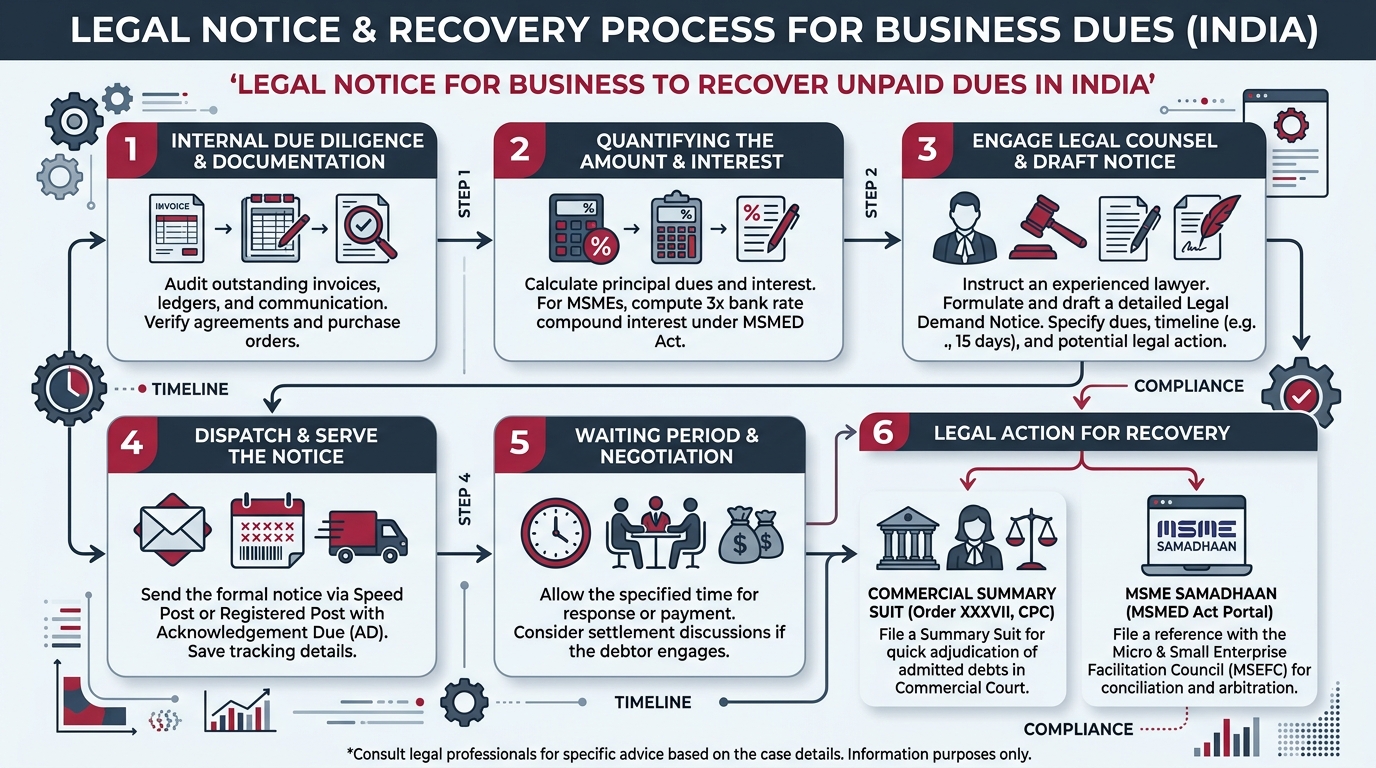
5. Step-by-Step Notice Drafting & Service Protocol
Issuing a commercial recovery notice requires precision to avoid procedural defects that could weaken subsequent court proceedings. Following this standardized 5-stage protocol ensures airtight legal admissibility.
Ledger Audit & Statutory Interest Calculation
Audit outstanding invoice ledgers to isolate principal dues, adjust credit notes or partial receipts, and compute contractual or MSME statutory compound interest up to the exact date of notice dispatch.
Entity Verification & Address Confirmation
Verify the defaulting entity's legal status via MCA Company Master Data, GST portal filings, and MSME Udyam database. Identify all managing directors, designated partners, or proprietors along with registered office and factory addresses.
Advocate Drafting on Formal Legal Letterhead
Engage a commercial recovery advocate to draft the statutory notice on official letterhead, reciting the transaction timeline, delivery acknowledgments, explicit invoice terms, default details, and statutory legal consequences.
Stipulation of 15-Day Mandatory Cure Period
Grant the debtor exactly 15 days from the date of notice receipt to remit the full outstanding amount alongside advocate drafting charges into the designated corporate bank account.
Verifiable Multi-Channel Dispatch & Tracking
Dispatch signed physical copies via India Post Speed Post with Acknowledgment Due (RPAD) to the registered office and operating branches. Concurrently transmit digitally signed PDF notices via registered corporate email and WhatsApp with delivery confirmation certificates.
6. Anatomy of an Enforceable Business Demand Notice
A poorly constructed demand notice can provide the defaulting buyer an opportunity to construct frivolous defenses or allege pre-existing disputes in subsequent judicial proceedings. An enforceable business recovery notice must incorporate the following foundational components:
- Counsel Authorization & Client Particulars: Clear statement declaring that the advocate is instructed and authorized by the creditor entity (Private Limited Company, LLP, MSME, or Sole Proprietor) to issue the statutory demand.
- Commercial Transaction Recital: Chronological overview of purchase orders, contracts, quotations, supply dates, delivery challan numbers, and transport records proving flawless execution of obligations.
- Tabular Invoice & Default Breakdown: Itemized schedule specifying invoice numbers, invoice dates, total billed values, partial payments credited, overdue balance amounts, and statutory interest calculated up to the notice date.
- Absence of Dispute or Quality Rejection: Explicit recitation that the debtor accepted goods or services without raising any written dispute or rejection notice within the contractual inspection period.
- Strict 15-Day Demand Window & Payment Details: Demand requiring the debtor to deposit full principal and interest into the creditor's designated corporate bank account within 15 days of notice receipt.
- Judicial Escalation & Cost Warning: Formal warning that failure to pay will trigger immediate legal proceedings under Order 37 CPC, Section 18 MSMED Act, Section 138 NI Act, or Section 9 IBC, holding the debtor liable for all legal costs, damages, and litigation expenses.
7. Debtor Response Windows & Post-Notice Judicial Action
In commercial debt recovery, serving a formal advocate demand notice shifts the psychological dynamic. Over 70% of defaulting commercial debtors initiate settlement discussions within 7 to 10 days of notice service to avoid reputational damage, vendor credit blacklisting, or commercial court injunctions.
If the debtor fails to discharge the liability or attempts to deflect payment with baseless excuses, the creditor business possesses unassailable evidentiary proof of pre-litigation notice and can execute the following multi-tiered legal actions:
1. MSME Samadhaan Reference (MSEFC Conciliation & Arbitration): Registered MSMEs file an online reference under Section 18 of the MSMED Act. The council conducts conciliation, and if unresolved, initiates arbitration yielding an executable arbitral award for 100% principal plus 3x compound interest.
2. Commercial Summary Suit (Order XXXVII CPC): File a summary money suit in the competent Commercial Court via the e-Courts Commercial Portal. The debtor must demonstrate a genuine defense to defend the suit, enabling creditors to obtain swift money decrees without protracted multi-year trials.
3. Section 138 NI Act Criminal Prosecution: If payment cheques bounce, file a criminal complaint before the Judicial Magistrate within 30 days of notice expiry, seeking 20% interim compensation under Section 143A and imprisonment of signatory directors.
4. Section 9 IBC Corporate Insolvency Petition: For corporate defaults exceeding ₹1 Crore, file an operational debt insolvency petition before the NCLT following Section 8 notice service, compelling corporate debtors to settle immediately to prevent insolvency liquidation.
8. Frequently Asked Questions
References: [1] Micro, Small and Medium Enterprises Development (MSMED) Act, 2006 (Sections 15-18). [2] Code of Civil Procedure, 1908 (Order XXXVII Commercial Summary Suits). [3] Commercial Courts Act, 2015 (Pre-Institution Mediation and Commercial Jurisdiction). [4] Negotiable Instruments Act, 1881 (Section 138 Cheque Dishonor). [5] Insolvency and Bankruptcy Code, 2016 (Sections 8 & 9 Operational Creditor Demands). [6] Indian Contract Act, 1872 (Breach of Contract & Quantum Meruit). [7] MSME Samadhaan Portal for Delayed Payment Recovery.
Recover Business & B2B Dues
Partner with senior commercial recovery advocates. We draft institutional demand notices, calculate statutory 3x compound interest, execute verified multi-channel dispatch, and handle MSEFC/Court filings.
Client Reviews
"As an engineering equipment manufacturer, we had over ₹48 Lakhs locked in overdue commercial invoices across two corporate clients who stopped responding to follow-ups. Legal Recovery drafted and served rigorous statutory demand notices citing the MSMED Act Section 16 interest clauses and Order 37 CPC. Both corporate debtors cleared 100% of the principal alongside negotiated delayed interest within 18 days of receiving the Speed Post notice. The speed, legal precision, and professional service exceeded our expectations."
More Commercial & Debt Recovery Guides
B2B Invoice Legal Notice
Complete legal roadmap to draft and send notice for unpaid commercial and trade invoices in India.
Vendor & Invoice Recoveries
Learn statutory procedures to recover delayed commercial invoices and unpaid supplier dues.
MSME Samadhaan Recovery
Claim 3x compound interest on delayed payments for registered MSME suppliers and enterprises.

Legal Recovery is India's trusted consumer protection and commercial debt resolution platform. Founded in 2022 and headquartered in New Delhi, Legal Recovery has counselled 15,000+ businesses, financial institutions, and consumers on debt recovery, commercial contract breaches, and loan defaults. Legal Recovery accelerates out-of-court settlements and connects you with top verified panel advocates.