Legal Notice for NBFC to Recover Unpaid Dues
Recover defaulted commercial loans, unsecured business debt, LAP, and bounced EMIs with an advocate-drafted statutory legal notice backed by SARFAESI, DRT, and Section 138 NI Act provisions.
Table of Contents
Swipe →Quick Answer
Non-Banking Financial Companies (NBFCs) and institutional lenders can issue an advocate-drafted statutory legal notice to recover defaulted loans, outstanding credit facilities, and bounced EMIs from defaulting borrowers and co-guarantors. The legal notice serves as an enforceable pre-litigation demand granting the debtor a mandatory 15-day cure window (or 60 days under SARFAESI Section 13(2)) to settle the outstanding principal, contractual interest, and penal charges. Failure to discharge the debt empowers the NBFC to initiate attachment of mortgaged assets without court intervention, lodge criminal complaints under Section 138 of the Negotiable Instruments Act or Section 25 of the Payment and Settlement Systems Act, and institute recovery proceedings before the Debt Recovery Tribunal.
1. Statutory & Regulatory Architecture for NBFC Recovery
Non-Banking Financial Companies (NBFCs) and digital lending platforms form a foundational pillar of India's credit architecture, servicing retail consumers, Micro, Small, and Medium Enterprises (MSMEs), and infrastructure corporations. When borrowers default on credit facilities, loan EMIs, or trade lines, NBFCs require rigorous, multi-tiered statutory legal remedies to recover outstanding dues while adhering strictly to regulatory guidelines issued by the Reserve Bank of India (RBI).
The primary statutory mechanism for secured credit recovery is the Securitisation and Reconstruction of Financial Assets and Enforcement of Security Interest (SARFAESI) Act, 2002. Qualifying NBFCs notified by the Ministry of Finance (NBFCs having asset sizes of ₹100 Crore and above, for loan debts of ₹20 Lakhs and above) are legally empowered to enforce security interests without the intervention of a civil court. Under Section 13(2) of the SARFAESI Act, once an account is classified as a Non-Performing Asset (NPA) in accordance with RBI prudential norms, the lender must serve a 60-day statutory demand notice calling upon the borrower and guarantors to discharge their full liabilities.
For unsecured business loans, consumer credit lines, and bounced repayment installments, NBFCs possess dual civil and criminal remedies. Under Section 138 of the Negotiable Instruments Act, 1881, the dishonor of repayment cheques triggers criminal liability. Similarly, Section 25 of the Payment and Settlement Systems Act, 2007 (PSSA) accords identical criminal status to dishonored electronic NACH (National Automated Clearing House) mandates and automated debit instructions.
Furthermore, where outstanding dues exceed ₹20 Lakhs, notified NBFCs can institute recovery proceedings before the Debt Recovery Tribunal (DRT) under the Recovery of Debts and Bankruptcy Act, 1993 (RDB Act). For corporate debtors with default quantum exceeding ₹1 Crore, Section 7 of the Insolvency and Bankruptcy Code, 2016 (IBC) permits NBFCs as financial creditors to initiate Corporate Insolvency Resolution Processes (CIRP). Serving a formal advocate-drafted demand notice is the mandatory pre-litigation cornerstone establishing an uncontroverted record of default.
2. Types of Defaults & Credit Portfolios Handled
NBFC recovery strategies differ fundamentally based on asset backing, collateral nature, borrower legal constitution, and loan tenure. A tailored legal notice must target the specific credit agreement breach and trigger the corresponding statutory consequences.
Loan Against Property (LAP) & Mortgage Defaults
Secured loans backed by equitable or registered mortgages over residential, commercial, or industrial real estate. Defaults beyond 90 days trigger NPA classification, enabling SARFAESI Section 13(2) 60-day demand notices followed by Section 13(4) physical possession through District Magistrate orders under Section 14.
Unsecured MSME & Business Working Capital Loans
High-yield term loans or line-of-credit facilities extended to proprietary firms, LLPs, and private limited companies without immovable collateral. Remedies focus on NACH bounce prosecutions under Section 25 PSSA, personal guarantor liability enforcement, institutional arbitration, and Commercial Court Summary Suits under Order 37 CPC.
Vehicle & Commercial Equipment Financing
Asset-backed financing where vehicles, construction equipment, or commercial fleets are hypothecated to the NBFC. The legal notice demands immediate regularization of arrears or surrender of the hypothecated asset, paving the way for Section 9 interim measures under the Arbitration Act for repossession and sale.
Digital Lending & Fintech Consumer Credit
App-based short-term personal loans and Buy-Now-Pay-Later (BNPL) credit facilities. In full compliance with the RBI Digital Lending Guidelines, recovery notices must be served through verified digital and postal channels without unlawful harassment, detailing exact overdue breakdowns and credit bureau reporting ramifications.
3. Pre-Notice Evidence & Account Dossier Checklist
To ensure that a recovery notice withstands judicial challenges in DRT, NCLT, or magistrate courts, NBFC credit operations must assemble an airtight documentary dossier under the Indian Contract Act, 1872and Bankers' Books Evidence Act principles.
Loan Sanction & Contract Execution
- Sanction Letter accepted and signed by borrower
- Duly executed Master Loan Agreement with schedule
- Personal & Corporate Guarantee Deeds
- Hypothecation Deed or Title Deed Deposit Memorandum
Repayment Instrument Dishonor Records
- NACH e-mandate registration and authorization logs
- Bank Return Memos for failed NACH / ECS transactions
- Original dishonored cheques with CTS-2010 return slips
- NPCI transaction failure reason codes (e.g., "01 - Insufficient Funds")
Certified Financial Statements & Ledger
- Certified statement of running loan account
- Section 65B Indian Evidence Act electronic certificate
- NPA classification date record in core banking system
- Itemized breakup of principal, normal interest, and penal charges
Borrower Identification & KYC
- Aadhaar, PAN, and registered office utility bills
- MCA Master Data showing active DINs and directors
- CIBIL/Experian credit bureau default reporting log
- Digital delivery logs of previous loan recall intimation letters
4. Strategic Recovery Forum Comparison Matrix
Selecting the optimum legal forum post-notice depends on whether the loan is secured or unsecured, the debt quantum, the borrower's corporate structure, and whether criminal offenses under the NI Act or PSSA have occurred.
| Legal Pathway | Governing Law | Threshold / Applicability | Average Timeline | Key Strategic Advantage |
|---|---|---|---|---|
| SARFAESI Enforcement | SARFAESI Act, 2002 (Sec 13) | Secured debt ≥ ₹20 Lakhs; NBFC asset ≥ ₹100 Cr | 3 to 6 Months | Direct possession and auction of mortgaged asset without court decree. |
| DRT Original Application (OA) | RDB Act, 1993 (Sec 19) | Secured or unsecured debt ≥ ₹20 Lakhs | 12 to 24 Months | Issuance of Recovery Certificate; attachment of bank accounts, salary, and personal assets. |
| Section 138 / PSSA Sec 25 | NI Act, 1881 & PSSA, 2007 | Any dishonored cheque or failed NACH debit | 6 to 18 Months | Criminal liability with imprisonment up to 2 years and fine up to 2x bounced amount. |
| Commercial Summary Suit | Order 37 CPC / Commercial Courts Act | Liquidated loan debts ≥ ₹3 Lakhs | 6 to 12 Months | Defendant must obtain leave to defend; instant decree if defense is frivolous. |
| Insolvency Petition (IBC Sec 7) | Insolvency & Bankruptcy Code, 2016 | Corporate default ≥ ₹1 Crore | 6 to 14 Months | Triggers Corporate Insolvency (CIRP); replaces defaulting promoter management. |
5. Step-by-Step Notice Drafting & Service Protocol
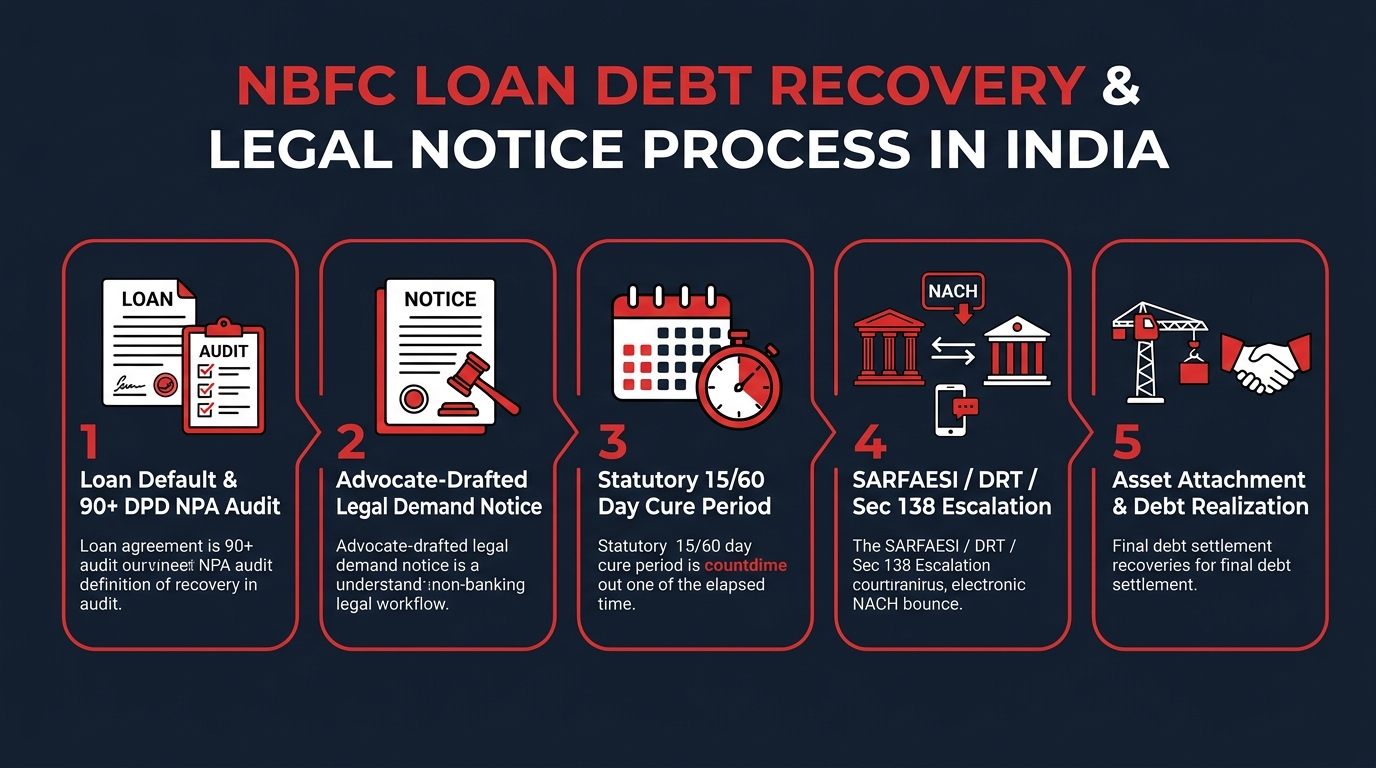
Serving an NBFC debt recovery notice requires strict compliance with statutory timeframes and service protocols. Following a standardized workflow guarantees evidentiary admissibility in subsequent legal actions.
Loan Account Audit & NPA Classification
Audit the defaulting loan account to calculate the exact overdue principal, accrued contractual interest, penal interest, and bounce charges. Confirm the exact NPA classification date according to RBI Master Directions.
Corporate & Guarantor Entity Verification
Verify borrower and guarantor corporate filings via the Ministry of Corporate Affairs (MCA) portal, confirm property title search reports for secured loans, and cross-check active residential and workplace addresses.
Advocate Drafting on Formal Letterhead
Engage an advocate to draft the statutory notice on official letterhead, reciting the credit sanction history, specific loan agreement clauses breached, NACH/cheque return particulars, and explicit statutory enforcement provisions under SARFAESI, DRT, and NI Act.
Stipulation of Statutory Cure Timelines
Grant the borrower the mandatory statutory timeline: exactly 15 days for standard commercial loan demands and Section 138/PSSA notices, or mandatory 60 days for Section 13(2) SARFAESI notices, to remit full dues into the NBFC collection account.
Multi-Channel Verifiable Dispatch & Tracking
Dispatch signed notices via India Post Registered Post with Acknowledgment Due (RPAD) and Speed Post to all registered addresses of borrowers, co-borrowers, and guarantors. Concurrently transmit digitally signed PDF copies via registered email and WhatsApp with delivery confirmation certificates.
6. Anatomy of an Airtight NBFC Demand Notice
A poorly structured demand notice creates loopholes that borrowers exploit to stall litigation or obtain stay orders. An enforceable NBFC recovery notice must include the following structural components:
- Advocate Authority & Power of Attorney: Clear declaration that the notice is issued under the express instructions and legal retainer of the authorized officer of the NBFC.
- Sanction & Disbursement History: Specific recital of loan application date, sanction letter number, loan account number, sanctioned facility amount, interest rate structure, and disbursement dates.
- Itemized Default Matrix: Tabular breakdown specifying the number of defaulted EMIs, overdue principal, normal contractual interest, penal interest, bounce charges, and total recall amount as of the notice date.
- Instrument Dishonor Particulars: Explicit details of dishonored cheques or NACH mandates including mandate ID, cheque numbers, presentation dates, return dates, and bank return reason memos.
- Joint & Several Guarantor Liability: Explicit clause invoking the co-extensive liability of personal and corporate guarantors under Section 128 of the Indian Contract Act.
- Statutory Escalation Warning: Unambiguous warning specifying imminent SARFAESI Section 13(4) asset attachment, DRT Original Application filing, Section 138/Section 25 criminal prosecution, and negative reporting to credit bureaus (CIBIL, Experian, CRIF High Mark).
7. Borrower Response Windows & Post-Notice Enforcement
Upon receipt of a formal advocate notice, delinquent borrowers typically enter into structured settlement negotiations within 10 to 14 days to prevent public asset auctions, criminal summons, or corporate insolvency filings. Over 65% of NBFC defaults are resolved through one-time settlements (OTS) or loan restructuring during this pre-litigation window.
If the borrower ignores the demand notice or sends a frivolous denial upon expiry of the statutory cure period, the NBFC possesses conclusive proof of pre-litigation service and can execute the following multi-pronged judicial measures:
1. Section 13(4) SARFAESI Enforcement: Issue possession notices, take symbolic or physical possession of mortgaged immovable property, and file an application under Section 14 before the Chief Metropolitan Magistrate (CMM) or District Magistrate (DM) for police assistance to take physical handover.
2. Section 138 NI Act / Section 25 PSSA Criminal Filing: Institute criminal complaints before the designated Judicial Magistrate or Metropolitan Magistrate Court within 30 days of the notice cure window expiry, securing bailable or non-bailable warrants against defaulting signatories.
3. Debt Recovery Tribunal (DRT) Original Application: File an Original Application (OA) under Section 19 of the RDB Act, obtaining interim injunctions restraining the borrower from alienating personal or corporate assets pending final recovery certificate issuance.
4. Section 7 IBC Corporate Insolvency Application: For defaulting corporate borrowers with claims exceeding ₹1 Crore, initiate insolvency proceedings before the National Company Law Tribunal (NCLT) to dissolve the defaulting board and recover financial debts through resolution.
8. Frequently Asked Questions
References: [1] Reserve Bank of India Master Directions on Non-Banking Financial Companies & Fair Practices Code. [2] Securitisation and Reconstruction of Financial Assets and Enforcement of Security Interest (SARFAESI) Act, 2002. [3] Recovery of Debts and Bankruptcy Act, 1993 (Debt Recovery Tribunal Procedures). [4] Negotiable Instruments Act, 1881 (Section 138 Dishonor of Cheque). [5] Payment and Settlement Systems Act, 2007 (Section 25 Electronic NACH Mandate Dishonor). [6] Insolvency and Bankruptcy Code, 2016 (Section 7 Financial Creditor Applications).
Recover NBFC & Fintech Dues
Partner with senior debt recovery advocates. We draft institutional demand notices, calculate compound & penal interest, execute verified multi-channel dispatch, and handle SARFAESI/DRT escalations.
Client Reviews
"As an NBFC portfolio recovery manager handling unsecured MSME business loan defaults across North India, serving legally airtight demand notices was a major operational bottleneck. Legal Recovery streamlined our pre-litigation process with advocate-signed demand notices citing Section 25 PSSA and SARFAESI provisions. Over 68% of our chronic 90+ DPD defaulting borrowers approached us for restructuring and one-time settlement within 14 days of notice delivery. Outstanding turnaround time and institutional compliance."
More Commercial & Debt Recovery Guides
Vendor & Invoice Recoveries
Learn statutory procedures to recover delayed commercial invoices and unpaid B2B supplier dues in India.
Cheque Bounce Recovery
Step-by-step roadmap to recover dishonored cheques and bounced loan EMIs under Section 138 NI Act.
MSME Samadhaan Recovery
Claim 3x compound interest on delayed payments for registered MSME suppliers and enterprises.

Legal Recovery is India's trusted consumer protection and commercial debt resolution platform. Founded in 2022 and headquartered in New Delhi, Legal Recovery has counselled 15,000+ businesses, financial institutions, and consumers on debt recovery, commercial contract breaches, and loan defaults. Legal Recovery accelerates out-of-court settlements and connects you with top verified panel advocates.