Legal Notice to Gym & Yoga Club for Membership Fee Refund
Recover advance annual gym subscriptions, personal training fees, and unauthorized auto-debits under the Consumer Protection Act 2019, CCPA Unfair Trade Practice Rules, and Indian Contract Act.
Table of Contents
Swipe →Quick Answer
A consumer can serve an advocate-vetted statutory legal notice to a gym, yoga studio, or fitness club demanding a full prorated refund of unutilized membership fees under Section 2(11), Section 2(46), and Section 2(47) of the Consumer Protection Act, 2019, rendering unilateral "No Refund" boilerplate clauses legally void as unfair trade practices and unfair contracts. When a fitness establishment suffers service deficiencies, closes down, changes certified trainers, or when the consumer experiences medical incapacity, the consumer has the statutory right to contract rescission and restitution under Section 56 and Section 73 of the Indian Contract Act, 1872. Serving a formal 15-day statutory demand notice places fitness center directors on strict notice before initiating fast-track proceedings before the District Consumer Disputes Redressal Commission (DCDRC) or invoking criminal liability under Section 316 and Section 318 of the Bharatiya Nyaya Sanhita, 2023 for cheating and criminal breach of trust.
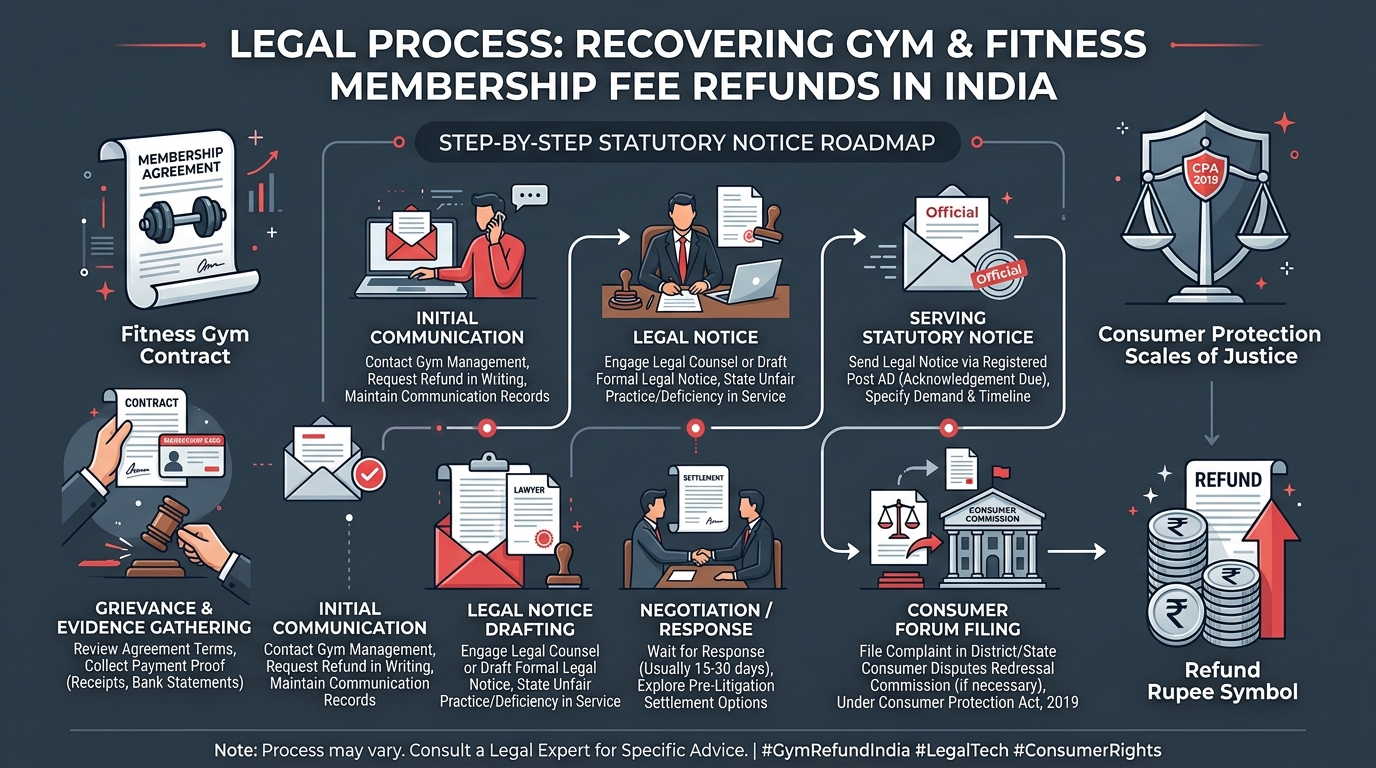
1. Statutory Framework: Consumer Rights & Fitness Membership Laws in India
The Indian fitness, yoga, and wellness industry has expanded rapidly with modern chains, boutique crossfit boxes, pilates studios, and premium luxury health clubs offering annual, multi-year, and lifetime subscription packages. To secure cash flows, many fitness operators extract large upfront payments ranging from ₹20,000 to ₹1,50,000 while inserting oppressive, non-negotiable clauses such as "Fees once paid will not be refunded or transferred under any circumstances whatsoever".
Under Indian consumer jurisprudence, these adhesive boilerplate terms have zero legal validity. The Consumer Protection Act, 2019 (CPA 2019) and established common law principles provide comprehensive statutory remedies against fitness centers engaging in predatory retention of unearned consumer capital.
Section 2(46) — Unfair Contract Doctrine
CPA 2019 explicitly defines an "Unfair Contract" as any contract between a service provider and a consumer that imposes unreasonable charge, penalty, or disproportionate disadvantage. A clause preventing refunds when services are deficient or terminated early is declared null and void.
Section 2(11) — Deficiency in Service
Any fault, imperfection, shortcoming, or inadequacy in the quality, nature, and manner of performance of gym facilities, equipment maintenance, trainer availability, or hygiene standards constitutes an actionable statutory deficiency.
Section 2(47) — Unfair Trade Practices
Making false claims about state-of-the-art machinery, personal trainers, operating hours, sauna/steam facilities, or guaranteed fitness transformations violates consumer standards and invites severe statutory penalties under Section 89 of CPA 2019.
Section 56 ICA 1872 — Frustration of Contract
Under the Indian Contract Act, 1872, unforeseen impossibility—such as gym location closure, relocation of member, or debilitating medical ailment certified by a physician—frustrates the contract, mandating restitution of advance fees.
| Gym 'No Refund' Boilerplate | Statutory Consumer Law Position | Legal Consequence / Enforceability |
|---|---|---|
| "Fees once paid are non-refundable under any circumstances." | Violates CPA 2019 Section 2(46) (Unfair Contract) and Section 23 ICA 1872. | Void Ab Initio; Prorated refund mandatory. |
| "Memberships cannot be frozen, cancelled, or transferred upon illness." | Repugnant to Section 56 of Indian Contract Act (Doctrine of Frustration). | Unenforceable; Medical certificate justifies full prorated refund. |
| "Gym management reserves unilateral right to alter timings or trainers." | Constitutes Deficiency in Service under Section 2(11) & Misleading Ads under Section 89. | Entitles member to contract cancellation with damages. |
| "Auto-debit mandates cannot be revoked before the annual term ends." | Direct violation of RBI e-Mandate Circulars & Consumer Protection Rules. | Illegal debit; Reversal plus penal interest at 18% p.a. |
2. Actionable Grounds: Unfair "No Refund" Clauses, Substandard Facilities & Closures
Consumers enrolled in gyms, yoga centers, crossfit studios, or martial arts clubs are not helpless when facing arbitrary corporate misconduct. Indian courts and consumer commissions have categorized several specific operational and contractual breaches as legitimate grounds for serving a statutory legal notice:
1Abrupt Center Shutdown, Indefinite Renovation, or Relocation
When a gym branch shutters unexpectedly, undergoes prolonged "renovation" spanning weeks without service, or moves to a distant location inaccessible to the subscriber, the establishment commits a total failure of consideration. The member is entitled to immediate reimbursement of 100% of the unexpired subscription value.
2Bait-and-Switch Personal Training & Trainer Desertion
Many fitness clubs upsell high-ticket "Personal Training (PT)" packages costing ₹30,000 to ₹1,00,000 based on specific celebrity trainers, certified nutritionists, or master yoga instructors. When the allocated trainer resigns and the gym fails to provide a trainer of equivalent credentials, or allots inexperienced interns, the consumer has the lawful right to an instant refund of unutilized PT sessions.
3Broken Machinery, Hazardous Equipment & Deficient Hygiene
Persistent equipment downtime (e.g., treadmills out of order, broken cables, damaged weights), hazardous electrical wiring, non-functional HVAC air conditioning, black mold in steam rooms, or filthy shower stalls constitute statutory health hazards and gross deficiency in service under Section 2(11) of CPA 2019.
4Medical Incapacity, Orthopedic Injury & Physical Disability
When a subscriber develops a lumbar spine disc herniation, cardiovascular complication, ligament tear, surgery requirement, or pregnancy where strenuous workouts are medically contraindicated, the contract becomes physically impossible to execute under Section 56 of the Indian Contract Act. Retaining money for workouts the consumer cannot medically perform constitutes unjust enrichment.
5Unauthorized Auto-Debit Recurring Deductions & Hidden Charges
Fitness chains leveraging digital payment gateways often enroll consumers in recurring credit card auto-debits without explicit consent or refuse to honor written cancellation notices. Under Reserve Bank of India (RBI) e-Mandate Framework, unauthorized auto-debits warrant immediate reversal, bank chargeback, and penal damages.
3. Legal Remedies: Statutory Demand Notice, DCDRC Consumer Complaints & CCPA Action
Securing a refund from an intransigent gym management requires a structured, escalating legal strategy. The legal avenues available to Indian fitness consumers include:
Advocate-Drafted Statutory Demand Notice (15-Day Compliance Window)
The most rapid and cost-effective remedy. An advocate-vetted legal notice served on the fitness center's registered office and head directors shatters corporate resistance. It formally demands refund of unutilized principal subscription fees, interest at 18% p.a., and legal expenses within 15 days, warning of imminent consumer court and criminal litigation. Over 70% of fitness fee disputes settle in Tier 1.
District Consumer Disputes Redressal Commission (DCDRC) via e-Daakhil
If the gym fails to refund the amount within 15 days, a formal consumer complaint can be filed under Section 35 of the CPA 2019 before the District Commission via e-Daakhil Online Filing Portal (edaakhil.nic.in). The consumer can claim full refund, interest, compensation for mental harassment (ranging from ₹25,000 to ₹1,00,000), and litigation costs.
CCPA Regulatory Intervention & Class Action Complaints
For widespread fitness franchise frauds where a gym chain closes multiple centers or systematically refuses refunds to hundreds of members, complaints are lodged with the Central Consumer Protection Authority (CCPA). The CCPA has the statutory power to order industry-wide investigations, impose penalties up to ₹10,00,000 under Section 21 of CPA 2019, and mandate collective consumer refunds.
Criminal Complaint under Bharatiya Nyaya Sanhita, 2023 (BNS)
Where gym founders collect heavy upfront multi-year fees with pre-planned intent to shut down operations and flee, an FIR or private criminal complaint is maintainable under Section 316 (Criminal Breach of Trust) and Section 318 (Cheating) of the Bharatiya Nyaya Sanhita, 2023.
4. Pre-Notice Evidentiary Checklist & Fitness Center Verification
Serving a legally watertight notice requires compiling conclusive documentary and digital proof establishing payment, terms promised, and the fitness center's subsequent breach. Before drafting the statutory notice, ensure the following evidentiary records are secured:
Mandatory Evidentiary Records Checklist:
- Membership Agreement / Registration Form: Physical receipt, digital onboarding confirmation, or terms sent via email/app displaying the membership period and fees paid.
- Financial Proof of Payment: Bank statement, credit card transaction receipt, UPI reference ID, or GST tax invoice confirming the exact consideration transferred to the gym entity.
- Communications Trail: WhatsApp chats, emails, or written letters sent to center management requesting membership cancellation, personal trainer change, or fee refund.
- Deficiency Evidence: Date-stamped photographs or videos of broken exercise machinery, out-of-order steam rooms, filthy facilities, closed center shutters, or renovation notices.
- Medical / Relocation Records:Registered medical practitioner's prescription/fitness certificate or employer transfer letter explaining inability to continue workouts.
- Corporate Verification via MCA: For corporate gym chains (e.g., Private Limited companies), verify the exact registered corporate office address and Director Identification Numbers (DIN) via the Ministry of Corporate Affairs (MCA) Portal.
5. Key Clauses in a Statutory Notice for Gym Fee Refund
A statutory legal notice issued by an advocate must be drafted with precision to withstand judicial scrutiny before consumer commissions. It must contain the following core structural components:
Parties Identification & Enrollment Facts
Full particulars of the consumer and gym legal entity (Proprietorship, Partnership, or Pvt Ltd), membership ID, date of joining, duration, and total consideration paid.
Chronological Narration of Deficiency
Exact dates of facility closure, trainer resignation, machine breakdown, unhygienic conditions, or submission of medical/relocation cancellation requests.
Repudiation of 'No Refund' Terms
Specific legal repudiation of one-sided boilerplate terms under Section 2(46) of the Consumer Protection Act 2019, CCPA guidelines, and Section 23 of the Indian Contract Act 1872.
Quantified Monetary Demand & 15-Day Deadline
Explicit demand for the unutilized prorated fee, personal training dues, interest at 18% p.a., legal drafting charges, and compensation within a mandatory 15-day compliance window.
6. Strategic Roadmap: From 15-Day Notice to Rapid Financial Redressal
Recovering stuck gym fees through Legal Recovery follows a proven four-stage legal protocol designed to maximize speed, compliance, and recovery percentages:
Advocate-Drafted Notice Served via Multi-Channel Hybrid Dispatch
The notice is prepared on the advocate’s official letterhead, digitally signed under Section 5 of the Information Technology Act 2000, and served simultaneously via India Post Speed Post with AD, registered gym email, and tracked WhatsApp delivery to center owners.
Pre-Litigation Negotiation & ODR Settlement Facilitation
Upon receiving formal notice, fitness center management typically initiates amicable settlement talks to avoid public reputational damage and regulatory scrutiny. Legal Recovery provides secure Online Dispute Resolution (ODR) rooms to execute binding refund settlements.
e-Daakhil Consumer Forum Complaint Filing (DCDRC)
If the gym ignores the 15-day notice, our panel advocates file a formal complaint before the District Consumer Disputes Redressal Commission claiming full refund, 18% annual interest, mental agony compensation, and legal costs.
CCPA Regulatory Escalation & Bank Chargeback Enforcement
Simultaneously, formal petitions are submitted to the Central Consumer Protection Authority for misleading advertisements and unfair trade practices, alongside bank chargeback escalation for unauthorized recurring debits.
7. Frequently Asked Questions
Authoritative Legal & Statutory References:
- Consumer Protection Act, 2019 — Section 2(11) (Deficiency), Section 2(46) (Unfair Contract) & Section 2(47) (Unfair Trade Practice), indiacode.nic.in
- Central Consumer Protection Authority (CCPA) — Guidelines on Prevention of Misleading Advertisements & Unfair Contract Terms, consumeraffairs.nic.in
- Indian Contract Act, 1872 — Section 23 (Unlawful Object), Section 56 (Frustration of Contract) & Section 73 (Breach Damages), indiacode.nic.in
- National Consumer Disputes Redressal Commission (NCDRC) — Precedents on Non-Refundable Subscription Clauses, ncdrc.nic.in
- National Consumer Commission Online Portal — e-Daakhil Consumer Complaint Filing System, edaakhil.nic.in
- Ministry of Corporate Affairs (MCA) — Verification of Corporate Fitness Franchises & Directors, mca.gov.in
- Bharatiya Nyaya Sanhita, 2023 — Section 316 (Criminal Breach of Trust) & Section 318 (Cheating), indiacode.nic.in
More Consumer Protection & Dispute Guides

Legal Recovery
India's Trusted Recovery Platform
Legal Recovery is India's trusted online legal notice and dispute resolution platform, connecting gym members, yoga practitioners, consumers, businesses, and professionals with seasoned panel advocates for rapid, advocate-vetted statutory demand notices at transparent flat fees. With ₹100 Crore+ recovered and 10,000+ cases resolved across India, Legal Recovery delivers verified legal impact without the delays and unpredictability of traditional law firms.
Gym Refusing Your Fee Refund?
Send an advocate-vetted statutory notice today. 74% of gyms and fitness clubs settle advance fee disputes within 15 days upon receiving a formal legal notice from Legal Recovery.
Flat fee • Advocate-drafted • Sent same day
Client Reviews
Aditya Kulkarni
"I paid ₹52,000 for an annual premium all-access gym, yoga, and personal training package at a luxury fitness center in Indiranagar, Bengaluru. Within eight weeks, my assigned personal trainer resigned without any replacement, the steam room and pool were shut for indefinite repairs, and morning yoga batches were arbitrarily cancelled. When I requested a prorated refund for the remaining ten months, the center manager refused, pointing to their "Strict Non-Refundable Fee Policy" on the back of the receipt. Legal Recovery drafted and served a formidable advocate-vetted statutory legal notice citing Section 2(46) Unfair Contracts under the Consumer Protection Act 2019, CCPA guidelines, and Section 56 of the Indian Contract Act. Within 10 days of notice delivery, the club headquarters contacted me, apologized in writing, and credited a full prorated refund of ₹43,300 straight to my bank account. Exemplary legal service for consumer rights!"