Legal Notice for Pharmacy Invoice Not Cleared
Recover unpaid pharmaceutical supplies, overdue chemist invoices, and hospital credit balances with an advocate-drafted statutory demand notice backed by MSMED Act 3x compound interest.
Table of Contents
Swipe →Quick Answer
Pharmaceutical distributors, wholesalers, and manufacturers can issue a formal advocate-vetted legal notice to recover unpaid pharmacy invoices from defaulting retail chemists, pharmacy chains, or hospitals. The legal notice establishes an enforceable 15-day pre-litigation ultimatum demanding the principal invoice amount along with statutory compound interest under the Micro, Small and Medium Enterprises Development (MSMED) Act, 2006 or commercial contractual terms. Non-compliance empowers the supplier to initiate expedited summary recovery proceedings in commercial courts or file an insolvency petition for operational debt.
1. Legal Framework for Unpaid Pharmacy Invoices
The pharmaceutical distribution ecosystem operates on high-volume, credit-intensive turnover involving carrying and forwarding (C&F) agents, super stockists, distributors, PCD pharma franchise owners, and retail pharmacies. When a retail chemist, corporate pharmacy chain, or private hospital withholds invoice clearance, it triggers catastrophic working capital paralysis across the entire pharmaceutical supply chain. Indian commercial law provides robust, multi-layered statutory protections to enforce prompt payment and deter mala fide payment withholding.
Under Section 15 of the Micro, Small and Medium Enterprises Development (MSMED) Act, 2006, any buyer purchasing pharmaceutical goods or healthcare supplies from an enterprise registered with an Udyam certificate is legally bound to clear payment within the mutually agreed period, which cannot exceed 45 calendar days from the date of delivery. If no formal credit duration is agreed upon in writing, the statutory payment ceiling is strictly capped at 15 days from the date of goods acceptance.
Where a pharmacy or hospital fails to settle the dues within the statutory period, Section 16 of the MSMED Act mandates that the buyer is unconditionally liable to pay compound interest with monthly rests on the outstanding amount at three times the bank rate notified by the Reserve Bank of India (RBI). Furthermore, under Section 73 of the Indian Contract Act, 1872, the supplier is entitled to full compensation for any direct financial loss resulting from the breach of contract, while Section 12A of the Commercial Courts Act, 2015 governs pre-institution mediation and fast-track commercial suit procedures.
Additionally, the Sale of Goods Act, 1930 (Sections 45 to 55) establishes the rights of an unpaid seller to exercise a lien over goods, stop consignments in transit, and sue the defaulting buyer for the price of goods delivered and accepted. Serving a formal advocate-drafted legal notice is the indispensable first legal step that creates conclusive documentary proof of commercial default before invoking judicial remedies.
2. Common Grounds for Pharmacy Payment Defaults
Commercial disputes in medicine distribution typically arise when debtors fabricate post-facto excuses to prolong payment cycles or offset unverified losses against valid supply invoices. Understanding these dispute vectors allows legal counsel to dismantle the debtor's defense in the initial demand notice.
Expired and Near-Expiry Medicine Deductions
Retail chemists frequently withhold payments for active fast-moving batches by asserting that older inventory batches have expired. Unless a specific written expiry-replacement agreement exists specifying physical return timelines and credit note protocols, withholding payment on delivered and consumed drug consignments is legally impermissible.
Unsigned Delivery Challans vs Digital E-Way Bills
Debtors often claim non-receipt of medicine cartons due to missing physical signatures on physical delivery challans. However, the generation and acceptance of GST E-Invoices and matched E-Way bills (Form GST EWB-01) create a statutory presumption of physical delivery under the Central Goods and Services Tax Act.
Hospital Credit Cycle & Third-Party Administrator (TPA) Delays
Institutional and in-house hospital pharmacies often delay distributor payments claiming pending insurance reimbursements from TPAs. In commercial law, privity of contract exists strictly between the supplier and the hospital; insurance settlement delays do not absolve the healthcare institution from its statutory payment obligations.
Dishonored Post-Dated Cheques (PDC)
Pharmacies routinely issue post-dated cheques to maintain continuous credit lines. When these cheques bounce with bank remarks such as "Funds Insufficient" or "Account Closed," the supplier obtains an immediate dual remedy under civil recovery law and criminal law under Section 138 of the Negotiable Instruments Act, 1881.
3. Crucial Evidence Checklist for Debt Recovery
A robust legal notice must be accompanied by an airtight evidentiary dossier that demonstrates an uncontroverted debt. In pharmaceutical debt recovery, regulatory compliance records maintained under the Drugs and Cosmetics Rules, 1945 serve as decisive statutory evidence.
GST & Invoicing Records
- GST Tax Invoices with valid IRN and QR codes
- Generated E-Way Bills (Part A and Part B)
- GSTR-1 filing records of the supplier
- GSTR-2B Input Tax Credit reconciliation showing buyer availing tax credits
Drug Licensing & Logistics
- Wholesale Drug License copies (Form 20B/21B)
- Batch manufacturing and expiry logs
- Proof of dispatch via courier or transporter LR receipts
- Physical or digital stock receipt acknowledgments
Financial & Ledger Records
- Certified statement of running ledger account
- Bank account statements reflecting partial payments
- Original dishonored cheques with return memos
- Udyam Registration Certificate for MSME interest
Commercial Correspondence
- Purchase Orders (PO) or stock indents
- WhatsApp and email payment reminders
- Written admissions of liability or balance confirmations
- Section 65B Indian Evidence Act electronic certificates
4. Strategic Forum Comparison for Commercial Recovery
Selecting the appropriate judicial forum post-notice depends on the creditor's MSME registration status, debt quantum, business constitution of the defaulting pharmacy, and whether negotiable instruments were dishonored.
| Legal Pathway | Governing Law | Statutory Interest Rate | Average Timeline | Key Strategic Advantage |
|---|---|---|---|---|
| MSEFC Samadhaan Filing | MSMED Act, 2006 (Sec 18) | 3x RBI Bank Rate (Compounded monthly) | 3 to 6 Months | No court fees; statutory 75% pre-deposit mandatory for buyer to appeal award. |
| Summary Suit (Order 37 CPC) | Code of Civil Procedure, 1908 | Contractual rate / 18% p.a. | 6 to 12 Months | Defendant must obtain leave to defend; instant decree if defense is sham. |
| Section 138 NI Act Complaint | Negotiable Instruments Act, 1881 | Up to 20% interim compensation (Sec 143A) | 6 to 18 Months | Criminal liability with imprisonment up to 2 years and fine up to 2x cheque amount. |
| Insolvency Petition (IBC Sec 9) | Insolvency & Bankruptcy Code, 2016 | Principal + agreed commercial interest | 6 to 14 Months | Applicable for corporate debts over ₹1 Crore; triggers Corporate Insolvency (CIRP). |
5. Step-by-Step Process to Send a Legal Notice
Issuing a commercial recovery notice requires adherence to strict procedural protocols. A standardized process ensures maximum compliance from the debtor pharmacy while building an unassailable court record.
Ledger Reconciliation & Invoice Ageing Analysis
Perform an exhaustive audit of all unpaid pharmaceutical invoices, cross-referencing debit notes, credit notes, returned medicine logs, and partial bank receipts. Establish the exact principal amount overdue beyond the agreed credit window.
Corporate & Licensing Entity Due Diligence
Verify the legal constitution of the debtor (Sole Proprietorship, Partnership Firm, LLP, or Private Limited Company) via the Ministry of Corporate Affairs (MCA) database and verify their retail drug license (Form 20/21) numbers. Identify all active directors, partners, or proprietors for personal and vicarious liability.
Advocate Drafting on Official Legal Letterhead
Engage an advocate to structure the formal demand on their official letterhead with Bar Council enrollment details. The notice must chronologically articulate the transaction history, cite statutory MSMED Act compounding interest, and set out consequences under the Commercial Courts Act and NI Act.
Stipulation of 15-Day Statutory Cure Period
Grant the defaulting pharmacy exactly 15 business days from the date of notice receipt to remit the full principal amount, accrued compound interest, and legal drafting costs into the creditor's designated bank account.
Multi-Channel Verifiable Dispatch
Dispatch the signed original notice via India Post Registered Post with Acknowledgment Due (RPAD) and Speed Post to ensure a legally conclusive tracking receipt. Simultaneously, transmit a certified digital copy via registered business email and WhatsApp to secure timestamped delivery evidence under Section 65B of the Evidence Act.
6. Crucial Elements of a High-Impact Notice
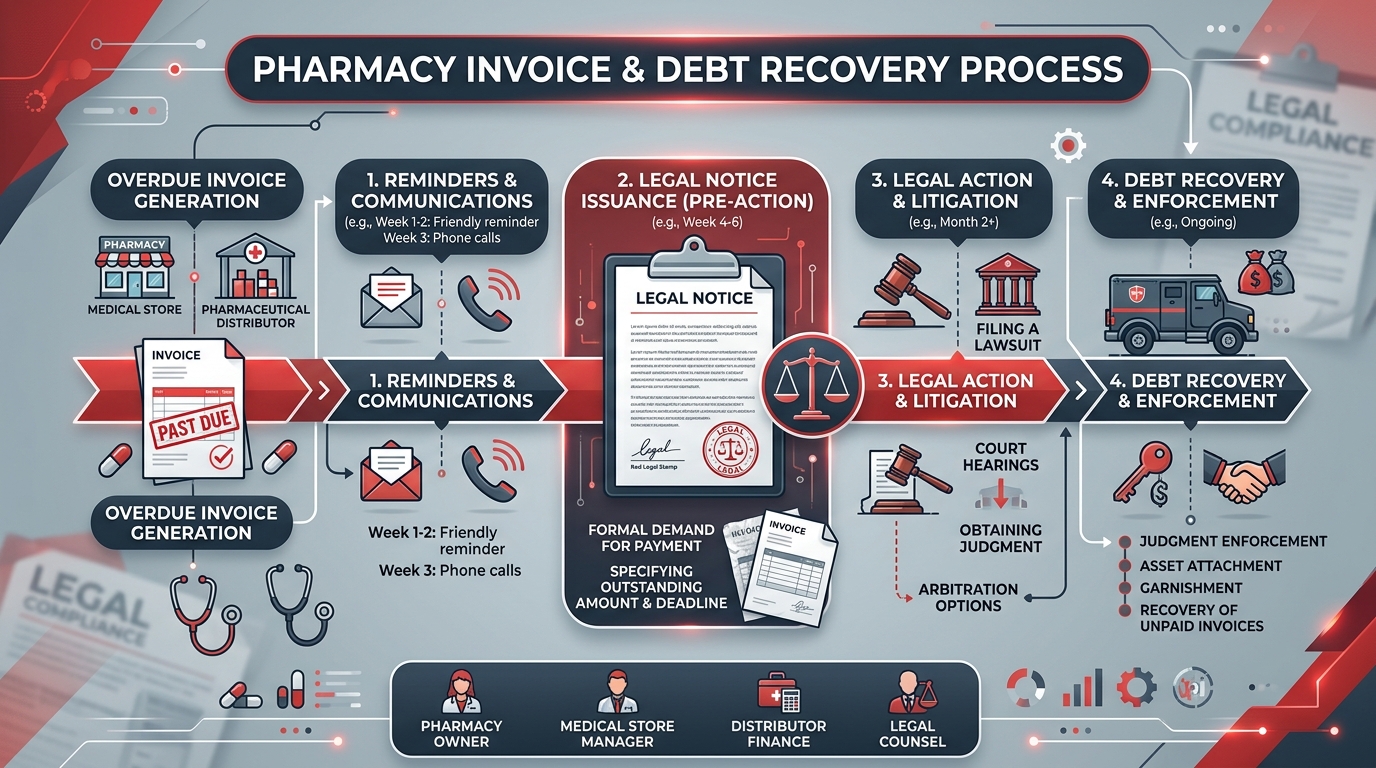
A poorly structured notice often leads to protracted evasive replies or dismissal in pre-institution mediation. To create overwhelming legal pressure, an effective pharmacy invoice recovery notice must incorporate the following foundational components:
- Advocate Credentials & Power of Attorney: Clear statement that the notice is served under the express instructions and legal retainer of the pharmaceutical supplier.
- Itemized Transaction Matrix: A tabulated annexure listing each invoice number, invoice date, delivery challan reference, E-Way bill number, medicine batch numbers, total invoice value, payments received, and outstanding balance.
- MSME Compounding Interest Calculation: Explicit calculation of monthly compounding interest at 3x RBI repo rate under Section 16 of the MSMED Act, 2006.
- GSTR-2B Tax Credit Estoppel Clause: Explicit reference to the debtor's GST filings confirming they availed tax input credit on the disputed invoices, legally barring them from denying goods receipt.
- Vicarious Director & Partner Liability: Holding corporate directors or partners individually and jointly liable for commercial deceit and inducement under Section 141 of the NI Act and civil contract principles.
- Cost of Legal Notice: Specific demand for reimbursement of legal notice drafting and advocate consultation expenses.
7. Resolution Timeline & Post-Notice Enforcement
Upon physical delivery of the legal notice, commercial debtors in the healthcare sector typically respond within 7 to 10 days to avoid business disruption, drug licensing scrutiny, or frozen banking credit facilities. Over 75% of pharmaceutical invoice disputes are resolved during this statutory 15-day window through structured settlement agreements or immediate RTGS/NEFT transfers.
If the debtor pharmacy remains non-responsive or sends an evasive refusal after the 15-day period lapses, the creditor possesses an unassailable record of pre-litigation compliance. The creditor can immediately execute the following judicial enforcement steps:
1. Online MSEFC Samadhaan Case Initiation: File the registered case online on the MSME Samadhaan portal. The council initiates statutory conciliation and, upon failure, conducts arbitration to pass a final executable decree within 90 days.
2. Commercial Court Summary Suit Filing: File a Summary Suit under Order XXXVII of the Code of Civil Procedure in the designated District Commercial Court, preventing the debtor from dragging proceedings unless they deposit security in court.
3. Dishonored Cheque Criminal Prosecution: File a criminal complaint under Section 138 of the Negotiable Instruments Act within 30 days of the notice period expiry in the competent Metropolitan Magistrate or Judicial Magistrate Court.
4. Drug Licensing Authority Intimation: In cases of fraudulent non-payment involving unreturned scheduled drugs or unauthorized diversion, notify the State Drugs Control Department regarding non-compliance with drug maintenance and purchase records under the Drugs and Cosmetics Act.
8. Frequently Asked Questions
References: [1] Micro, Small and Medium Enterprises Development Act, 2006 (Sections 15-18). [2] Commercial Courts Act, 2015 (Pre-Institution Mediation & Summary Procedures). [3] Negotiable Instruments Act, 1881 (Section 138). [4] Drugs and Cosmetics Rules, 1945. [5] GST E-Invoice System & E-Way Bill Portal.
Recover Pharmacy Dues
Connect with experienced commercial recovery advocates. We draft customized statutory demand notices, calculate MSME compound interest, and execute verified postal dispatch.
Client Reviews
"A multi-speciality hospital pharmacy had blocked our pharma distribution invoices worth ₹14.8 Lakhs for over 7 months citing auditing delays. Legal Recovery drafted and served a formal MSME-backed legal notice with compound interest calculations. The hospital management cleared the entire outstanding balance within 11 days of receiving the notice. Highly professional and effective legal intervention."
More Commercial & Debt Recovery Guides
Vendor & Invoice Recoveries
Learn statutory procedures to recover delayed commercial invoices and unpaid B2B supplier dues in India.
Unpaid Business Invoices
Step-by-step roadmap to recover corporate and retailer pending bills through legal channels.
MSME Samadhaan Recovery
Claim 3x compound interest on delayed payments for registered MSME suppliers and enterprises.

Legal Recovery is India's trusted consumer protection and commercial debt resolution platform. Founded in 2022 and headquartered in New Delhi, Legal Recovery has counselled 15,000+ businesses and consumers on financial disputes, commercial contract breaches, and delayed invoices. Legal Recovery accelerates out-of-court settlements and connects you with top verified panel advocates.