Legal Notice to Company for Gratuity Not Paid by Employer
Recover withheld gratuity dues, accumulated service benefits, and delayed Full & Final settlements under the Payment of Gratuity Act, 1972 with mandatory 10% statutory interest per annum.
Table of Contents
Swipe →Quick Answer
Under Section 7(3) and Section 7(3A) of the Payment of Gratuity Act, 1972, an employer must calculate, determine, and disburse gratuity dues to an eligible employee within 30 days of separation, failing which mandatory simple interest at 10% per annum accrues automatically. If a company unlawfully withholds or delays gratuity payment, the employee can issue an advocate-drafted statutory legal notice demanding immediate settlement with statutory interest and threatening summary proceedings before the Controlling Authority under Form N and recovery certification under Section 8. Over 78% of defaulting employers settle outstanding gratuity claims within the 15-day notice period to avoid quasi-judicial prosecution, district revenue attachment, and penal sanctions.
1. Statutory Framework: Payment of Gratuity Act, 1972 & Entitlement
In Indian labor jurisprudence, gratuity is not an ex-gratia gift, discretionary bonus, or managerial bounty. As established by the Supreme Court of India in the landmark judgment of Bakshish Singh v. Darshan Engineering Works & Ors. (1994), gratuity constitutes a statutory retirement benefit and an indefeasible monetary right earned by an employee through steadfast past service. The statutory architecture governing gratuity recovery is codified under the Payment of Gratuity Act, 1972 (India Code), enacted by Parliament as a comprehensive self-contained social security code under the oversight of the Ministry of Labour and Employment.
Statutory Applicability Thresholds (Section 1(3))
The Payment of Gratuity Act, 1972 applies automatically across India to the following establishments:
Under Section 4(1) of the Act, gratuity becomes payable to an employee on separation after rendering continuous service of not less than five years upon superannuation, retirement, resignation, or termination. However, the completion of continuous service of five years is strictly not necessary where the termination of the employment of any employee is due to death or disablement.
The 4-Year 240-Day Continuous Service Principle
Under Section 2A of the Act, continuous service in a 12-month period requires working for at least 240 days (190 days in underground mines or seasonal establishments). In landmark rulings including Mettur Beardsell Ltd. v. Regional Labour Commissioner (Madras HC) and Surendra Kumar Verma v. Central Govt. Industrial Tribunal (Supreme Court), courts established that an employee who completes 4 years and 240 days of continuous service in their fifth year satisfies the statutory requirement and is 100% entitled to full gratuity.
2. Unlawful Forfeiture & Illegal HR Deductions (Section 4(6))
Corporate employers across India frequently deploy unlawful administrative pretexts to withhold or deduct earned gratuity. Common HR excuses include unserved notice period buyouts, unreturned office laptops, non-compete allegations, pending client audits, or corporate restructuring. Under Indian labor statutes, every single one of these unilateral deductions is illegal and void ab initio.
| Employer Pretext | Statutory Legality | Binding Judicial Precedent |
|---|---|---|
| Notice Period Shortfall / Recovery | STRICTLY ILLEGAL | Gratuity cannot be set off against notice buyout claims without a domestic inquiry order. |
| Unreturned Laptop / Asset Dispute | STRICTLY ILLEGAL | Company must file civil action for hardware; cannot withhold statutory social security dues. |
| FnF Settlement Administrative Delays | STRICTLY ILLEGAL | Section 7(3) mandates 30-day disbursement independent of internal FnF clearance cycles. |
| Alleged Misconduct without Dismissal | STRICTLY ILLEGAL | Jaswant Singh Gill v. BCCL (2007): Forfeiture requires termination on specific statutory grounds. |
| Company Restructuring / Cashflow Crunch | STRICTLY ILLEGAL | State of Punjab v. Labour Court (1979): Gratuity is a statutory charge above unsecured debts. |
The Exhaustive Conditions for Forfeiture under Section 4(6)
Under Section 4(6) of the Payment of Gratuity Act, 1972, forfeiture is permissible only under two narrow, strictly proven statutory circumstances:
Section 4(6)(a) — Actual Property Loss
Gratuity can be forfeited only to the extent of actual quantified damagecaused by the employee's willful act or negligence. The employer must conduct a formal domestic inquiry, quantify the exact loss, and issue a reasoned forfeiture order prior to separation.
Section 4(6)(b) — Riotous Conduct / Offenses
Gratuity may be wholly or partially forfeited only if the employee was formally terminated for riotous or disorderly behavior, acts of violence, or an offense involving moral turpitude committed during the course of employment.
Furthermore, under Section 13, no gratuity payable under the Act is liable to attachment in execution of any decree or order of any civil, revenue, or criminal court. Under Section 14, the Act has an overriding effect that nullifies any inconsistent clauses in employment agreements or company handbooks.
3. Statutory 15/26 Formula & Mandatory 10% Interest (§ 7(3A))
When issuing a statutory demand notice, legal precision in calculating the principal gratuity amount and the statutory accrued interest is paramount. Employers frequently calculate gratuity using 30 days instead of the statutory 26 working days divisor, deliberately reducing employee payouts.
| Parameter | Software Engineer (5.4 Yrs) | Engineering Lead (6.8 Yrs) | Director / VP (11.2 Yrs) |
|---|---|---|---|
| Last Drawn Basic + DA | ₹45,000 / mo | ₹85,000 / mo | ₹1,60,000 / mo |
| Calculated Service Tenure | 5 Completed Years | 7 Completed Years | 11 Completed Years |
| 15 Days Wage (Basic×15÷26) | ₹25,961.54 | ₹49,038.46 | ₹92,307.69 |
| Principal Gratuity Payable | ₹1,29,808 | ₹3,43,269 | ₹10,15,385 |
| Delay Period | 6 Months (180 days) | 9 Months (270 days) | 12 Months (365 days) |
| Statutory 10% Interest (§ 7(3A)) | ₹6,490 | ₹25,745 | ₹1,01,538 |
| Total Recoverable Demand | ₹1,36,298 | ₹3,69,014 | ₹11,16,923 |
Mandatory Nature of 10% Simple Interest under Section 7(3A)
In H. Gangahanume Gowda v. Karnataka Agro Industries Corpn. Ltd. (2003) 3 SCC 40, the Supreme Court held that the payment of interest on delayed gratuity under Section 7(3A) is a mandatory statutory command. An employer cannot escape interest liability by citing administrative delays, departmental inquiries, or lack of liquid funds.
4. Pre-Notice Evidentiary Checklist & Document Audit
A formidable legal notice requires a clear documentary record. By assembling salary records alongside official separation communications, legal counsel can construct an airtight claim that leaves the defaulting company with no legal defense.
Employment & Service Records
- Appointment letter and signed employment agreement
- Confirmation letter and annual promotion / appraisal letters
- Experience certificate and official relieving letter
- Resignation letter along with written HR acceptance email
Salary, Banking & Statutory Filings
- Last 3 to 6 months itemized payslips showing Basic Pay + DA
- Bank account statements reflecting net salary credits
- Form 16 / 26AS tax statements confirming service tenure
- Copy of Form I statutory gratuity application (if submitted)
5. Step-by-Step Legal Recovery: Form I to Controlling Authority
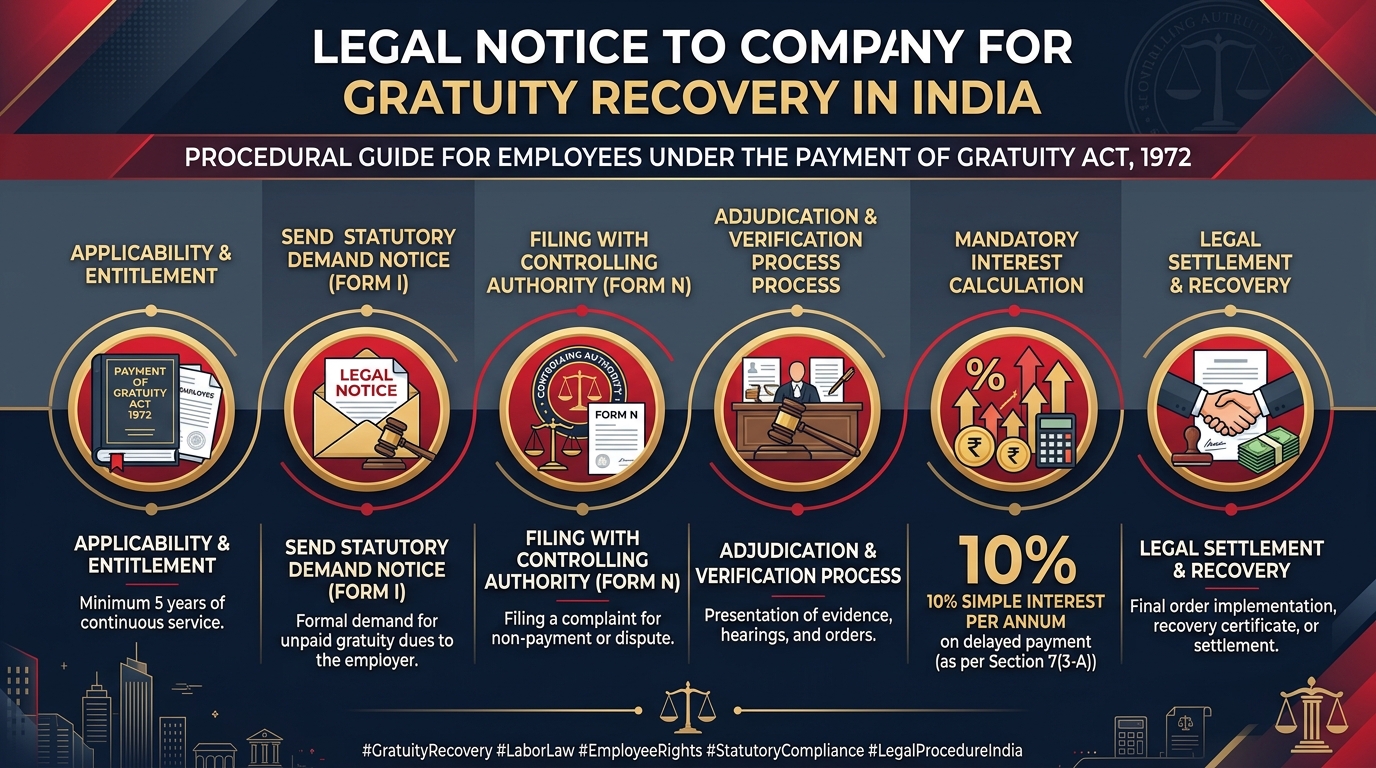
Recovering unpaid gratuity requires adhering to the statutory machinery prescribed under the Payment of Gratuity (Central) Rules, 1972. Follow this proven 5-step enforcement protocol:
Step 1: Statutory Application in Form I under Rule 7(1)
The employee submits a formal statutory application in Form I to the employer in person or via registered post, putting on record the exact service tenure and last drawn wages.
Step 2: 30-Day Employer Determination Window (Form L / M)
Under Section 7(2), the employer must issue a notice in Form L specifying the determined amount and payment date within 15 days of receiving Form I (or within 30 days of separation). Failure to issue Form L constitutes immediate statutory default.
Step 3: Issue Advocate-Drafted Statutory Legal Notice
Upon expiry of the 30-day statutory window, engage a senior labor panel advocate to issue a statutory demand legal notice citing Section 4, Section 7(3A) mandatory 10% interest, and Section 9 penal liability, setting a 15-day pre-litigation compliance window.
Step 4: File Form N Application before the Controlling Authority
If the employer fails to disburse the dues within 15 days of notice service, file an application in Form N under Section 7(4) and Rule 10 before the Controlling Authority (Assistant Labour Commissioner) for summary adjudication.
Step 5: Recovery Certificate (Form T) & Section 8 Revenue Attachment
If the employer refuses to comply with the Controlling Authority's order, apply under Form T for issuance of a Recovery Certificate under Section 8. The Controlling Authority directs the District Collector to attach company bank accounts and recover the dues as arrears of land revenue.
6. Key Clauses in an Advocate-Drafted Gratuity Legal Notice
A generic, templated notice lacks legal force and is easily ignored by corporate HR and legal departments. An advocate-vetted statutory notice must incorporate watertight factual recitals and precise statutory invocations:
1. Employment Chronology & Continuous Service
Reciting date of joining, confirmation, resignation, and last working day, establishing that continuous service exceeded the 5-year or 4-year 240-day statutory threshold without breaks.
2. Wage Breakdown & 15/26 Formula
Documenting the exact components of "wages" under Section 2(s), distinguishing basic pay and DA for accurate 15/26 formula calculation and setting out the exact principal debt.
3. Demonstration of Statutory Default (§ 7(2) & 7(3))
Proving that the employer failed to determine gratuity within 30 days or issue Form L/M, establishing non-compliance and triggering mandatory statutory liability.
4. 10% Interest Claim & Director Penal Exposure (§ 7(3A) & § 9)
Claiming 10% p.a. simple interest and notifying Managing Directors and HR Heads of individual penal exposure carrying up to 1 year imprisonment and criminal breach of trust under BNS 2023.
8. Frequently Asked Questions
Statutory Authorities & Official Regulatory References
All statutory provisions, calculation rules, timeline mandates, and penalties cited in this guide are directly grounded in central enactments and verified official government portals:
More Employment & Consumer Protection Recovery Guides

Legal Recovery
India's Trusted Online Recovery Platform
Legal Recovery is India's trusted online legal notice and dispute resolution platform, connecting employees, software professionals, executives, managers, and retired personnel with seasoned labor and commercial panel advocates for rapid, advocate-vetted statutory demand notices at transparent flat fees. With ₹100 Crore+ recovered and 10,000+ cases resolved across India, Legal Recovery delivers verified legal impact without the delays and unpredictability of traditional law firms.
Employer Withholding Your Gratuity?
Send an advocate-vetted statutory legal notice today. 78% of corporate employers settle unpaid gratuity dues with statutory interest within 15 days upon receiving formal notice from Legal Recovery.
Flat fee • Advocate-drafted • Sent same day
Client Reviews
Aniruddh Deshmukh
"After completing 7 continuous years as Senior Engineering Manager at a Pune IT firm, the management withheld my statutory gratuity of ₹6,75,000 following my resignation. They cited baseless project handover delays and withheld my settlement for 5 months without issuing Form L or Form M. Legal Recovery drafted a formidable statutory legal demand notice under Section 4 and Section 7(3A) of the Payment of Gratuity Act, 1972, invoking mandatory 10% statutory interest and directors' personal liability. Within 11 days of receiving the advocate-vetted notice via Speed Post AD, the company's legal department cleared the entire gratuity amount of ₹6,75,000 along with accrued statutory interest into my account. Tremendous legal efficiency!"