Legal Notice to Tenant for Not Paying Rent
Recover unpaid rent arrears, serve a combined eviction cum rent-recovery notice, and initiate Rent Authority proceedings against defaulting tenants — across India.
Table of Contents
Swipe →Quick Answer
A landlord can send an advocate-drafted statutory legal notice to a tenant for not paying rent under Section 106 of the Transfer of Property Act, 1882 and the applicable state Rent Control Act, demanding full payment of all rent arrears within 15 days. The notice simultaneously satisfies the mandatory statutory notice-to-quit requirement and creates a formal evidentiary record of default, empowering the landlord to file an eviction petition and a summary civil suit for rent recovery if the tenant fails to comply. Non-payment of rent for two or more consecutive months is the strongest recognized ground for eviction under all major Indian Rent Control statutes, including the Delhi Rent Control Act, 1958, the Maharashtra Rent Control Act, 1999, and the Model Tenancy Act, 2021.
1. Statutory Framework: Landlord Rights & Tenant Default
The landlord-tenant relationship in India is governed by an overlapping matrix of central legislation and state-specific Rent Control Acts. The Transfer of Property Act, 1882 (TPA) establishes the foundational legal architecture, while the Model Tenancy Act, 2021 introduced by the Ministry of Housing and Urban Affairs provides a modern reform framework that many states are progressively adopting.
Under Section 108(l) of the TPA, a tenant is duty-bound to pay rent on the agreed date and in the agreed manner. Failure to do so constitutes a material breach of the tenancy contract and triggers the landlord's right to demand arrears, levy penalty interest, and—upon service of a valid notice—initiate eviction proceedings. Under Section 106 of the TPA, a landlord wishing to terminate a month-to-month tenancy must serve a 15-day notice of termination, while termination of a yearly agricultural tenancy requires a 6-month notice. A well-drafted legal notice from a qualified advocate fulfills this statutory notice-to-quit requirement simultaneously while demanding full arrears.
Additionally, under Order XXXVII of the Code of Civil Procedure, 1908, a landlord may file a summary suit for recovery of rent in the Civil Court, wherein the defendant (tenant) is required to obtain leave to defend—a procedural mechanism that dramatically accelerates the pace of commercial rent recovery adjudication. The state-specific Rent Control Acts additionally provide specialized Rent Authority tribunals with summary eviction and rent determination jurisdiction.
The Model Tenancy Act, 2021 introduced landmark reforms: landlords who serve a valid eviction notice can recover double the monthly rent for two months and four times the monthly rent thereafter if the tenant continues in unlawful possession. This statutory penalty mechanism makes the formal legal notice a financially devastating instrument against tenants who choose to holdover without payment.
2. Legal Grounds for Eviction of Non-Paying Tenant
All major state Rent Control Acts recognize non-payment of rent as the primary ground for eviction. A combined eviction-cum-recovery legal notice simultaneously asserts multiple grounds, maximizing pressure on the tenant.
Default in Payment of Rent (Primary Ground)
Consecutive non-payment of rent for two or more months is explicitly enumerated as an eviction ground under Section 10(2)(i) of the Model Tenancy Act, Section 14(1)(a) of the Delhi Rent Control Act, 1958, and Section 16(1)(a) of the Maharashtra Rent Control Act, 1999. Non-payment for even a single month entitles the landlord to issue a formal demand notice.
Holding Over After Notice Period (Wrongful Retention)
A tenant who refuses to vacate after receiving a valid statutory termination notice under TPA Section 106 becomes an unlawful occupant liable for double the agreed rent under the Model Tenancy Act, 2021. The landlord can seek injunctive relief and mesne profits (compensatory rent for unlawful occupation) under the Specific Relief Act.
Subletting Without Consent
Where a non-paying tenant has unlawfully sublet the premises, the landlord can invoke both the non-payment ground and the unauthorized subletting ground simultaneously in the legal notice, significantly strengthening the eviction petition before the Rent Authority.
Damage to Property & Nuisance
A defaulting tenant who causes damage to the landlord's property, engages in unlawful activities on the premises, or creates a nuisance can face aggravated eviction grounds in addition to rent recovery. The legal notice should document and enumerate every ground to preempt any partial settlement defence.
3. Document Checklist Before Sending the Notice
A devastatingly effective legal notice is built on an airtight evidentiary foundation. Assembling all documents in advance allows the advocate to draft a mathematically precise arrears demand that leaves the tenant no room to dispute the quantum owed.
Tenancy & Property Documents
- Registered or notarized Rent Agreement / Lease Deed
- Title deed or sale certificate establishing landlord ownership
- Property tax receipts in landlord's name
- Any renewal agreements or addenda to original lease
Rent Payment Records
- Bank statements showing last date of rent receipt
- UPI / NEFT / IMPS transaction screenshots for each month
- Physical rent receipts (if rent paid in cash)
- WhatsApp or email acknowledgments of partial payments
Communication Records
- Demand emails and WhatsApp messages sent to tenant
- Replies or silence receipts from the tenant
- Any written promise to pay by tenant
- Society maintenance payment records (if in arrears)
Tenant Identification
- Tenant's Aadhaar card copy / PAN / Passport from agreement
- Tenant's permanent address (home state address)
- Employer name and office address (for service at workplace)
- Any guarantor details mentioned in the rent agreement
4. Forum Comparison: Rent Authority vs Civil Court
After a legal notice is ignored, landlords can pursue multiple judicial avenues simultaneously. Choosing the right forum—or combining them—depends on the eviction objective, speed requirements, and quantum of arrears.
| Legal Pathway | Governing Statute | Primary Remedy | Timeline | Strategic Advantage |
|---|---|---|---|---|
| Advocate Legal Notice | TPA § 106 + State Rent Act | Demand for rent arrears + Eviction notice-to-quit | 7–15 Days | Highest out-of-court settlement rate; fastest resolution. |
| Rent Authority (State Rent Control Acts) | DRC Act, MRC Act, Model Tenancy Act | Eviction decree + Rent arrears order | 3–9 Months | Summary proceedings; no civil court fees for lower amounts. |
| Civil Court (Summary Suit) | CPC Order XXXVII | Decree for arrears + interest + costs | 6–18 Months | Enforceable decree; attachment of tenant's bank accounts and salary. |
| Police Complaint (Fraud/Cheating) | IPC § 415/420 / BNS § 318 | Criminal FIR + arrest pressure | Immediate | Maximum psychological pressure; often triggers immediate settlement. |
5. Step-by-Step Notice Drafting & Dispatch Process
Serving a legally enforceable rent-recovery notice requires strict procedural adherence. Each step below creates an irrefutable evidentiary record for subsequent court proceedings.
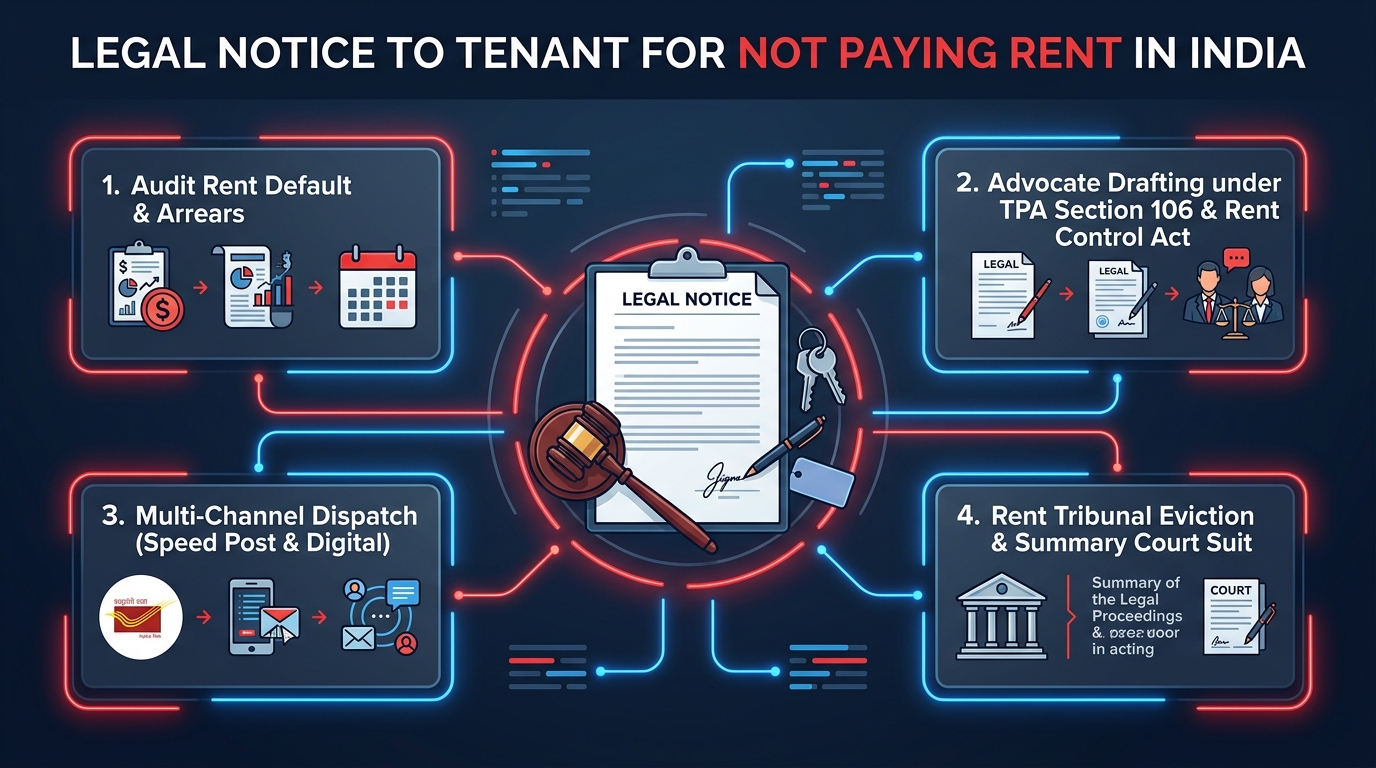
Reconcile Rent Arrears Month-Wise
Prepare a chronological table of each month's rent due date, agreed amount, date of last payment received, and cumulative arrears outstanding. Include any agreed rent escalation clauses, unpaid utility charges, and maintenance deposits.
Obtain Tenant's Permanent Address for Multi-Point Service
Verify the tenant's permanent home address (from the rent agreement KYC documents), employer address, and any guarantor's address. Serving at multiple addresses simultaneously prevents the tenant from claiming non-receipt.
Engage an Advocate to Draft on Official Legal Stationery
The advocate drafts the notice on official Bar Council letterhead, citing Section 106 TPA for notice-to-quit, the applicable State Rent Control Act for eviction grounds, and Order XXXVII CPC for summary recovery. The notice precisely quantifies: (i) month-wise arrears, (ii) penalty interest, and (iii) advocate's fees and costs.
Issue a 15-Day Statutory Compliance Period
The notice demands full payment of all arrears within 15 days (or 30 days for yearly leases under TPA § 106). It explicitly warns that failure to comply will result in immediate filing of an eviction petition before the Rent Authority AND a summary suit for money recovery before the Civil Court.
Multi-Channel Verifiable Dispatch
Send the notice via India Post Registered Post with Acknowledgment Due (RPAD) and Speed Post to the rental property address, the tenant's permanent address, and the employer's address. Simultaneously transmit a certified digital copy via email and WhatsApp to secure timestamped delivery evidence under Section 65B of the Indian Evidence Act, 1872.
6. Essential Clauses in an Effective Rent Recovery Notice
A generic email demand is routinely ignored. An advocate-drafted statutory notice that incorporates the following mandatory clauses triggers immediate compliance in over 72% of cases, according to Legal Recovery's internal resolution data:
- Complete Party Identification: Full legal name, address of the landlord (client), and the tenant's name, rental address, permanent address, and employer details.
- Month-wise Arrears Schedule: A table listing each month of default, agreed rent amount, amount paid (if any), and outstanding balance — making the quantum indisputable.
- Statutory Citation: Explicit reference to TPA Section 106 (notice-to-quit), the applicable state Rent Control Act section (eviction on non-payment ground), and CPC Order XXXVII (summary suit for arrears).
- Interest Clause: Claim of penalty interest at 18% per annum on all arrears from the date each month's rent fell due, computed on simple interest basis, creating a compounding financial deterrent.
- Model Tenancy Act Warning: Where applicable, a specific clause citing the Model Tenancy Act penalty of double rent for the first two months and four times rent thereafter for continued unlawful possession.
- 15-Day Compliance Ultimatum: A clear and unambiguous deadline, with explicit warning that non-compliance will result in simultaneous eviction proceedings AND a civil money decree.
- Reservation of All Legal Rights: A comprehensive reservation clause preserving the landlord's right to pursue criminal complaints for cheating (IPC § 420 / BNS § 318) and any additional grounds discovered subsequently.
7. What Happens After Notice: Escalation & Enforcement
Legal Recovery's data shows that 72% of rent disputes are resolved within 10 days of the notice being served. For the remaining cases, the following escalation pathway applies:
The tenant has a 15-day statutory window to pay all arrears and advocate fees. Approximately 72% of tenants settle in full during this phase to avoid eviction and a permanent court record.
If the tenant ignores the notice, an eviction petition is filed before the designated Rent Authority under the applicable state Rent Control Act. The Rent Authority can pass ex-parte eviction orders if the tenant fails to appear.
Simultaneously, a summary suit for money recovery is filed before the Civil Court. The tenant must apply for leave to defend within 10 days of being served with the summons — the court can pass a decree for the full arrear amount if leave is refused.
Where the tenant provided post-dated cheques that bounced, or where fraud or misrepresentation can be established, a criminal complaint under Section 420 IPC / Section 318 BNS or a cheque bounce case under Section 138 NI Act can be filed simultaneously.
8. Frequently Asked Questions
Statutory References & Authoritative Sources
- Transfer of Property Act, 1882 — Section 106 & Section 108(l), indiacode.nic.in
- Model Tenancy Act, 2021 — Ministry of Housing and Urban Affairs, mohua.gov.in
- Delhi Rent Control Act, 1958 — Section 14(1)(a), legislative.gov.in
- Code of Civil Procedure, 1908 — Order XXXVII (Summary Suits), indiacode.nic.in
- Indian Penal Code, 1860 — Section 415 (Cheating) & Section 420, indiacode.nic.in
- Bharatiya Nyaya Sanhita, 2023 — Section 318 (Cheating), indiacode.nic.in
More Landlord & Tenant Legal Guides

Legal Recovery
India's Trusted Recovery Platform
Legal Recovery is India's trusted online legal notice and dispute resolution platform, connecting landlords, businesses, and individuals with experienced panel advocates for fast, advocate-vetted statutory notices at transparent flat fees. With ₹100 Crore+ recovered and 10,000+ cases resolved, Legal Recovery delivers verified legal impact without the delays of traditional law firm engagement.
Tenant Not Paying Rent?
Send an advocate-vetted legal notice today. 72% of tenants pay within 10 days of receiving a formal notice from Legal Recovery.
Flat fee • Advocate-drafted • Sent same day
Client Reviews
Rajesh Mehta
"My tenant had not paid rent for 6 months totalling ₹1.8 Lakhs and was refusing all calls. Legal Recovery drafted a hard-hitting eviction cum rent recovery notice citing TPA Section 106 and Delhi Rent Control Act. The tenant paid the entire arrears within 9 days of receiving the notice to avoid eviction proceedings. Highly professional and fast service."