Legal Notice for Zomato Refund Not Received
Has Zomato wrongfully withheld your refund, levied an arbitrary 100% cancellation penalty, delivered spoiled food, or failed to deliver an order? Issue a formal advocate-drafted legal notice under the Consumer Protection Act, 2019 to recover your money with statutory interest and damages.
Table of Contents
Swipe →Quick Answer
A legal notice for a Zomato refund not received is a formal statutory demand drafted by an advocate and served upon Zomato Limited requiring immediate reimbursement of wrongfully retained consumer funds. This formal legal document cites actionable violations under Section 2(11) for deficiency in service and Section 2(47) for unfair trade practices under the Consumer Protection Act, 2019, alongside Rule 4(11) of the Consumer Protection (E-Commerce) Rules, 2020. Serving this advocate notice establishes a mandatory 15-day pre-litigation compliance window, compelling Zomato’s corporate legal department to credit the principal refund with 18% statutory interest and compensation before formal consumer court proceedings commence.
1. Anatomy of Zomato Refund Defaults & Service Deficiencies
The expansion of on-demand food delivery and quick-commerce hyper-logistics in India has fundamentally transformed retail consumer behaviour. Zomato, listed on the National Stock Exchange under Zomato Limited (operating food ordering, Zomato Gold dining benefits, Hyperpure B2B supplies, and Blinkit quick commerce), processes millions of daily food orders and retail transactions. However, this high transaction velocity is accompanied by an increasing volume of unresolved customer disputes, automated customer support rejections, and unlawful withholding of consumer refunds.
Consumers frequently face situations where money is debited from their bank accounts through Unified Payments Interface (UPI), debit cards, credit cards, or net banking, yet the promised food items arrive damaged, contaminated, incomplete, or fail to be delivered entirely. In established commercial jurisprudence, failure to execute consideration requires an instantaneous restitution of funds. However, digital platform architectures often employ algorithmic barriers that prevent consumers from accessing human grievance executives.
The Automated Chat Support Bottleneck
When a consumer reports a non-delivery or food quality breach via the Zomato mobile application, initial interactions are mediated by automated algorithmic bots. These bots are programmed with rigid corporate refund parameters, routinely responding with canned statements such as: “As per our cancellation and refund policy, this order is ineligible for a refund.” Such automated refusals bypass the statutory dispute redressal mechanisms mandated by the Ministry of Consumer Affairs and the Consumer Protection (E-Commerce) Rules, 2020.
Under Indian law, private corporate terms of service and internal algorithmic policies cannot extinguish or override statutory consumer rights. When an e-commerce platform collects payment for food or groceries that it fails to deliver in merchantable and hygienic condition, retaining those funds constitutes unlawful enrichment and actionable deficiency in service under the Consumer Protection Act, 2019.
2. Statutory Legal Framework: CPA 2019 & E-Commerce Rules
Serving an enforceable legal notice on a major publicly traded enterprise like Zomato Limited requires anchoring every claim in established statutory provisions and regulatory guidelines. Indian consumer jurisprudence establishes strict accountability for digital intermediaries, food business operators (FBOs), and online payment systems.
Section 2(11) — Deficiency in Service
Covers any fault, imperfection, shortcoming, or inadequacy in the quality, nature, and manner of performance required to be maintained under contract or statutory law. Retaining paid funds after failed, defective, or delayed food delivery constitutes an undeniable deficiency.
Section 2(47) — Unfair Trade Practice
Prohibits unfair methods of competition and deceptive practices, including refusing to refund consideration paid for undelivered or substandard goods, false advertising regarding preparation times, and unconscionable contract terms.
Rule 4(11) — E-Commerce Rules, 2020
Prohibits e-commerce entities from imposing cancellation charges on consumers unless the platform demonstrates that it has incurred corresponding financial loss, and mandates prompt refund processing upon service cancellation.
RBI Turn Around Time (TAT) Directive
Under RBI Circular DPSS.CO.PD No.1158/02.14.003/2019-20, failed digital payments must be reversed within T+1 calendar days. Failure to adhere to these reversal timelines renders the merchant liable to pay statutory compensation of ₹100 per day of delay.
Additionally, under the Food Safety and Standards Act, 2006 and the Food Safety and Standards (Licensing and Registration of Food Businesses) Regulations, e-commerce food aggregators are recognized as Food Business Operators (FBOs). Aggregators are legally obligated to ensure that partner restaurants adhere to mandatory sanitary standards, and platforms share joint liability when hazardous, contaminated, or stale food is delivered to consumers.
3. Actionable Grounds to Issue a Notice to Zomato Limited
A legally robust notice must not rely on subjective complaints; it must articulate specific, verifiable breaches of statutory obligations. The following recurring factual scenarios represent the most common and legally actionable grounds for issuing an advocate notice to Zomato:
1. 100% Unilateral Cancellation Forfeiture
Occurs when a consumer cancels an order after excessive preparation delays (e.g., waiting 60+ minutes beyond the promised estimated time of arrival), and Zomato deducts a 100% cancellation penalty despite the breach originating from merchant kitchen backlogs or logistics allocation failure.
2. Missing Items & Package Tampering in Food / Blinkit Orders
Occurs when high-value dishes or grocery items are missing from sealed packages, and Zomato customer support refuses to issue a proportionate refund, unilaterally claiming that the delivery partner completed delivery according to weight estimates.
3. Spoiled, Adulterated, or Foreign Contaminant Deliveries
Delivering rotten meat, rancid gravies, insects, glass shards, or expired food violates basic consumer health protections. When Zomato customer care offers an arbitrary ₹50 platform voucher instead of a full monetary reimbursement and medical compensation, it constitutes aggravated service deficiency.
4. False “Delivered” Status (Ghost Delivery)
Occurs when delivery personnel trigger the “Delivered” status on their GPS interface without physically arriving at the consumer’s address, followed by automated support refusing to investigate GPS track records or refund the unfulfilled transaction.
5. Payment Debited at Gateway but Order Generation Failed
Financial consideration is successfully deducted via UPI or banking gateway, but application server latency causes the order creation to fail. If automated reconciliation fails to return the money within the RBI-mandated T+1 working day window, the platform is liable for statutory damages.
6. Unauthorized Zomato Gold Membership Deductions
Recurring auto-debit deductions for Zomato Gold or Pro subscription renewals executed without providing the mandatory prior e-mandate notification, coupled with a total refusal to cancel and refund the unutilized subscription fee.
4. Dispute Resolution Channels: Comparative Analysis
Aggrieved consumers have multiple paths to resolve uncredited refunds from Zomato. The comparison matrix below analyzes the turnaround timeline, cost efficiency, resolution probability, and legal enforceability of each dispute mechanism:
| Resolution Channel | Expected Timeline | Cost / Effort | Success Rate | Legal Enforceability & Damages |
|---|---|---|---|---|
| In-App Chatbot Support | 1 to 24 Hours | Low | 10% – 20% | Non-binding. Automated bot responses generally dismiss complex refund claims or offer low-value platform vouchers. |
| UPI / Card Chargeback | 30 to 90 Days | Moderate | 45% – 55% | Recovers principal funds only. Banks often reject claims if Zomato submits automated dispatch logs. |
| Advocate Legal Notice | 15 Days | Low (Handled Online) | 85% – 92% | Highest pre-litigation impact. Escalates directly to Zomato corporate legal counsel; recovers principal plus statutory interest and damages. |
| National Consumer Helpline (NCH) | 30 to 60 Days | Low | 50% – 60% | Advisory mediation portal. Cannot enforce judicial penalties if corporate representatives decline to settle. |
| District Consumer Forum (e-Daakhil) | 6 to 18 Months | Moderate to High | 95%+ | Judicially binding decree. Grants complete refund, substantial mental harassment compensation, and litigation costs. |
5. Zomato Corporate Identity, Blinkit & Service Addresses
A critical error committed by self-represented consumers is sending communications to customer support email addresses or branch warehouses. Under the Code of Civil Procedure, 1908 and company law, a legal notice must be formally delivered to the registered corporate office and designated nodal officers of the operating entity.
Zomato Limited (formerly Zomato Media Private Limited)
In disputes involving spoiled food, contamination, or restaurant overcharging, the legal notice should implead both Zomato Limited as Respondent No. 1 and the partner restaurant merchant as Respondent No. 2. In grocery disputes originating from Blinkit, Blink Commerce Private Limited should be specifically added to ensure comprehensive legal enforceability.
6. Step-by-Step Advocate Drafting & Notice Dispatch
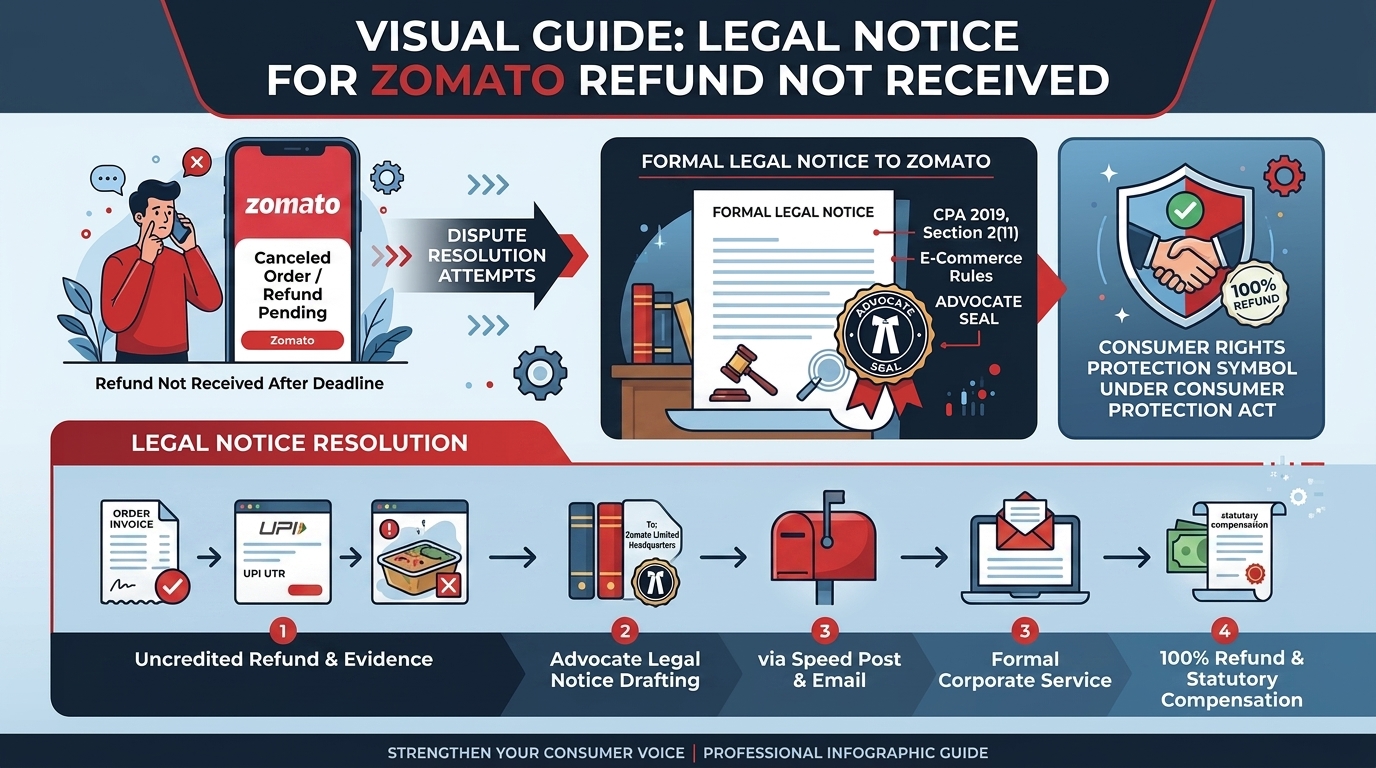
Successfully recovering consumer funds from technology conglomerates requires an organized, legally rigorous methodology. Legal Recovery implements the following five-stage protocol for maximum recovery efficiency:
Compile Transaction Invoices, Bank UTR Records & Photographic Evidence
Retrieve the digital tax invoice from the Zomato app, bank account statement showing the debited amount and Unique Transaction Reference (UTR) number, unboxing photographs/videos demonstrating food defects or missing items, and complete chat transcripts with customer support.
Identify the Proper Legal Entity (Zomato Limited / Blinkit) & Registered Office
Verify the exact corporate standing of Zomato Limited and any associated quick-commerce seller entities to ensure that service of process is legally valid under the Companies Act, 2013.
Calculate Principal Claim, 18% Statutory Interest & Mental Harassment Damages
Tabulate the disputed transaction value, compound interest at 18% per annum from the debit date, damages for mental distress and time loss (typically ₹10,000 to ₹25,000), and advocate drafting fees.
Draft the Formal Legal Notice on Advocate Letterhead with Statutory Citations
An advocate drafts the statutory notice articulating chronological facts, statutory breaches under the Consumer Protection Act, 2019, E-Commerce Rules, 2020, and FSSAI regulations, accompanied by a strict 15-day compliance ultimatum.
Dispatch via Speed Post / Registered Post AD & Serve Corporate Nodal Grievance Email
Serve physical copies through India Post Speed Post / Registered Post with Acknowledgment Due (RPAD) to Zomato’s registered and corporate offices, while electronically transmitting the signed notice to the designated nodal officer.
7. Essential Clauses in an Enforceable Zomato Legal Notice
A poorly structured legal notice will be dismissed by corporate legal counsel as an informal grievance. To carry legal enforceability before consumer courts, an advocate-drafted notice must incorporate the following foundational clauses:
1. Advocate Authority & Bar Enrollment
Recites the advocate’s Bar Council registration details and statutory authority to represent the consumer under Section 30 of the Advocates Act, 1961.
2. Unambiguous Factual Chronology
Details the order number, itemized food contents, transaction timestamps, payment method, delivery address, promised ETA, and the specific failure event.
3. Statutory Characterization of Breach
Explicitly links the platform’s conduct to Section 2(11) (deficiency in service) and Section 2(47) (unfair trade practices) of the Consumer Protection Act, 2019, removing any doubt regarding unlawful retention of funds.
4. Formally Quantified Monetary Demand
Itemizes the principal refund, interest accrual, quantified compensation for harassment, and legal costs, establishing an exact settlement figure.
5. 15-Day Litigation Ultimatum Clause
Concludes with a strict 15-day compliance window from the date of receipt, warning that non-compliance will lead to immediate filing of a consumer complaint before the District Consumer Disputes Redressal Commission under Section 35 of the Consumer Protection Act, 2019, holding Zomato liable for all litigation expenses and punitive damages.
8. Escalation to District Consumer Commission (e-Daakhil)
In over 85% of refund disputes handled by Legal Recovery, serving an advocate legal notice achieves an immediate out-of-court financial settlement. Corporate legal departments understand that defending a formal lawsuit before a consumer commission entails significant advocate appearance fees, executive time, and public reputational exposure far exceeding the disputed refund sum.
However, if Zomato fails to credit the funds within the 15-day statutory notice period, the consumer gains the clear right to initiate formal proceedings. Through the central government’s e-Daakhil digital portal, a consumer complaint can be filed before the competent District Consumer Disputes Redressal Commission without requiring physical presence at court hearings.
Under Section 34(2) of the Consumer Protection Act, 2019, a consumer can file the case in the District Commission where the consumer resides or works for gain, rather than where Zomato’s corporate headquarters are situated. In judicial proceedings, the unheeded legal notice and postal delivery tracking certificate serve as primary documentary exhibits proving corporate negligence, bad faith, and persistent service deficiency.
9. Frequently Asked Questions
Statutory & Regulatory Authorities
Recover Your Zomato Refund
We assign a specialized consumer panel advocate to custom draft your legal notice, dispatch it via India Post RPAD to Zomato’s corporate headquarters, and track delivery in real time.
Client Reviews
“Zomato deducted ₹2,940 for an order that was marked delivered but never reached my doorstep. Customer support closed the chat repeatedly. Legal Recovery served an advocate legal notice to Zomato Limited’s Gurugram headquarters, and my entire refund plus compensation was transferred to my bank within 5 days. Truly phenomenal legal support!”
More Consumer Protection Guides
Swiggy Refund Not Received
Advocate guide to issuing a statutory legal notice for uncredited Swiggy food and Instamart grocery refunds.
Online Refund Not Received
Complete legal guide to recovering delayed or blocked refunds from major e-commerce platforms.
Flipkart Return & Refund Notice
Legal procedures to resolve denied returns, rejected refunds, and seller disputes on Flipkart.
Wrong / Damaged Delivery
Learn how to issue a legal notice to retail merchants for defective or counterfeit deliveries.
Consumer Court Filing Guide
Step-by-step guide to escalating your claim to the District Consumer Commission via e-Daakhil.
All Legal Notice Services
Browse the full repository of advocate-drafted statutory legal notice solutions for money recovery.

Legal Recovery is India’s trusted tech-legal platform empowering consumers and businesses to resolve disputes, recover pending dues, and send legally vetted notices with speed and authority. Our network of seasoned advocates ensures your voice is heard and your rights are protected across all judicial forums.