Send a Legal Notice to Company for Not Paying Gratuity
Recover your withheld gratuity amount, 10% mandatory statutory interest, and enforce personal director liability against defaulting employers under the Payment of Gratuity Act, 1972.
Table of Contents
Swipe →Quick Answer
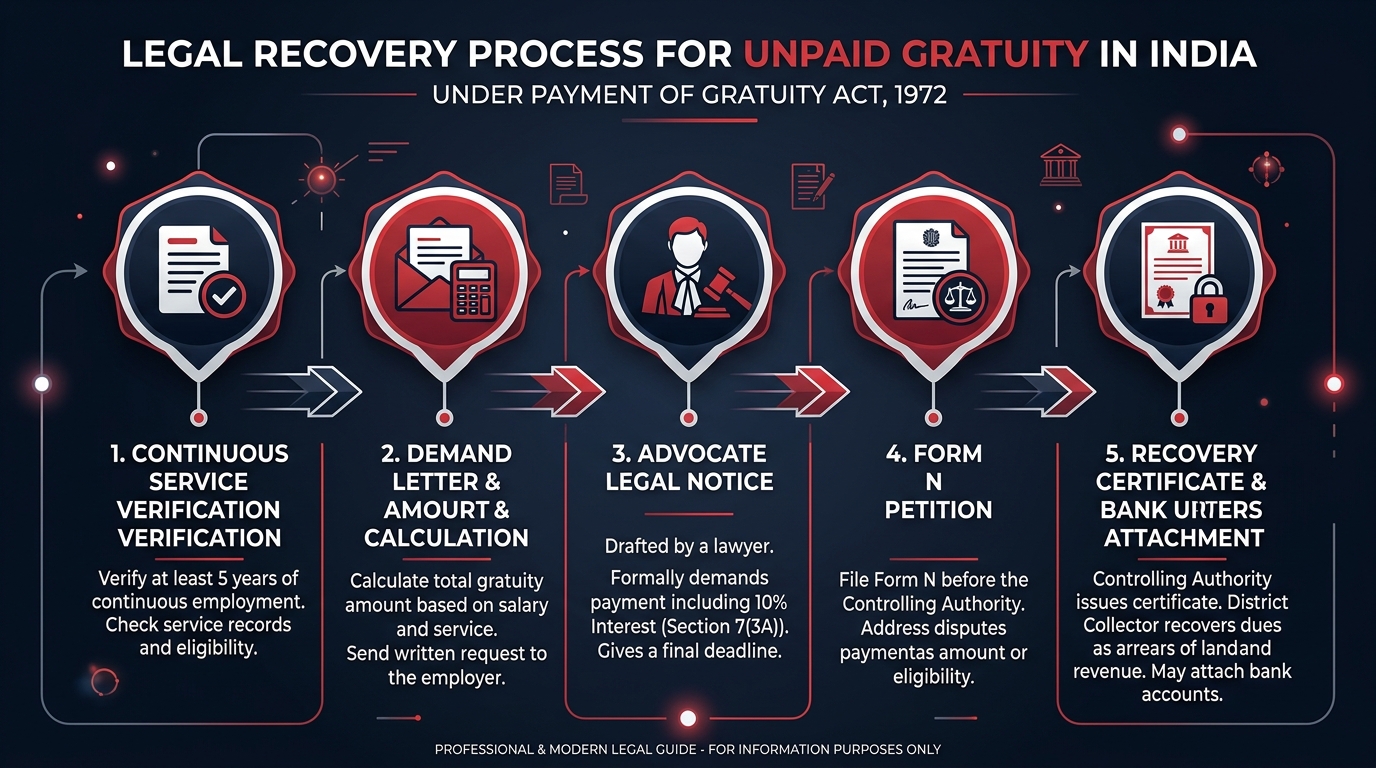
Under Section 4 and Section 7(3) of the Payment of Gratuity Act, 1972, an employee who has completed five years of continuous service (or 4 years and 240 days) is legally entitled to full gratuity payment within 30 days of resignation, retirement, or termination. If an employer withholds or delays gratuity, serving an advocate-drafted statutory legal notice under Section 7(3A) demands immediate clearance of the principal amount along with mandatory 10% per annum statutory interest and puts company directors on personal legal notice. If the company fails to settle the dues within the stipulated 15-day notice window, the employee can initiate recovery proceedings under Form N before the Controlling Authority (Labour Commissioner) and obtain a Section 8 Recovery Certificate to attach company bank accounts through the District Collector as arrears of land revenue.
1. Statutory Framework: Payment of Gratuity Act, 1972 & Non-Negotiable Employee Rights
In the Indian corporate ecosystem, gratuity is frequently mischaracterized by human resource departments as a discretionary retirement bonus or an ex-gratia incentive tied to management satisfaction. In reality, gratuity is a strictly codified statutory retiral benefit governed by the Payment of Gratuity Act, 1972. The Act applies mandatorily to every factory, mine, oilfield, plantation, port, railway company, shop, and commercial establishment in which ten or more persons are employed or were employed on any day of the preceding twelve months. Once an establishment crosses this threshold of 10 employees, the Act continues to govern the entity perpetually, regardless of subsequent workforce reductions.
As unequivocally held by the Supreme Court of India in the landmark judgment Jaswant Singh Gill v. Bharat Coking Coal Ltd. (2007) 1 SCC 663, gratuity is not a bounty, gratuitous gift, or discretionary reward distributed at the employer's whim. It represents a vested property right earned through dedicated, long-standing service. Withholding, delaying, or arbitrarily deducting earned gratuity constitutes a direct violation of statutory welfare law and triggers severe legal repercussions against both the corporate entity and its principal officers:
Section 4(1): Gratuity shall be payable to an employee on the termination of employment after rendering continuous service for not less than five years upon superannuation, retirement, resignation, death, or disablement. In cases of death or disablement, the 5-year condition is statutorily waived.
Section 7(3) & Section 7(3A): The employer must determine and disburse gratuity within 30 days. Delay beyond 30 days incurs mandatory statutory simple interest at 10% per annum under Central Government Notification (S.O. 874(E)), as reaffirmed in Y.K. Singla v. Punjab National Bank (2013) 3 SCC 472.
Section 13: No gratuity payable under the Act shall be liable to attachment in execution of any decree or order of any civil, revenue, or criminal court. Gratuity cannot be offset against internal corporate loans, third-party vendor liabilities, or arbitrary company recovery claims.
Section 14: The provisions of the Act have overriding effect notwithstanding anything inconsistent contained in any enactment, employment agreement, employment bond, company handbook, or HR settlement policy. Any employment clause restricting gratuity is null and void ab initio.
2. Debunking Corporate Excuses: Handover Delays, Notice Buyouts & Section 4(6) Protections
When employees resign after years of meritorious contribution, defaulting employers and startup founders routinely concoct administrative pretexts to stall or deduct gratuity payouts during Full and Final (FnF) settlements. It is essential to recognize that virtually all standard corporate justifications for withholding gratuity are completely unlawful under Indian jurisprudence.
Under the Payment of Gratuity Act, the circumstances under which an employer can lawfully forfeit gratuity are exhaustive, strictly construed, and governed exclusively by Section 4(6):
Exhaustive Statutory Grounds for Forfeiture under Section 4(6):
- Section 4(6)(a) — Damage to Property:Gratuity may be forfeited only to the extent of actual, quantifiable financial damage or loss caused to the employer's property by the employee's willful omission or negligence, provided the employee was formally terminated for such act after a strict domestic inquiry establishing exact pecuniary liability.
- Section 4(6)(b) — Riotous Conduct or Moral Turpitude:Gratuity may be wholly or partially forfeited only if the employee's services were terminated for riotous, disorderly behavior, violence, or an offense involving moral turpitude committed during employment, provided the employee has been convicted by a court of competent jurisdiction.
As settled by the Supreme Court in Union of India v. C.G. Ajay Babu (2018) 8 SCC 529, forfeiture of gratuity cannot be sustained merely on an allegation of administrative misconduct or internal disciplinary censure unless there is an express termination order premised on moral turpitude with independent court conviction or quantified physical property loss.
| Corporate Pretext / Reason | Legal Status | Statutory / Judicial Position |
|---|---|---|
| Unserved Notice Period / Shortfall Buyout | STRICTLY UNLAWFUL | Section 14 overrides employment contracts. Gratuity cannot be set off against notice period pay. |
| Pending Project Handover or Client Sign-Off | STRICTLY UNLAWFUL | Handover delays do not constitute termination under Section 4(6). 30-day payment rule remains absolute. |
| Pending Return of Laptop / ID Card / Company Assets | STRICTLY UNLAWFUL | Asset recovery must follow independent civil process; Section 13 bars attaching or withholding gratuity. |
| Company Facing Cash Flow Crunch or Restructuring | STRICTLY UNLAWFUL | Financial constraints do not exempt statutory welfare liability; delay incurs 10% compound recovery. |
| Formal Termination for Quantified Theft with Domestic Inquiry | PERMITTED (PRO-RATA) | Only to the exact extent of proven pecuniary loss under Section 4(6)(a). Remainder must be paid. |
3. Gratuity Calculation Matrix & The Landmark 4 Years 240 Days Service Rule
Accurately calculating your statutory gratuity entitlement is critical before issuing a formal legal notice. Under Section 4(2)of the Payment of Gratuity Act, 1972, for every completed year of service or part thereof in excess of six months, the employer is statutorily bound to pay gratuity at the rate of fifteen days' wages based on the rate of wages last drawn by the employee.
The 4 Years and 240 Days Continuous Service Rule Explained
One of the most frequently contested legal issues is whether an employee who resigns before completing five full calendar years is entitled to gratuity. Employers routinely reject claims for employees who worked 4 years and 8 months, citing a strict 5-year literal barrier.
This corporate defense has been decisively rejected by the judiciary. Under Section 2A(2)(a)(ii) of the Payment of Gratuity Act, 1972, an employee is deemed to be in continuous service for a period of one year if they have actually worked under the employer for not less than 240 days in the preceding twelve calendar months (or 190 days in underground mines or seasonal operations).
In landmark decisions such as Mettur Beardsell Ltd. v. Regional Labour Commissioner (Madras High Court) and rulings by the Supreme Court of India, it has been settled that once an employee completes 4 full years of continuous service and completes at least 240 working days in the fifth year (equivalent to roughly 4 years and 240 days / ~4.8 years), the employee has legally completed five years of continuous service and is entitled to full statutory gratuity for all 5 years.
Real-World Calculation Example:
Consider an employee who worked for 7 years and 8 months with a last drawn Basic Salary of ₹85,000 and Dearness Allowance (DA) of ₹15,000 (Total qualifying monthly wage = ₹1,00,000):
- Total Completed Service: 7 years 8 months = 8 Completed Years (rounded up).
- Per-Day Wage Calculation: ₹1,00,000 ÷ 26 = ₹3,846.15
- 15 Days Wage: ₹3,846.15 × 15 = ₹57,692.30
- Total Gratuity Payable: ₹57,692.30 × 8 = ₹4,61,538.46
- Statutory Interest if delayed 6 months @ 10% p.a. (Section 7(3A)): ₹23,076.92
- Total Enforceable Recovery Claim: ₹4,84,615.38
4. Pre-Notice Evidentiary Checklist & Electronic Records under Section 63 BSA
Under Indian procedural law, electronic evidence plays a decisive role in establishing employment tenure, salary structure, and employer default. The Bharatiya Sakshya Adhiniyam, 2023 (BSA) under Section 63 (which replaces Section 65B of the Indian Evidence Act, 1872) governs the admissibility of digital communications. Prior to issuing a formal legal notice, you must consolidate and secure the following documentation:
1. Employment Tenure Records
Original Appointment Letter, Promotion Letters, Salary Revision Addendums, Employee ID Card, and Relieving / Experience Certificate verifying start and end dates.
2. Last Drawn Salary Slips & Form 16
Salary slips for the last 3-6 months preceding separation clearly itemizing Basic Salary and Dearness Allowance (DA), along with Form 16 Part A and Part B.
3. Resignation & Acceptance Trail
Resignation email sent to management/HR, official acknowledgment and acceptance email, approved last working day (LWD) confirmation, and no-dues clearance sign-offs.
4. Form I Statutory Application Copy
Copy of statutory Form I (Application for Gratuity by Employee) served via email or registered post, along with proof of receipt or tracking reports.
5. Written Demands & Email Refusals
Complete email thread with HR, Finance, or Managing Directors demanding gratuity, detailing 30-day default, and any evasive responses or unlawful deduction threats.
6. Bank Account Statements
Certified bank statements for the salary credit account demonstrating historical salary deposits and confirming the total absence of gratuity credit post-separation.
5. Critical Statutory Clauses in a Legal Notice to Company for Withheld Gratuity
A generic demand letter drafted without statutory rigor will often be ignored by corporate legal counsel. A formidable advocate-drafted statutory legal notice under the Payment of Gratuity Act, 1972 must incorporate precise legal assertions that pin liability directly upon the company and its board of directors:
Explicitly details the employee's date of joining, confirmed separation date, total continuous service tenure (citing Section 2A and the 240-day rule), last drawn basic wage, and establishes that the employer establishment falls within the mandatory scope of Section 1(3) of the Act.
Highlights the employer's failure to issue Form L (Notice of Determination of Gratuity) or Form M (Notice Rejecting Claim) and records the expiration of the mandatory 30-day statutory settlement window following separation.
Demands simple interest at 10% per annum on the principal gratuity amount from the due date until the date of actual payment, citing binding Central Government notifications and Supreme Court precedents.
Puts managing directors, key managerial personnel (KMP), and HR heads on personal legal notice that non-payment of gratuity constitutes a cognizable statutory offense under Section 9, punishable with imprisonment up to one year and compounding fines.
Sets a peremptory 15-day deadline for full settlement, failing which an application under Form N will be filed before the Controlling Authority seeking a Section 8 Recovery Certificate for the District Collector to attach company bank accounts as arrears of land revenue.
7. Step-by-Step Strategic Roadmap from Legal Notice to Bank Account Attachment
Executing a disciplined, evidence-backed legal strategy ensures rapid recovery of your withheld gratuity while minimizing procedural delays. Here is the proven 6-step recovery workflow:
Step 1: Continuous Service Audit & Gratuity Calculation
Verify exact dates of joining and relieving. Calculate completed continuous service, apply the 240-day rule for the terminal year if applicable, and determine statutory gratuity plus 10% interest.
Step 2: Submit Statutory Form I Employee Demand
Serve a formal application under Form I to the employer pursuant to Rule 7 of the Payment of Gratuity Rules. This formally triggers the statutory 30-day employer settlement window.
Step 3: Issue Advocate-Drafted Statutory Legal Notice
Engage panel advocates to draft a comprehensive statutory demand notice citing Section 4, 7(3A), 8, and 14 of the Payment of Gratuity Act, holding company directors personally liable.
Step 4: Simultaneous Dispatch via Speed Post AD, Registered Email & WhatsApp
Serve the notice upon the company’s registered office, managing directors, and HR leadership with India Post Speed Post tracking and Section 63 BSA electronic certificates.
Step 5: File Form N Claim Petition before Controlling Authority
If the company fails to disburse payment within the 15-day notice window, file Form N before the Assistant Labour Commissioner to secure a formal judicial determination.
Step 6: Execute Section 8 Bank Account Attachment through Collector
Upon failure to pay the determined amount, enforce the Section 8 Recovery Certificate through the District Collector to attach company bank accounts as arrears of land revenue.
8. Frequently Asked Questions
Statutory Authorities & Legal Citations:
More Employment & Salary Recovery Guides

Legal Recovery
India's Trusted Recovery Platform
Legal Recovery is India's trusted online legal notice and dispute resolution platform, connecting corporate employees, managers, professionals, and gig workers with seasoned panel advocates for rapid, advocate-vetted statutory demand notices at transparent flat fees. With ₹100 Crore+ recovered and 10,000+ cases resolved across India, Legal Recovery delivers verified legal impact without the delays and unpredictability of traditional law firms.
Company Withholding Your Earned Gratuity?
Send an advocate-vetted statutory notice today. Over 82% of companies disburse withheld gratuity and FnF dues within 15 days of notice service.
Flat fee • Advocate-drafted • Sent same day
Client Reviews
Vikramaditya Rao
"When I resigned as Principal Software Architect after 8 continuous years of service at a Bengaluru fintech firm, the management withheld my earned gratuity of ₹9,45,000 for six months. They cited vague pending client transition clearances and internal corporate restructuring after an overseas buyout. Legal Recovery drafted a formidable statutory legal demand notice under Section 4, Section 7(3A), and Section 8 of the Payment of Gratuity Act, 1972, demanding the principal amount plus 10% statutory interest and warning of director personal liability. Within 12 days of serving the notice via Speed Post AD and email to the board of directors, the company's legal counsel intervened and disbursed the full ₹9,45,000 along with accrued statutory interest directly into my bank account. Truly exceptional legal expertise!"