Legal Notice to Startup Company for Delayed Salary
Recover unpaid monthly wages, withheld Full & Final (FnF) settlements, bonuses, and expense reimbursements under the Code on Wages 2019, Indian Contract Act, and IBC Operational Debt rules.
Table of Contents
Swipe →Quick Answer
An aggrieved employee, software engineer, or executive can serve an advocate-drafted statutory legal notice to a startup company for delayed or unpaid salary under Section 17 of the Code on Wages, 2019 and Section 73 of the Indian Contract Act, 1872, demanding full release of accumulated wage arrears, notice pay, and expense reimbursements within a 15-day peremptory window. Startup founders and managing directors who deliberately defer payroll citing funding round delays or force equity swaps commit an actionable breach of employment contract and face personal liability alongside statutory interest under Section 15 of the Payment of Wages Act, 1936. If the startup fails to comply within 15 days, the employee can initiate summary recovery under Order 37 of the Code of Civil Procedure, 1908, file a statutory wage complaint before the Labour Commissioner, or serve an Operational Creditor Demand Notice under Section 8 of the Insolvency and Bankruptcy Code, 2016 (IBC) to trigger corporate insolvency proceedings before the NCLT.
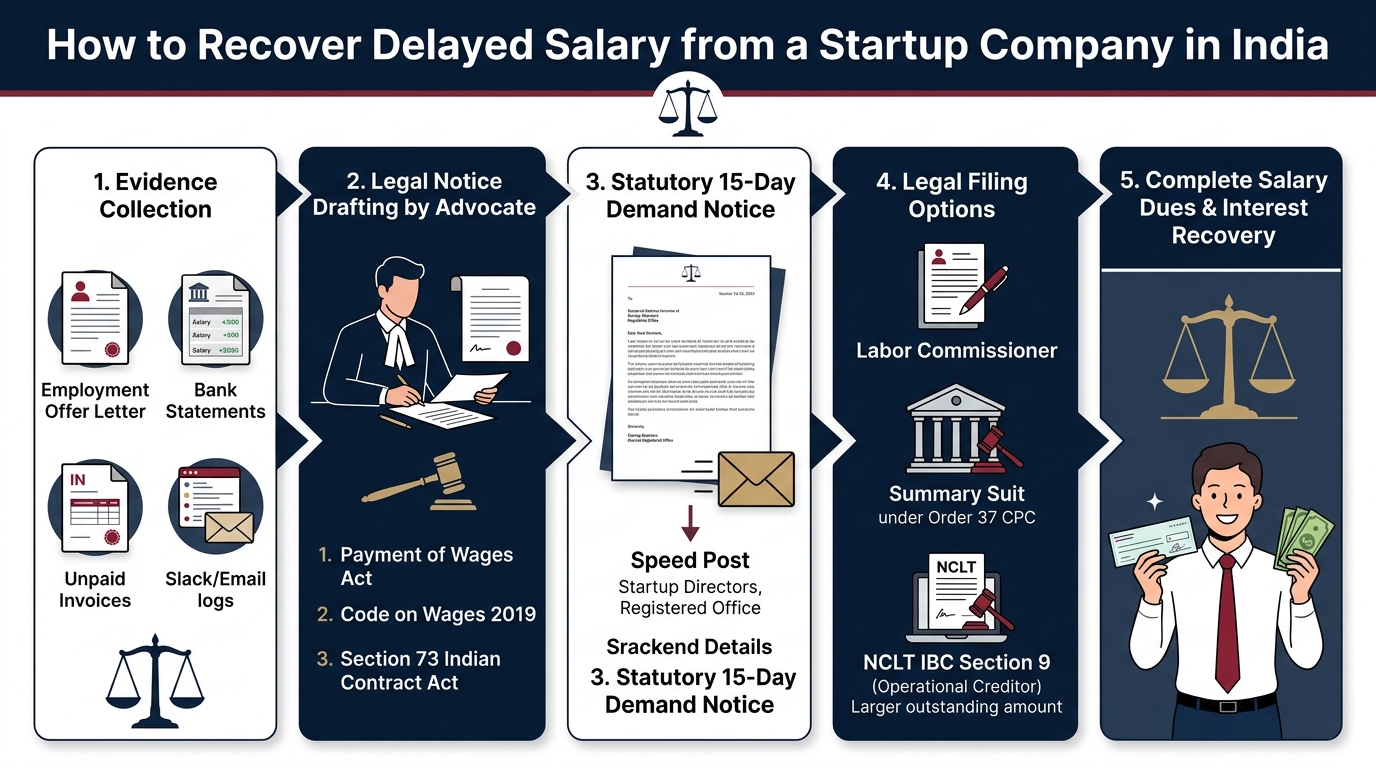
1. Statutory Framework: Indian Wage Laws & Startup Mandates
Over the past several years, the Indian startup ecosystem across tech hubs like Bengaluru, Gurugram, Hyderabad, Pune, and Mumbai has experienced sharp funding contractions, commonly known as "funding winters." While founders and venture capital investors manage burn rates and pivot business models, startup employees frequently bear the brunt through unannounced salary freezes, multi-month wage deferrals, unpaid Full and Final (FnF) settlements, and unfulfilled performance bonuses. Under Indian labor jurisprudence, employee compensation is not an optional operational expense dependent on venture capital runway; it is a paramount, non-negotiable statutory obligation.
Several key statutory enactments provide an unassailable legal shield for startup employees seeking recovery of their rightful compensation:
- Section 17 of the Code on Wages, 2019 (Time Limit for Payment of Wages): The statute explicitly establishes that employers must pay monthly salaries to employees on or before the 7th or 10th day of the succeeding wage month, depending on the total workforce strength. Furthermore, where an employee is removed, dismissed, retrenched, or resigns, all unpaid wages and statutory dues must be settled within two working days of the termination of employment.
- Payment of Wages Act, 1936 (Section 15 & Section 18): Authorizes employees or their legal counsel to file statutory claims before the designated Authority for delayed or unlawfully withheld wages. Under Section 15(3), the Authority is empowered to direct the employer not only to disburse the full arrears but also to pay statutory compensation of up to ten times the amount wrongfully withheld.
- Indian Contract Act, 1872 (Section 73 & Section 74): Employment offer letters, appointment agreements, and bonus schedules constitute legally enforceable bilateral contracts. When a startup defaults on payroll, it commits a fundamental material breach, entitling the employee to sue for full liquidated damages, salary arrears, and commercial interest at 18% per annum.
- Section 33C(2) of the Industrial Disputes Act, 1947: Empowers workmen and technical employees to file recovery applications before the Labour Court for computing and recovering any monetary benefit or salary due under an employment settlement, award, or contractual service condition.
In landmark judgments such as State of Punjab v. Jagjit Singh (2017) 1 SCC 148 and Workmen of the Food Corporation of India v. Food Corporation of India (1985) 2 SCC 136, the Supreme Court of India reaffirmed that the right to receive timely remuneration for work performed is inextricably linked to the fundamental right to livelihood and human dignity under Article 21 of the Constitution of India. Employers cannot unilaterally suspend payroll operations while demanding continued full-time services from their workforce.
2. Startup Tactics for Salary Delays & Legal Vulnerabilities
When early-stage or growth-stage startups encounter cash-flow crunches, management teams frequently employ a standardized playbook of delay tactics. Understanding the legal illegality of each tactic is critical when instructing an advocate to draft a watertight statutory notice:
The "Series-A Funding / Investor Tranche" Deferral
Founders verbally or via Slack promise that "salaries will be credited the moment our bridge round closes." Under Indian contract law, investor funding is an internal equity transaction and cannot legally serve as a condition precedent to paying earned employee wages.
Forcible Equity / ESOP Substitution
Pressuring employees to accept unvested stock options or illiquid private shares in exchange for foregone cash salaries. Section 15 of the Payment of Wages Act strictly mandates payment in legal tender; non-consensual equity swaps are void and actionable.
Ghosting During Notice Period & FnF Clearance
Cutting off email access, deactivating Slack workspaces, and ignoring WhatsApp follow-ups once an employee tenders their resignation. Full & Final settlement deferrals beyond 30 days violate the Code on Wages and generate immediate statutory interest claims.
Coercive Withholding of Relieving & Experience Letters
Refusing to issue standard exit documentation or Form 16 unless the departing employee signs a predatory "No Dues Certificate" waiving unpaid arrears. High Courts hold this practice to be illegal extortion under civil and criminal law.
Comparison Table: Informal Negotiation vs. Statutory Notice vs. Judicial Recovery
| Action / Channel | Legal Weight | Founder / Board Impact | Settlement Probability |
|---|---|---|---|
| Internal Slack / Email Reminders | Zero statutory compulsion; creates basic paper trail | Easily deferred, brushed off as low-priority operational friction | Low (15% - 25%) |
| Advocate Statutory Legal Notice | Formal legal document; creates 15-day limitation & personal director warning | Immediate escalation to Company Secretary, Board & Legal Counsel; threatens fundability | High (72% - 84% pre-litigation settlement) |
| Summary Suit (Order 37 CPC) / Labour Court | Judicial decree with property attachment & freezing of bank accounts | High operational distress, public litigation record, investor diligence red-flag | 100% enforceable court decree |
| NCLT IBC Operational Debt Filing | Insolvency petition under Section 9 IBC to trigger corporate resolution | Extreme existential risk; founders risk losing complete corporate control | Immediate settlement before petition admission |
3. Legal Forum Options: Summary Suits, Labor Courts & IBC Petitions
If a startup fails to disburse delayed salary arrears within the mandatory 15-day compliance window specified in the advocate-vetted legal notice, the employee has multiple high-impact judicial and quasi-judicial remedies across civil, labor, corporate, and criminal jurisdictions:
A. Fast-Track Summary Suit under Order XXXVII of the Code of Civil Procedure, 1908
For salaried employees, unpaid wages constitute an undisputed liquidated demand arising out of a written employment contract. Under Order XXXVII of the CPC (Order 37), the defaulting startup has no automatic right to defend the suit. The company must seek leave to defend from the court within 10 days of receiving summons, demonstrating a genuine, bona fide triable defense. If the startup cannot substantiate a valid legal defense for non-payment, the court immediately enters a summary money decree against the company.
B. Statutory Complaint Before the Labour Commissioner / Authority under Payment of Wages Act
Employees can initiate formal proceedings before the Deputy Labour Commissioner or the Authority constituted under Section 15 of the Payment of Wages Act, 1936 and the Code on Wages, 2019. The Labour Authority issues formal summons to the startup founders, conducts conciliation hearings, and possesses statutory authority to attach company bank accounts to recover wage arrears and levy penalties.
C. Commercial Courts Act, 2015 & Mandatory Pre-Institution Mediation (PIM)
Where employment dues involve senior executives, directors, or consulting partners exceeding the specified pecuniary threshold, claims can be instituted under the Commercial Courts Act, 2015. Under Section 12A, parties undergo time-bound mediation before the District Legal Services Authority (DLSA), which often yields a legally binding settlement deed without lengthy trial cycles.
D. Operational Creditor Demand Notice & NCLT Petition under the Insolvency & Bankruptcy Code (IBC)
Under Section 8 of the Insolvency and Bankruptcy Code, 2016 (IBC), employees are statutory Operational Creditors. Serving a Form 3/Form 4 Demand Notice on the startup puts the company on strict 10-day notice. If the startup fails to pay or show an existing dispute, employees (individually or collectively meeting statutory thresholds) can file a Section 9 petition before the National Company Law Tribunal (NCLT) to initiate Corporate Insolvency Resolution Proceedings (CIRP), a lethal risk that triggers prompt settlement.
E. Criminal Prosecution for Breach of Trust & Cheating under Bharatiya Nyaya Sanhita, 2023
Where startup founders induced employees to continue working under false promises of upcoming funding while secretly siphoning company revenues, employees can file a criminal complaint under Section 316 (Criminal Breach of Trust) and Section 318 (Cheating) of the Bharatiya Nyaya Sanhita, 2023 (BNS). Moreover, if the employer deducted Employee Provident Fund (EPF) or Tax Deducted at Source (TDS) from salaries but failed to deposit the amounts with the EPFO or Income Tax Department, the directors face direct non-bailable criminal prosecution under Section 405/406 IPC (Section 316 BNS) and Section 276B of the Income Tax Act, 1961.
4. Pre-Notice Evidentiary Checklist & MCA Entity Verification
A statutory demand notice derives its legal force from verifiable documentary and electronic evidence. Before dispatching the notice, the aggrieved professional and their legal counsel must systematically assemble the following evidentiary bundle:
Essential Evidence Gathering Matrix:
- Contractual Employment Instruments: Original signed Offer Letter, Employment Contract, Non-Disclosure Agreement (NDA), Key Result Area (KRA) sheets, and subsequent annual increment/appraisal revision letters.
- Payroll History & Bank Credit Records: Certified bank account statements spanning the last 12 months highlighting historical monthly salary credits and the exact point where payroll deposits stopped or became erratic.
- Issued Pay Slips & Tax Documents: System-generated monthly salary slips, Form 16 Part A and Part B, Form 26AS tax credit statements, and EPFO Universal Account Number (UAN) passbook statements showing PF contribution lapses.
- Contemporaneous Digital Communications: Exported Slack channels, Microsoft Teams chat threads, WhatsApp message histories, and emails with Founders, CXOs, and HR Leads acknowledging pending salary deferrals, cash-flow delays, or promising future payment dates.
- Resignation & Exit Proof:Formal resignation email, acknowledgement of resignation by management, handover completion checklists, and all formal written reminders sent requesting Full & Final (FnF) clearance.
⚠️ Critical Step: Ministry of Corporate Affairs (MCA) Corporate Verification
Startups frequently rebrand their public trading names, shift physical office spaces without updating paperwork, or operate under holding entity structures. Legal Recovery advocates verify the company's active status on the Ministry of Corporate Affairs (MCA) Portal. This verification extracts the official registered office address, Corporate Identification Number (CIN), and Director Identification Numbers (DIN) of all active directors, ensuring statutory notices are served with undeniable legal validity.
5. Essential Clauses in a Statutory Demand Notice to a Startup
A generic letter or unstructured email demand lacks the legal teeth necessary to compel startup boards and investors to prioritize an employee payout. An advocate-drafted statutory demand notice must incorporate specific, precision-crafted legal clauses:
1. Identification of Corporate Parties & Director Capacity
Explicitly naming the corporate entity with its full MCA registered name, CIN, and registered office address, alongside individual named founders and whole-time directors in their executive capacity under Section 166 of the Companies Act, 2013.
2. Detailed Employment Narrative & Service Milestones
Setting out the exact date of joining, designated job title, monthly Cost-to-Company (CTC), net in-hand remuneration structure, and confirmation of diligent, unblemished service rendered by the employee up to the date of salary default or exit.
3. Tabular Itemization of Overdue Liquidated Dues
A transparent monthly financial schedule breaking down unpaid base salary, house rent allowances, unpaid quarterly bonuses, approved travel/business expense reimbursements, notice pay entitlement, and accrued leave encashment.
4. Statutory Interest & Commercial Compensation Demand
Formal assertion of statutory commercial interest calculated at 18% per annum from the respective due date of each unpaid monthly wage, alongside damages under Section 73 of the Indian Contract Act for financial hardship and credit score impairment.
5. Peremptory 15-Day Demand & Notice of Multi-Forum Litigation
A strict 15-day compliance directive mandating direct bank transfer of the aggregate debt. The clause explicitly puts the company on warning of immediate Order 37 summary suit filing, Labour Authority attachment, IBC Operational Creditor demand, and MCA director complaints upon expiry.
6. Strategic Roadmap: 15-Day Notice to Full Salary Disbursement
Legal Recovery follows a streamlined, advocate-led recovery protocol engineered specifically for tech professionals, executives, and startup employees facing delayed remuneration:
Step 1: Case Intake & Forensic Evidence Audit
You submit your employment offer letter, pay slips, bank statements, and founder Slack/email correspondence via our secure digital intake portal. Our specialized employment law team reviews your contract and computes your exact liquidated debt.
Step 2: MCA Entity Verification & Director Profiling
Our legal team verifies the startup on the MCA database, confirming active corporate status, registered office address, and the Director Identification Numbers (DINs) of all active board members to establish joint and several corporate liability.
Step 3: Advocate Drafting & Statutory Notice Formulation
A seasoned High Court advocate drafts your customized demand notice, weaving together provisions of the Code on Wages 2019, Indian Contract Act 1872, Order 37 CPC, and IBC Operational Debt rules, establishing an unassailable legal demand.
Step 4: Multi-Channel Tracked Dispatch
The notice is formally dispatched on advocate letterhead via India Post Registered Post AD and Speed Post to the registered office and all director residential addresses, alongside formal digital service via tracked email with delivery timestamps.
Step 5: 15-Day Compliance Window & Strategic Resolution
Over 80% of venture-backed startups and growth enterprises settle outstanding salary arrears, issue relieving certificates, or execute formal settlement deeds during this 15-day window to prevent formal litigation, reputational damage, and investor due-diligence red flags.
7. Frequently Asked Questions
Statutory Acts, Judicial Precedents & Regulatory Authorities
- Code on Wages, 2019 — Section 17 (Time Limit for Payment of Wages) & Section 18 (Deductions), Ministry of Labour & Employment
- Payment of Wages Act, 1936 — Section 15 (Claims Arising Out of Deductions or Delay in Payment), labour.gov.in
- Indian Contract Act, 1872 — Section 73 (Compensation for Loss or Damage Caused by Breach of Contract), indiacode.nic.in
- Code of Civil Procedure, 1908 — Order XXXVII (Summary Procedure on Liquidated Debts), indiacode.nic.in
- Insolvency and Bankruptcy Code, 2016 (IBC) — Section 8 & Section 9 (Operational Creditor Demand Notice & CIRP), ibbi.gov.in
- Ministry of Corporate Affairs (MCA) — Company Master Data, Registered Office & Director Identification (DIN), mca.gov.in
- Bharatiya Nyaya Sanhita, 2023 — Section 316 (Criminal Breach of Trust) & Section 318 (Cheating), indiacode.nic.in
- Supreme Court of India — State of Punjab v. Jagjit Singh (2017) 1 SCC 148 (Right to Equal Pay and Wage Protection under Article 21), main.sci.gov.in
More Consumer Protection & Dispute Guides

Legal Recovery
India's Trusted Recovery Platform
Legal Recovery is India's trusted online legal notice and dispute resolution platform, connecting tech professionals, engineers, executives, contractors, and employees with seasoned panel advocates for rapid, advocate-vetted statutory demand notices at transparent flat fees. With ₹100 Crore+ recovered and 10,000+ cases resolved across India, Legal Recovery delivers verified legal impact without the delays and unpredictability of traditional law firms.
Startup Delaying Your Earned Salary?
Send an advocate-vetted statutory notice today. 82% of venture-backed startups and companies settle pending salary dues within 15 days upon receiving formal legal notice from Legal Recovery.
Flat fee • Advocate-drafted • Sent same day
Client Reviews
Aniruddh Deshmukh
"I worked as a Lead Software Architect at a VC-funded fintech startup in Bengaluru. When their Series-A extension got delayed, the founders withheld 4 months of my salary totaling ₹8.45 Lakhs, promising equity swaps instead of cash. After they ignored my internal Slack messages and formal emails, I engaged Legal Recovery. Their panel advocates drafted and dispatched a formidable statutory legal notice citing Section 17 of the Code on Wages 2019, Section 73 of the Indian Contract Act, and Section 316 of the Bharatiya Nyaya Sanhita directly to the startup's registered office and founder-directors. Within 11 days of receiving the notice, the company cleared my entire outstanding salary of ₹8.45 Lakhs along with my relieving documentation. Exemplary and rapid legal intervention."