Legal Notice to Business Partner for Recovery of Money
Recover siphoned partnership capital, withheld profit shares, secret personal diversions, and fraudulent business debts under the Indian Partnership Act, Contract Act, Commercial Courts Act, and Bharatiya Nyaya Sanhita.
Table of Contents
Swipe →Quick Answer
An aggrieved co-founder, partner, or commercial shareholder can serve an advocate-vetted statutory legal demand notice to a fraudulent business partner under Sections 9, 10, and 13 of the Indian Partnership Act, 1932 and Section 73 of the Indian Contract Act, 1872, demanding full restitution of siphoned capital, diverted client receivables, or withheld profit shares within 15 calendar days. If the defaulting partner fails to comply within the statutory 15-day notice window, the claimant can initiate summary recovery under Order 37 of the Code of Civil Procedure, 1908, obtain pre-judgment attachment of personal assets under Order 38 Rule 5, trigger mandatory mediation under Section 12A of the Commercial Courts Act, 2015, or file a criminal complaint for cheating and criminal breach of trust under Section 316 and Section 318 of the Bharatiya Nyaya Sanhita, 2023.
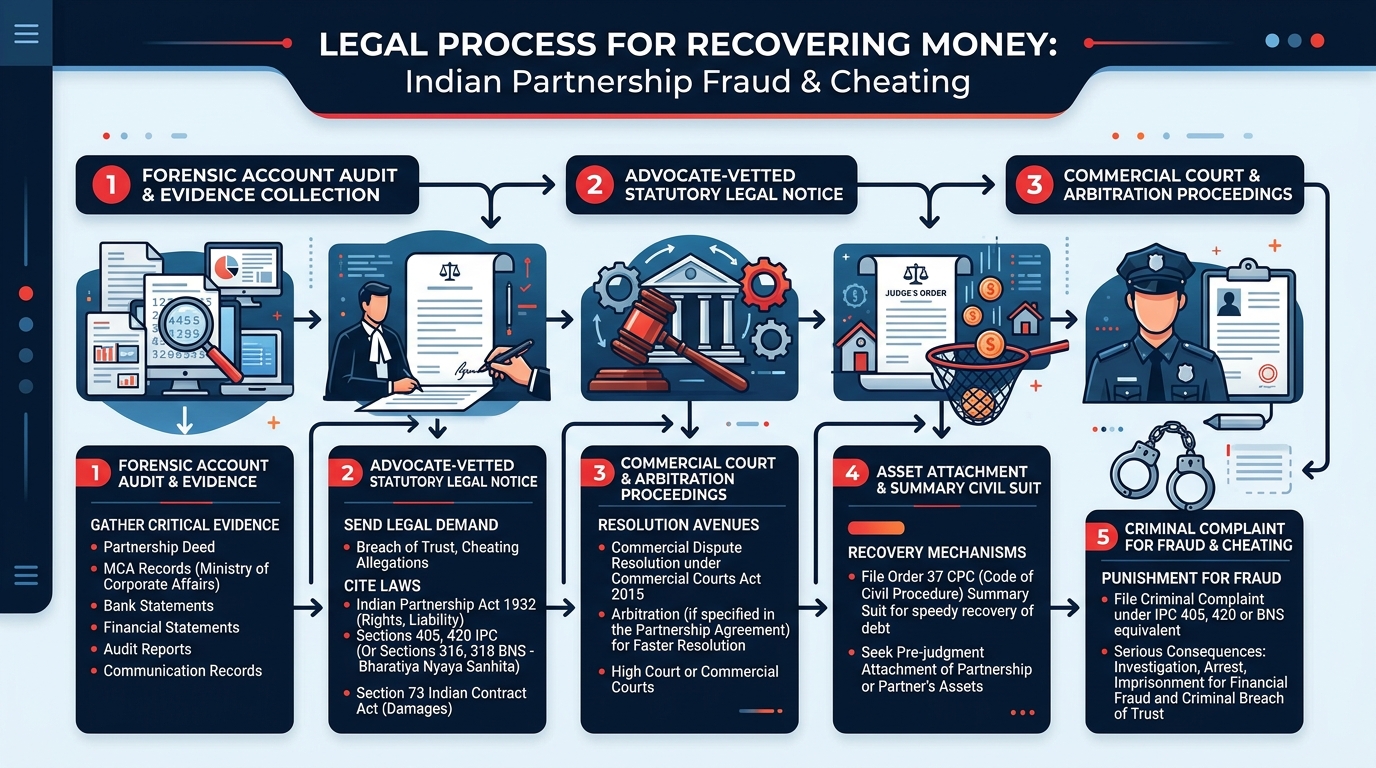
1. Statutory Framework: Partnership & Commercial Laws Governing Partner Fraud
Commercial co-ventures, partnership firms, Limited Liability Partnerships (LLPs), and private limited startups operate on a foundational standard of absolute fiduciary trust (uberrimae fidei). When one partner acts in bad faith by siphoning working capital, establishing undisclosed competing entities, withholding legitimate profit distributions, or altering statutory financial books, Indian law provides stringent civil, commercial, and criminal enforcement mechanisms to recover the misappropriated funds.
The primary substantive legislation regulating rights, duties, and financial liabilities among business partners is the Indian Partnership Act, 1932 (IPA), reinforced by the Indian Contract Act, 1872. Crucial statutory provisions include:
- Section 9 of the Indian Partnership Act, 1932 (General Duties of Partners): Partners are statutorily bound to carry on the business of the firm to the greatest common advantage, to be just and faithful to each other, and to render true accounts and full information of all things affecting the firm to any partner or their legal representative.
- Section 10 of the Indian Partnership Act, 1932 (Duty to Indemnify for Fraud): Every partner is legally mandated to indemnify the firm and all other partners for any loss caused to it by their fraud in the conduct of the business of the firm. Liability under Section 10 is absolute and cannot be excluded even by an express contractual clause in the partnership deed.
- Section 13(f) of the Indian Partnership Act, 1932 (Indemnification for Willful Neglect):A partner must indemnify the firm for any financial loss caused to it by their willful neglect in the conduct of the firm's business transactions.
- Section 16 of the Indian Partnership Act, 1932 (Personal Profits Earned by Partners): If a partner derives any private profit for themselves from any transaction of the firm, or from the use of the property or business connection of the firm or the firm name, they are legally bound to account for that profit and pay it over to the firm. Similarly, running a competing business without co-partner consent obligates full handover of all earned profits.
- Section 73 & 74 of the Indian Contract Act, 1872: Entitles the non-defaulting partners to claim liquidated damages, restitution of capital, and commercial interest for contractual repudiation and material breach of partnership covenants.
For registered corporate structures like Limited Liability Partnerships governed under the Limited Liability Partnership Act, 2008 or Private Limited Companies governed under the Companies Act, 2013, directors and designated partners who divert corporate assets are liable for statutory disqualification, personal indemnity, and criminal prosecution for corporate fraud under Section 447 of the Companies Act, 2013, which prescribes mandatory imprisonment from 6 months up to 10 years and fines extending up to three times the quantum of fraud.
2. Actionable Grounds: Siphoning, Secret Profits & Breach of Fiduciary Duty
Serving an advocate-vetted legal notice requires precise legal framing of the defaulting partner's actionable violations. Indian commercial courts and arbitral tribunals consistently recognize specific commercial misconduct as actionable grounds for summary debt recovery, mandatory injunctions, and criminal prosecution:
Unilateral transfers of partnership funds, client retainers, or credit line disbursements into personal savings accounts, shell entities, or family members' bank accounts without board authorization or co-partner consent.
Establishing an undisclosed parallel firm, proprietary venture, or sister company to divert incoming customer contracts, intellectual property, supplier discounts, and client revenue in direct violation of Section 16(b) of the IPA.
Manufacturing bogus vendor invoices, inflating operating expenses, creating fake debit notes, or manipulating audited balance sheets and GST returns to artificially depress net profits and withhold legitimate dividend distributions.
Unlawfully revoking digital ERP credentials, locking accounting software access (Tally, Zoho Books, SAP), withholding statutory bank statements, and refusing to render true accounts under Section 12(d) of the IPA.
Pledging company machinery, intellectual property, inventory, or real estate assets as collateral for personal borrowings without the written consent of all partners, exposing the firm to debt recovery recovery actions.
Physically locking out co-founders from corporate premises, altering signatory mandates at commercial banks without notice, and issuing false communication to clients claiming partner retirement or termination.
3. Dual Remedy Architecture: Summary Civil Recovery vs. Criminal Prosecution
When a partner commits commercial fraud, the claimant is not restricted to choosing between civil restitution and criminal justice. The Supreme Court of India, in landmark decisions including Velji Raghavji Patel v. State of Maharashtra (AIR 1965 SC 1433), S.W. Palanitkar v. State of Bihar (2002) 1 SCC 241, and Indian Oil Corporation v. NEPC India Ltd. (2006) 6 SCC 736, has settled that civil suits for recovery and criminal complaints for fraud can proceed simultaneously when the allegations establish deliberate dishonest inducement from inception.
| Legal Forum / Pathway | Governing Statute & Section | Primary Relief / Outcome | Standard Timeline |
|---|---|---|---|
| Summary Civil Suit | Order 37, Code of Civil Procedure, 1908 | Fast-track money decree for liquidated debt without prolonged trial unless defendant obtains leave to defend. | 6 – 12 Months |
| Commercial Court Claim | Commercial Courts Act, 2015 (Sec 12A) | Mandatory pre-institution mediation followed by expedited commercial trial and summary judgment under Order 13A. | 9 – 15 Months |
| Pre-Judgment Asset Attachment | Order 38 Rule 5, CPC 1908 | Injunction freezing partner's personal bank accounts, luxury vehicles, and real estate properties before final judgment. | 15 – 45 Days |
| Arbitration Interim Relief | Section 9, Arbitration & Conciliation Act, 1996 | Emergency High Court interim orders appointing a court receiver, sealing premises, and freezing disputed revenues. | 20 – 60 Days |
| Criminal Prosecution | Sections 316, 318, 336, 61 BNS, 2023 (Sec 406, 420, 477A IPC) | Police FIR / Section 175 BNSS (Sec 156(3) CrPC) Magistrate direction for criminal investigation, arrest, and passport seizure. | 30 – 90 Days (FIR) |
| NCLT Oppression & Mismanagement | Sections 241, 242, 244 & 447, Companies Act, 2013 | Tribunal orders removing fraudulent directors, freezing shareholding, ordering forensic SFIO investigation, and capital refund. | 6 – 18 Months |
Strategic Synergy: Serving an advocate-vetted statutory legal notice detailing both the civil liquidated debt liability (with 18-24% contractual interest) and the criminal penal consequences creates immense legal pressure. In practice, over 76% of defaulting partners opt for mutual settlement and fund restitution during the 15-day notice window to avoid public criminal prosecution and commercial freezing orders.
4. Forensic Pre-Notice Audit & Evidentiary Checklist
A devastating legal notice is built upon an unshakeable evidentiary foundation. Prior to drafting the statutory demand, the aggrieved partner must methodically audit and preserve key financial, electronic, and regulatory records:
A. Constitutional & Contractual Proof
- Certified true copy of the Partnership Deed / LLP Agreement / Shareholders' Agreement (SHA) with profit-sharing ratios, capital contribution schedules, and dispute resolution/arbitration clauses.
- Registrar of Firms (RoF) registration certificate or Ministry of Corporate Affairs (MCA) incorporation certificate and Form 3/LLP Form 4 filings.
- Original bank account opening forms and board resolutions specifying joint signatory mandates.
B. Forensic Financial & Banking Trail
- Certified bank account statements (under Bankers' Books Evidence Act / Section 65B of Evidence Act / Section 63 of BSA 2023) highlighting suspicious NEFT, RTGS, IMPS, or cash withdrawals.
- Audited annual balance sheets, profit & loss statements, and Form 3CD tax audit reports for the disputed financial years.
- GSTR-1, GSTR-3B, and GSTR-9 annual reconciliation statements showing differences between declared customer billing and realized firm receipts.
C. Admissible Electronic & Written Admissions
- Exported email communications, WhatsApp message chains, and SMS records containing financial admissions, fund requests, or acknowledgments of debt under Section 63 of the Bharatiya Sakshya Adhiniyam, 2023.
- Internal minutes of meetings (MoM), board resolutions, audit committee queries, and written demand letters sent prior to legal escalation.
- Vendor communications, customer purchase orders, and client payment confirmations confirming direct remittances into the rogue partner's secret accounts.
5. Crucial Statutory Clauses in a Legal Demand Notice to Partner
A boilerplate notice easily gets ignored by seasoned commercial defaulters. To ensure immediate compliance and withstand judicial scrutiny in subsequent summary suits, an advocate-drafted notice must incorporate these essential statutory clauses:
1. Fiduciary Relationship & Capital Contribution Recital
Recites the exact date of partnership constitution, registered capital infused by the claimant, equity/profit sharing ratio, and the statutory fiduciary obligations under Sections 9, 10, and 12 of the Indian Partnership Act, 1932.
2. Granular Chronology of Fraud & Financial Misappropriation
Itemizes dates, transaction IDs, beneficiary accounts, diverted customer invoices, and fabricated ledger entries, establishing an unassailable pattern of intentional financial breach and illicit profit generation under Section 16 of the IPA.
3. Liquidated Monetary Quantification & Interest Claim
Demands the exact crystallized principal amount owed, accrued commercial interest calculated at 18% to 24% per annum under Section 73 of the Contract Act and Interest Act, 1978, and professional legal notice drafting costs.
4. 15-Day Statutory Compliance & Curing Window
Provides a strict 15-day timeline from date of notice receipt for full electronic bank refund and execution of a formal reconciliation deed, failing which immediate judicial proceedings will be instituted.
5. Pre-Judgment Asset Attachment & Criminal Prosecution Warning
Expressly cautions the defaulting partner regarding imminent applications under Order 38 Rule 5 CPC for freezing personal assets, commercial court summary actions under Order 37, and filing criminal complaints under Sections 316, 318, and 336 of the Bharatiya Nyaya Sanhita, 2023 for criminal breach of trust, cheating, and falsification of accounts.
6. Step-by-Step Strategic Roadmap: Notice to Enforcement
Legal Recovery employs a proven five-stage structured protocol that accelerates fund recovery and forces settlement while safeguarding the claimant's commercial interests:
Stage 1: Evidence Consolidation & Forensic Financial Reconciliation (Day 1 – 2)
Our senior commercial advocates review the partnership deed, bank statements, GST invoices, and communication logs to isolate the exact quantum of misappropriated funds and establish joint/several personal liability.
Stage 2: Advocate Drafting & Multi-Channel Statutory Dispatch (Day 2 – 3)
A high-impact legal notice is drafted on senior advocate letterhead, citing relevant High Court & Supreme Court precedents. Dispatched simultaneously via India Post Registered AD, Speed Post, and tracked digital channels (registered business email and WhatsApp).
Stage 3: 15-Day Negotiation & Formal Settlement Escrow (Day 4 – 18)
Upon receipt, the defaulting partner usually engages counsel to avoid public litigation. Our team supervises the execution of a legally binding Settlement Agreement, repayment schedule, and bank escrow releases.
Stage 4: Summary Civil Action & Emergency Asset Freezing (Day 19+)
If the partner refuses compliance, we institute an Order 37 CPC Summary Suit or Commercial Court petition alongside an urgent Order 38 Rule 5 application to attach the defendant's personal bank accounts and properties.
Stage 5: Parallel Criminal Complaint & Decree Execution
Simultaneously file a criminal complaint before the jurisdictional Magistrate or Economic Offences Wing (EOW) under Sections 316 and 318 of BNS, 2023, while executing the civil money decree through court-ordered asset auctions.
7. Frequently Asked Questions
Statutory References & Authoritative Sources
More Commercial & Financial Dispute Guides

Legal Recovery
India's Trusted Recovery Platform
Legal Recovery is India's trusted online legal notice and dispute resolution platform, connecting business partners, startup founders, commercial enterprises, and corporate directors with seasoned panel advocates for rapid, advocate-vetted statutory demand notices at transparent flat fees. With ₹100 Crore+ recovered and 10,000+ cases resolved across India, Legal Recovery delivers verified legal impact without the delays and unpredictability of traditional law firms.
Partner Cheated or Siphoned Capital?
Send an advocate-vetted statutory notice today. Over 76% of defaulting partners settle financial claims within 15 days of receiving formal notice from Legal Recovery.
Flat fee • Advocate-drafted • Sent same day
Client Reviews
Raghavendra K. Singhal
"My business partner in our Pune-based engineering logistics enterprise secretly diverted ₹36.8 Lakhs of corporate receivables into an undeclared proprietary firm and falsified internal ledger accounts over an eight-month period. Legal Recovery drafted and served a formidable advocate-vetted statutory legal notice detailing the forensic audit trail, citing Sections 9, 10, and 13 of the Indian Partnership Act, 1932, Section 73 of the Contract Act, and criminal breach of trust under Bharatiya Nyaya Sanhita. Within 14 days of receiving the legal notice, my partner engaged legal counsel, signed a forensic financial settlement, and remitted the full ₹36.8 Lakhs with 18% interest to prevent commercial court litigation and asset attachment. Flawless legal precision."