Legal Notice for Trading Scam on Telegram
Recover money lost to fake institutional stock trading groups, illicit IPO allocation schemes, clone APKs, and crypto traps on Telegram. Serve urgent advocate-drafted statutory notices to freeze mule bank accounts under BNS Section 318(4), IT Act Section 66D, and BNSS Section 106.
Table of Contents
Swipe →Victims of Telegram stock trading, fake institutional institutional placement, or cryptocurrency scams can legally recover misappropriated funds by serving an advocate-drafted statutory legal notice under Section 318(4) of the Bharatiya Nyaya Sanhita, 2023 (BNS), Section 66D of the Information Technology Act, 2000, and Section 106 of the Bharatiya Nagarik Suraksha Sanhita, 2023 (BNSS). Serving formal legal demand notices upon recipient mule account holders, intermediary banks, and payment aggregators mandates immediate debit freezes on tainted balances under Reserve Bank of India (RBI) anti-money laundering circulars. Victims can subsequently file a summary restitution application under Section 503 of the BNSS before the jurisdictional Chief Judicial Magistrate to obtain formal court orders releasing the frozen funds directly back to the depositor’s original bank account.
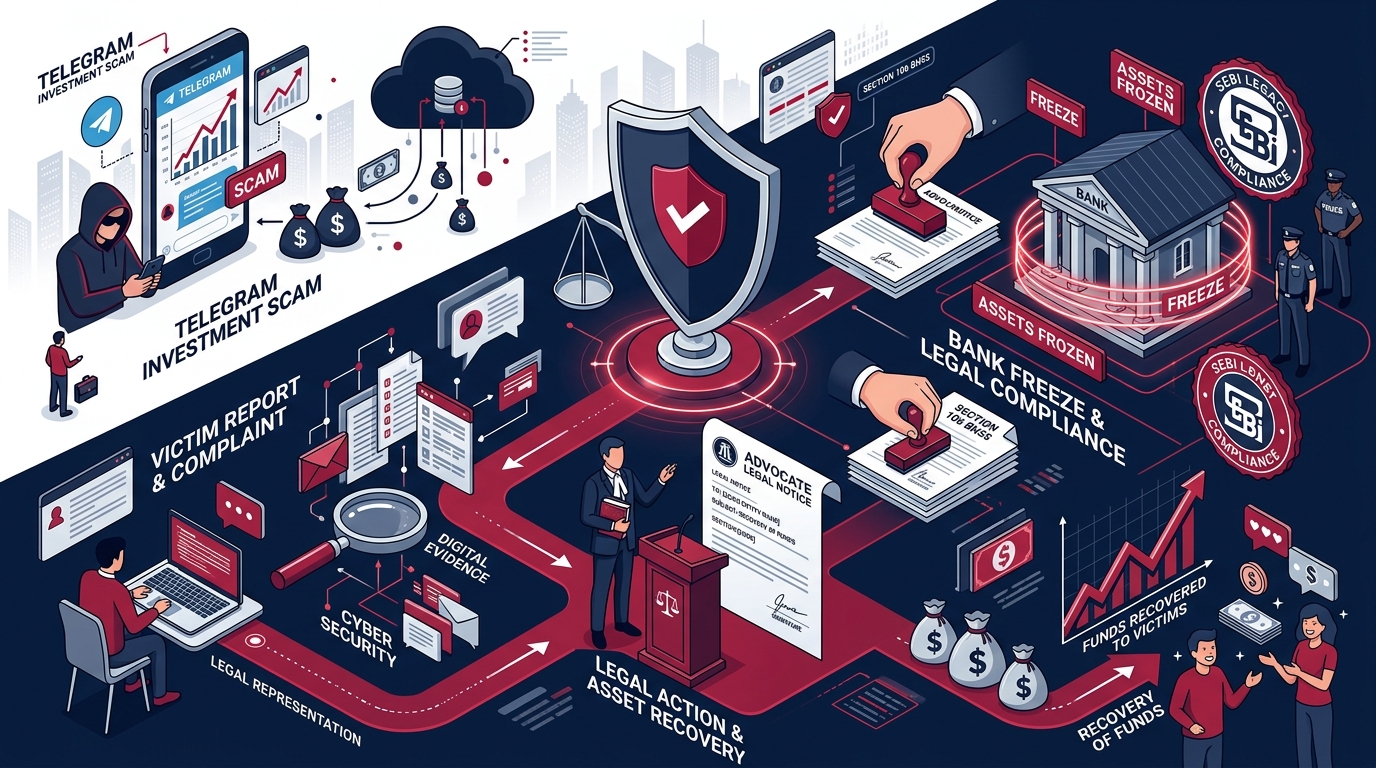
Statutory Roadmap: From Cyber Crime Registration to Section 106 BNSS Bank Freezes and Section 503 BNSS Magistrate Refund Orders
1. Anatomy of Telegram Trading Scams: Clone Apps, Institutional Traps & Mule Rings
Organized financial cyber syndicates operate heavily across encrypted messaging applications, orchestrating sophisticated investment deceptions designed to exploit retail investors seeking abnormal market returns. The operational architecture of a Telegram trading scam typically unfolds across structured psychological and technological stages:
Fraudsters impersonate SEBI-registered portfolio managers, global investment banks (such as Morgan Stanley, Goldman Sachs, or BlackRock), or reputed domestic brokerages. They populate public and private Telegram channels with thousands of automated bot accounts posting fabricated profit screenshots and forged regulatory certificates.
Victims are instructed to bypass Google Play Store and Apple App Store by installing sideloaded Android Application Packages (APKs) or registering on custom web portals. These applications simulate live market feeds via modified TradingView widgets, displaying fictitious multi-fold portfolio growth while no actual exchange transactions take place.
Instead of depositing capital into SEBI-regulated Clearing Corporations (ICCL or NCL), victims are directed to make RTGS, IMPS, and UPI transfers to third-party individual or current accounts labeled as "institutional liquidity providers". These are rented mule accounts opened using forged KYC credentials across Indian retail banks.
When the investor requests a partial or total capital withdrawal, the syndicate abruptly freezes the dashboard and demands 20% to 35% in upfront "SEBI Capital Gains Tax", "Foreign Exchange Clearance Surcharge", or "VIP Unlocking Fees". Paying these sums yields zero payouts and deepens total financial loss.
Recognizing this deceptive architecture is vital for drafting an unassailable legal notice. Because funds move through domestic banking channels before offshore conversion into cryptocurrency (USDT), prompt statutory action targeting recipient banks and account holders provides the highest probability of complete financial restitution.
2. Statutory Framework: BNS 318(4), IT Act 66D & SEBI PFUTP Regulations
A legally sound notice for Telegram investment fraud must invoke substantive criminal, cyber, and securities statutes to establish strict liability, fraudulent inducement, and regulatory violations:
Section 318(4) & Section 316 of the Bharatiya Nyaya Sanhita, 2023 (BNS)
Section 318(4) of the BNS (corresponding to Section 420 of the erstwhile Indian Penal Code) prescribes severe imprisonment up to seven years and mandatory fines for cheating and dishonestly inducing the delivery of property. Section 316 of the BNS prosecutes criminal breach of trust where entrusted investment capital is converted to personal use. Invoking these provisions in the legal notice establishes that all recipients of the funds acted in furtherance of a shared criminal conspiracy under Section 61(2) BNS.
Section 66D of the Information Technology Act, 2000
Section 66D establishes a dedicated criminal offense for "cheating by personation by using computer resource", punishable with imprisonment up to three years and fine. This applies directly to Telegram channel administrators, bot creators, and fake website operators who falsely represent themselves as licensed SEBI brokers, research analysts, or registered institutional investment managers.
SEBI Act, 1992 & SEBI (PFUTP) Regulations, 2003
Regulation 3 and Regulation 4 of the Securities and Exchange Board of India (Prohibition of Fraudulent and Unfair Trade Practices Relating to Securities Market) Regulations, 2003 strictly prohibit any person from employing manipulative or deceptive devices to induce the purchase or sale of securities. Operating unauthorized collective investment schemes or dispensing unregistered stock tips via social media violates Section 11AA and Section 12A of the SEBI Act, 1992, rendering all generated proceeds subject to disgorgement and impoundment under Section 11B.
Prevention of Money Laundering Act, 2002 (PMLA)
Under Section 3 of the PMLA, any person directly or indirectly involved in any process or activity connected with proceeds of crime—including concealment, possession, acquisition, or use—is guilty of money laundering. Beneficiary mule account holders cannot escape liability under the guise of being passive intermediaries once a formal statutory notice establishes the tainted origin of the funds.
3. Beneficiary Mule Accounts: Legal Demand & Statutory Notice to Account Holders
In almost all Telegram trading deceptions, the actual mastermind remains concealed behind virtual private networks (VPNs) and offshore identities. However, the domestic bank accounts into which the victim transferred funds are registered to identifiable Indian citizens and corporate entities. Serving a statutory legal demand notice directly to these beneficiary account holders is a potent legal tactic:
Strategic Objectives of Serving Legal Notice on Mule Account Holders:
- •Elimination of the "Bona Fide Third-Party" Defense: Once served with an advocate legal notice citing specific Unique Transaction Reference (UTR) numbers and police complaint IDs, the account holder is officially stripped of any claim that they received the funds in good faith without notice of illicit origin.
- •Triggering Personal Civil and Criminal Liability: The notice demands immediate restitution of the precise sum within 7 to 15 days, warning that failure to refund triggers joint liability for criminal conspiracy under Section 61(2) BNS, cheating under Section 318(4) BNS, and civil suits for recovery with 18% per annum interest.
- •Pressure to Cooperate with Law Enforcement: Frequently, account holders who rented out their bank credentials for small commissions panic upon receiving formal advocate notices on official legal letterheads, prompting them to approach law enforcement, expose the syndicate coordinators, and surrender remaining funds.
- •Documentary Evidentiary Anchor for Court Attachment: The dispatched Speed Post A/D receipt and delivery tracking report constitute conclusive proof under Section 27 of the General Clauses Act, 1897 that formal demand was made prior to judicial attachment.
4. Bank Account Freezing under Section 106 BNSS & RBI Directives
Financial institutions maintain a strict fiduciary and regulatory obligation to prevent their networks from being weaponized for cyber extortion and illegal money routing. When serving statutory legal notice on intermediary and beneficiary banks, the following operational and statutory mandates must be enforced:
Section 106 of the Bharatiya Nagarik Suraksha Sanhita, 2023 (BNSS)
Section 106 of the BNSS empowers police officers and investigating agencies to seize or attach property found under circumstances creating suspicion of the commission of any offense. When a formal legal notice containing NCRP complaint numbers, UTR transaction logs, and advocate certification is delivered to the Bank’s Nodal Cyber Cell Officer, the bank is legally required to execute a temporary debit freeze (lien marking) on the target account balance to safeguard the disputed res pending judicial directives.
RBI Master Direction on Customer Protection & Zero Liability Framework
Under RBI Circular RBI/2017-18/15 (Customer Protection – Limiting Liability of Customers in Unauthorised Electronic Banking Transactions), commercial banks and payment system operators are required to maintain 24x7 fraud monitoring systems. If a bank exhibits systemic negligence—such as permitting high-volume, suspicious transactions in newly opened accounts without enhanced KYC verification or ignoring immediate freeze requests—the bank forfeits safe-harbor protections and can be held liable before the RBI Ombudsman.
The Indian Cyber Crime Coordination Centre (I4C) & CFCFRMS Integration
The Citizen Financial Cyber Fraud Reporting and Management System (CFCFRMS), accessible via helpline 1930, connects commercial banks, payment aggregators, and law enforcement in real time. Serving a legal notice simultaneously with an NCRP filing ensures that bank compliance teams trace the entire money trail—freezing Layer-1, Layer-2, and Layer-3 mule accounts before the syndicate converts the capital into cryptocurrency on foreign peer-to-peer exchanges.
5. Intermediary Liability: Serving Legal Notice to Telegram under IT Rules, 2021
While messaging platforms frequently invoke "safe harbor" immunity under Section 79 of the Information Technology Act, 2000, that protection is strictly conditional and subject to active compliance with the Information Technology (Intermediary Guidelines and Digital Media Ethics Code) Rules, 2021:
Enforcing Platform Due Diligence & Safe Harbor Forfeiture:
- •Rule 3(1)(b) Due Diligence Mandate: Intermediaries are legally prohibited from knowingly hosting, displaying, or transmitting content that deceives or misleads users regarding financial products, impersonates registered entities, or promotes unlawful securities schemes.
- •Statutory 24-Hour / 36-Hour Take-Down Obligation:Under Section 79(3)(b) of the IT Act, once an intermediary receives "actual knowledge" via court order or formal legal notification from an authorized party detailing illegal activity, the platform must expeditiously remove or disable access to the infringing channels, bots, and group links.
- •Preservation of Basic Subscriber Info (BSI) & IP Logs: Serving a statutory legal notice upon Telegram’s Resident Grievance Officer legally compels the platform to preserve administrator IP registration logs, SIM card binding records, device identifiers, and chat history for a mandatory period of 180 days under Rule 3(1)(h) of the IT Rules for submission to investigating officers.
6. Digital Evidence Preservation Checklist under Section 63 BSA
Electronic evidence is volatile. Cyber fraudsters routinely delete Telegram channels, wipe chat logs, or terminate cloned servers once an investor demands withdrawals. To ensure that your legal notice and subsequent court filings possess decisive probative value, compile evidence strictly in accordance with Section 63 of the Bharatiya Sakshya Adhiniyam, 2023 (BSA):
Banking & Financial Transaction Logs
- Original bank statements showing debit timestamps & narration
- Exact Unique Transaction Reference (UTR) / IMPS reference numbers
- Beneficiary account numbers, IFSC codes, and account holder names
- UPI Transaction IDs and Virtual Payment Addresses (VPAs)
Telegram Channel & Admin Metadata
- Telegram group invite links (t.me/...) and channel ID numbers
- Admin user handles (@username), display names, and phone numbers
- Full chat export in HTML/JSON format preserving timestamps
- Screenshots of promises, fake profit leaderboards, and trading signals
Fraudulent App & Website Artifacts
- Downloaded APK installation file and SHA-256 cryptographic hash
- Complete website URLs, domain registration details, and host IP
- Screenshots of fabricated user dashboard showing inflated balances
- Demands for tax payments, unlocking fees, or withdrawal penalties
Statutory Section 63 BSA Electronic Certificate
- Affidavit describing the device make, model, OS, and serial number
- Verification that electronic device operated under lawful control
- Hash verification confirming no alteration or tampering of records
- Endorsement by the legal advocate representing the recovery claim
7. Magistrate Court Recovery: Section 503 BNSS De-Freezing Petitions
A common misconception among fraud victims is that once cyber police or banks freeze suspect accounts, the money is automatically refunded. Under Indian criminal jurisprudence, frozen funds represent "muddamal" (case property / proceeds of crime) and can only be lawfully released pursuant to a judicial order:
The Section 503 BNSS (Erstwhile Section 457 CrPC) Judicial Procedure:
- Identification of Frozen Quantum: Through the cyber police station handling your NCRP complaint, obtain the official status report specifying which beneficiary bank accounts have been debit-frozen and the exact balance secured.
- Drafting and Filing the De-Freezing Petition: An advocate files an application under Section 503 BNSS before the Chief Judicial Magistrate (CJM) or Metropolitan Magistrate having territorial jurisdiction over the police station or bank branch.
- Proof of Unbroken Audit Trail: The petition attaches the advocate legal notice, UTR bank receipts, and Section 63 BSA electronic certificate proving that funds deposited by the victim directly constitute the frozen balance in the mule account.
- Execution of Indemnity Bond (Supurdnama): The court directs the petitioner to execute a solvent surety or indemnity bond undertaking to produce the amount if any rival legitimate claim arises.
- Judicial Directive to Bank Manager: The Magistrate issues a binding court order directing the branch manager of the holding bank to debit the frozen proceeds and credit them directly into the victim’s verified source savings account.
8. Comparative Legal Matrix: Civil, Criminal & Regulatory Remedies
Recovering capital lost in Telegram trading scams requires an integrated, multi-forum approach. The table below details the available statutory pathways, target respondents, typical timeframes, and recovery efficacy:
| Legal Pathway | Governing Statute | Primary Target | Expected Timeline | Strategic Impact |
|---|---|---|---|---|
| Statutory Legal Demand Notice | BNS § 318(4), IT Act § 66D, BNSS § 106 | Mule Account Holders & Bank Nodal Officers | Immediate (24–48 Hrs) | Places banks on strict legal notice; triggers immediate debit freezes; prevents further fund layering. |
| National Cyber Crime Portal (1930 / NCRP) | IT Act § 70B & MHA CFCFRMS Framework | Intermediary Banking Nodes & Wallets | 2 to 7 Days | Inter-bank automated hold mechanism to freeze Layer-1 and Layer-2 accounts across financial networks. |
| Magistrate Refund Application | Section 503 BNSS (Erstwhile § 457 CrPC) | Holding Bank Branch & Seized Accounts | 30 to 90 Days | Judicially enforceable court order compelling banks to remit frozen funds back to the victim. |
| Summary Civil Recovery Suit | Order 37, Code of Civil Procedure, 1908 | Identified Mule Operators & Corporate Entities | 6 to 12 Months | Secures enforceable monetary decree with 18% p.a. interest; enables attachment of immovable assets. |
| SEBI SCORES & Regulatory Disgorgement | SEBI Act § 11B & PFUTP Regulations | Unregistered Investment Advisors & Entities | 3 to 6 Months | Regulatory impoundment of illegal advisory proceeds; nationwide debarment of offending entities. |
9. Frequently Asked Questions
Authoritative Legal Sources & Statutory References
More Cyber Fraud & Financial Recovery Guides

Legal Recovery
India's Trusted Recovery Platform
Legal Recovery is India's premier tech-enabled legal notice and financial dispute resolution platform, connecting victims of digital financial crime, Telegram investment syndicates, corporate defaults, and contractual breaches with experienced panel advocates for swift, statutory legal notices and court-approved restitution at flat, transparent fees. Having facilitated ₹100 Crore+ in asset recoveries across 10,000+ cases throughout India, Legal Recovery combines procedural rigor with rapid digital execution.
Trapped in a Telegram Trading Scam?
Act within the golden hour. Send an advocate-vetted statutory legal notice to freeze recipient mule bank accounts before funds are siphoned off.
Flat fee • Advocate-drafted • Same-day dispatch
Client Reviews
Dr. Siddharth Menon
"I was lured into a Telegram VIP group named "Institutional Wealth Advisory & Institutional Stock Allotments" with over 18,000 members sharing screenshots of 300% trading profits. Over 3 weeks, I was guided to download a cloned institutional trading app and transfer ₹14,60,000 across 4 separate beneficiary accounts in ICICI, HDFC, and Yes Bank for high-frequency institutional IPO trades. When my portfolio balance showed ₹48,20,000 and I requested a withdrawal, they demanded an additional ₹4,50,000 as "SEBI clearance tax". Realizing I was scammed, I reached out to Legal Recovery. Their panel advocates drafted and served urgent statutory legal notices under BNS Section 318(4), IT Act Section 66D, and BNSS Section 106 to the beneficiary account holders and bank nodal officers within 6 hours. Combined with the 1930 cyber portal complaint, the notices compelled the banks to freeze ₹11,80,000 in two mule accounts. Legal Recovery then helped file the Section 503 BNSS refund application before the Chief Judicial Magistrate, and I received my money back into my source account. Truly life-saving legal expertise!"