Legal Notice to Co-Founder for Unpaid Dues & Equity
Recover unpaid founder salary, deferred sweat equity compensation, and enforce vested shareholding under the Companies Act 2013, Indian Contract Act 1872, Specific Relief Act, and NCLT oppression provisions.
Table of Contents
Swipe →Quick Answer
A startup founder, technical architect, or early partner can serve an advocate-drafted statutory legal notice to a defaulting co-founder and company under Section 73 of the Indian Contract Act, 1872 and Sections 56, 88, 169, and 241 of the Companies Act, 2013, demanding immediate release of unpaid compensation, sweat equity remuneration, and formal allotment of vested equity shares within 15 days. If the co-founders fail to comply, the claimant can initiate oppression and mismanagement proceedings before the National Company Law Tribunal (NCLT) or file a commercial suit for specific performance under Section 10 of the Specific Relief Act, 1963 alongside emergency interim injunctions to freeze cap table alterations and share transfers.
1. Statutory Framework: Founder Rights, Equity Vesting & Company Law in India
In the Indian startup ecosystem, early founders often bootstrap technological architecture, product development, operations, and business development in exchange for equity ownership, sweat equity allotments, or deferred salary disbursements. When commercial traction accelerates or external venture capital rounds materialize, disputes frequently erupt where controlling co-founders unlawfully dilute early contributors, freeze unpaid remuneration, or refuse to formalize share allotments.
The substantive rights of co-founders in private limited companies and corporate entities are anchored across several interlocking statutory frameworks:
- Companies Act, 2013 — Section 88 & Section 56 (Register of Members & Share Transfer):Every corporate entity is statutorily mandated to maintain an accurate Register of Members under Section 88. Refusal to enter a lawful shareholder's name or executing share transfers without proper instrument compliance under Section 56 constitutes a punishable corporate default.
- Companies Act, 2013 — Section 169 (Removal of Directors): Controlling shareholders cannot arbitrarily remove a founder-director without issuing special notice, affording reasonable opportunity of representation, and adhering to strict statutory board voting procedures.
- Companies Act, 2013 — Sections 241 & 242 (Oppression and Mismanagement): Any member holding at least 10% of issued share capital (or 1/10th of total members) can petition the National Company Law Tribunal (NCLT) against oppressive actions, illegal dilution, or exclusion from management affairs.
- Indian Contract Act, 1872 — Section 73 & Section 74 (Breach of Founders' Agreement):Breach of express covenants in a Founders' Agreement, Shareholder Agreement (SHA), or Term Sheet entitles the aggrieved founder to recover actual monetary damages, lost salary, and liquidated compensation.
- Specific Relief Act, 1963 — Section 10 (Specific Performance of Share Contracts): Following the 2018 amendment, specific performance is mandatory for commercial contracts. Courts are obligated to direct specific performance of equity transfer agreements where monetary damages cannot adequately compensate loss of unique equity shareholding.
Furthermore, founder remuneration agreements executed through board resolutions or employment contracts constitute enforceable liquidated debts. Under Section 2(y) of the Code on Wages, 2019, accrued founder salary and performance bonuses form part of statutory wages, prohibiting unauthorized deductions or indefinite deferrals once agreed company milestones have been attained.
2. Actionable Grounds: Unlawful Dilution, Forced Ouster & Unpaid Founder Dues
A robust statutory demand notice must specify the exact factual defaults, corporate law breaches, and bad-faith conduct committed by the defaulting co-founders. Indian tribunals and commercial courts recognize several distinct grounds for legal intervention:
Unlawful Dilution & Unnotified Rights Issues
Managing founders increasing authorized share capital or issuing preferential shares/convertible notes to third parties or themselves without serving statutory notice under Section 62(1)(a) of Companies Act 2013 to wipe out a co-founder’s equity.
Non-Allotment of Vested Equity & MCA Non-Filing
Failing to execute Board resolutions, omit filing Form PAS-3 (Return of Allotment) with the Registrar of Companies (ROC), or refusing to deliver stamped share certificates under Section 56(4) after vesting milestones are completed.
Withholding Agreed Founder Salary & Deferred Compensation
Refusing to disburse accrued monthly compensation, consultancy fees, or deferred sweat equity payments agreed during bootstrapping phases after the startup secures external angel, VC, or grant funding.
Illegal Director Removal & Board Lockouts
Revoking executive access, locking email/code repositories, and passing fraudulent board resolutions to remove the co-founder as director without complying with Section 169 special notice requirements.
Bad-Faith "Bad Leaver" Characterization
Fabricating baseless performance allegations or manufactured disciplinary charges to trigger bad-leaver clauses and confiscate 100% of the founder's vested shares at nominal or zero valuation.
Siphoning Intellectual Property & Corporate Opportunity
Incorporating a parallel shell company or transferring core proprietary algorithms, trademarks, and client contracts to an entity owned exclusively by the defaulting co-founder in breach of fiduciary duties.
3. Legal Remedies: NCLT Oppression Petitions, Commercial Suits & Injunctions
Depending on the shareholding percentage, existence of an arbitration clause in the Founders' Agreement, and the nature of the claim (equity restoration vs. monetary debt), Indian law provides powerful multi-tier judicial forums:
| Judicial Forum & Statutory Authority | Applicable Legal Section | Primary Relief Sought | Strategic Impact |
|---|---|---|---|
| National Company Law Tribunal (NCLT) | Companies Act, 2013 — Sec 241, 242 & 59 | Rectification of Register of Members; setting aside illegal dilution | Directs independent forensic audit, appoints administrator, freezes board powers |
| High Court / Commercial Court (Arbitration) | Arbitration & Conciliation Act, 1996 — Sec 9 & 11 | Urgent interim injunction restraining share transfer or VC funding | Prevents third-party investor rights from crystallizing over disputed shares |
| Commercial Court Summary Suit | Commercial Courts Act, 2015 & Order 37 CPC | Liquidated recovery of unpaid founder salary & consulting dues | Expedited money decree with pre-institution mediation under Sec 12A |
| Civil Court (Specific Performance) | Specific Relief Act, 1963 — Section 10 | Mandatory order directing issuance of equity share certificates | Forces startup entity to issue shares without monetary substitution |
| Magistrate Court / Police Cyber Cell | Bharatiya Nyaya Sanhita, 2023 — Sec 316, 318, 336 | Criminal prosecution for fraud, forgery & breach of trust | Creates direct personal liability and reputational risk for defaulting founders |
Mandatory Pre-Institution Mediation under Section 12A Commercial Courts Act
Under the authoritative ruling of the Supreme Court of India in Patil Automation Pvt. Ltd. v. Rakheja Engineers Pvt. Ltd. (2022) 10 SCC 1, commercial suits concerning founder agreements, shareholder dues, and executive contracts must undergo mandatory pre-institution mediation through the District Legal Services Authority (DLSA) unless urgent interim relief is claimed. Serving a comprehensive statutory legal notice satisfies evidentiary conditions, defines the exact dispute scope, and accelerates commercial settlement during the mediation window.
4. Landmark Judicial Precedents on Founder Equity & Oppression
Indian company law jurisprudence firmly protects founder rights, equitable participation, and legitimate expectations in quasi-partnership startups. Key Supreme Court and NCLAT authorities include:
Tata Consultancy Services Ltd. v. Cyrus Investments Pvt. Ltd. (2021) 9 SCC 449
The Supreme Court affirmed that closely held companies and startups operating on mutual trust and personal relationships are akin to quasi-partnerships. When controlling shareholders breach underlying founder agreements or exclude key partners from governance in bad faith, NCLT holds broad remedial jurisdiction under Section 242.
Dale & Carrington Invt. P. Ltd. v. P.K. Prathapan (2005) 1 SCC 212
The Supreme Court ruled that directors act in a fiduciary capacity on behalf of all shareholders. Issuing additional shares solely to reduce a co-founder into a minority or consolidate personal control is an abuse of fiduciary power, rendering the entire allotment illegal and void ab initio.
Needle Industries (India) Ltd. v. Needle Industries Newey (India) Holding Ltd. (1981) 3 SCC 333
Established that an illegal share issue that prejudicially affects a shareholder’s voting rights or financial interest amounts to oppression under corporate law, entitling the aggrieved party to statutory rectification.
Sangramsinh P. Gaekwad v. Shantadevi P. Gaekwad (2005) 11 SCC 314
Held that failure to adhere strictly to statutory provisions regarding share transfers and disregard of pre-emptive rights embedded in corporate constitutional documents constitutes actionable oppression.
5. Pre-Notice Evidentiary Checklist & MCA Register Verification
To establish an unassailable legal foundation before drafting the demand notice, consolidate all documentary evidence establishing equity promises, milestone fulfillment, and financial liabilities:
Foundational Agreements
- ✓ Executed Founders' Agreement & SHA
- ✓ Vesting Schedule & Cliff Specifications
- ✓ Board Resolutions on Remuneration
Milestone & IP Proof
- ✓ Intellectual Property Assignment Deeds
- ✓ GitHub / Source Code Commit Logs
- ✓ Product Roadmap & MVP Sign-Offs
Financial & Banking Trails
- ✓ Bank statements showing deferred salary
- ✓ Form 26AS / AIS tax deduction records
- ✓ Expense reimbursement ledgers & invoices
Digital Admissions & Chat Logs
- ✓ Slack / WhatsApp chats promising equity
- ✓ Pitch Decks shared with VC investors
- ✓ Emails detailing cap table breakdown
🏛️Statutory MCA Portal Audit & Cap Table Verification
Before dispatching the notice, our legal team conducts a forensic audit on the Ministry of Corporate Affairs (MCA) portal. We extract the company's Master Data, verify authorized share capital, inspect filed Form MGT-7 (Annual Return), Form PAS-3 (Return of Allotment), and Form DIR-12 (Director Appointments/Resignations). This ensures the statutory notice is served on all current directors at the exact registered office, eliminating procedural service defects in court.
6. Key Clauses in a Co-Founder Statutory Demand Notice
An advocate-drafted statutory demand notice must balance assertive commercial demands with clinical statutory precision:
Recital of Incorporation, Founding Roles & Equity Covenants
Articulate the inception date of the venture, initial equity split agreements, reverse vesting schedules, executive designations, and reciprocal obligations undertaken by each co-founder.
Itemized Milestone Delivery & Sweat Equity Contribution
Set out a comprehensive record of technological milestones achieved, product code deployed, revenue generated, and sweat equity contributed during the bootstrapping tenure.
Breach of Fiduciary Duties, Unlawful Dilution & Default Narration
Detail the defaulting co-founder's unlawful actions, including unnotified share issuances, failure to execute Form PAS-3, unauthorized cap table modifications, and wrongful cessation of founder compensation.
Quantified Liquidated Debt & Commercial Interest Computation
Formally demand payment of exact unpaid salary, consulting remuneration, out-of-pocket expenses, and statutory interest calculated at 18% per annum under Section 73 of the Contract Act.
Peremptory 15-Day Demand & Litigation Escalation Warning
Mandate immediate rectification of the Register of Members, delivery of stamped share certificates, and payment of dues within 15 days, failing which the claimant will institute NCLT Section 241/242 petitions, Section 9 High Court injunctions, and BNS criminal complaints at the defaulting founders’ sole cost and peril.
7. Strategic Roadmap: 15-Day Demand to NCLT / Court Enforcement
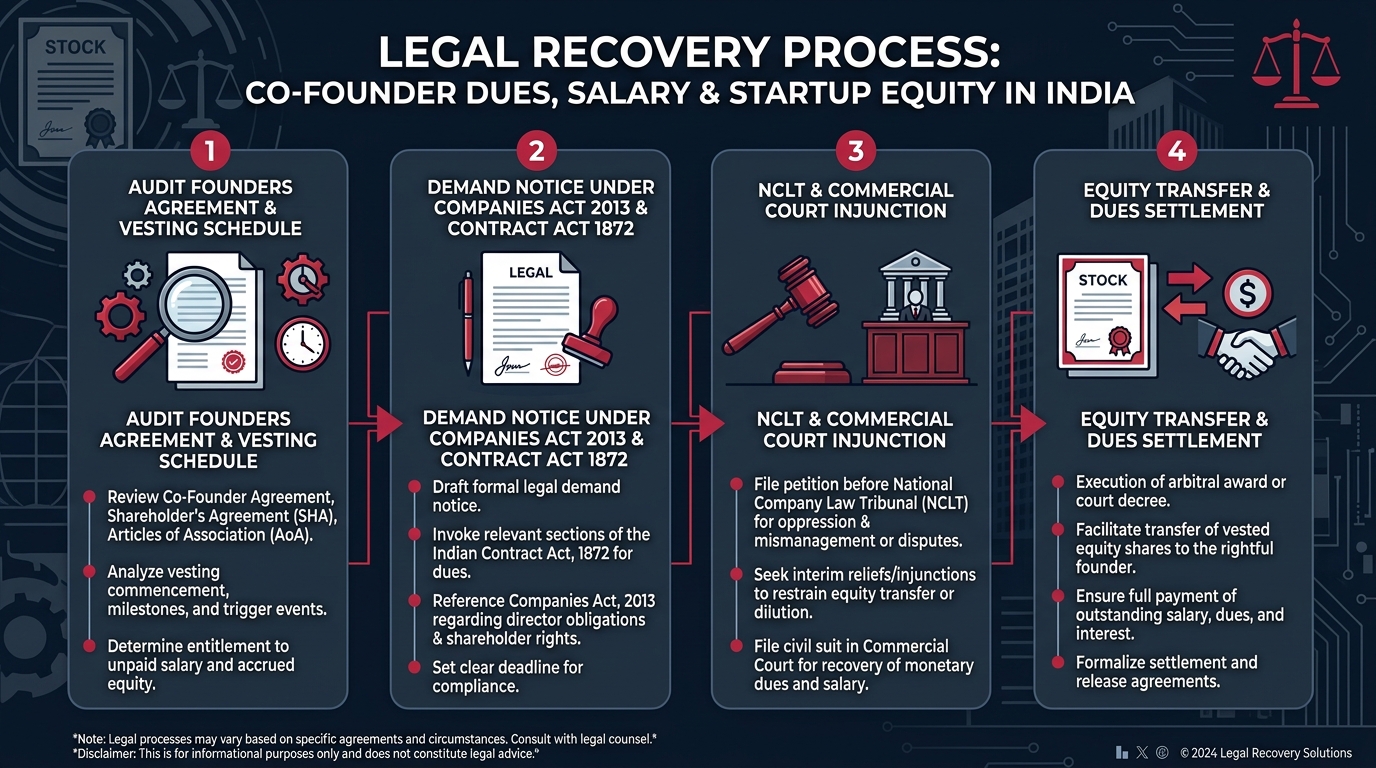
Serving an advocate-vetted statutory notice through Legal Recovery resolves over 72% of founder equity disputes out of court. If the defaulting founders remain recalcitrant, our structured multi-stage escalation protocol protects your startup rights:
Advocate Demand Notice Served via Multi-Channel Hybrid Dispatch
The notice is issued on official advocate letterhead, digitally signed under Section 5 of the Information Technology Act, 2000, and delivered simultaneously via Speed Post AD, verified corporate emails, and tracked WhatsApp channels.
Virtual ODR Mediation & Settlement Deed Execution
Upon receiving notice, startups frequently seek confidential settlement to protect upcoming funding rounds. Legal Recovery facilitates structured Online Dispute Resolution (ODR) to execute legally binding e-signed Settlement Deeds and cap table restructuring agreements.
Emergency Section 9 High Court / Commercial Court Injunction
If the company attempts to close an investment round or transfer IP during the dispute, our panel counsels file an urgent petition under Section 9 of the Arbitration Act or Order 39 CPC to freeze share transfers.
NCLT Company Petition (Sec 241/242) & ROC Rectification
Our corporate litigators institute formal oppression and mismanagement proceedings before the designated NCLT bench, seeking mandatory rectification of the Register of Members under Section 59 and monetary recovery decrees.
8. Frequently Asked Questions
Authoritative Statutory & Judicial References:
- Companies Act, 2013 — Sections 56, 62, 88, 169, 241 & 242, indiacode.nic.in
- Indian Contract Act, 1872 — Sections 73 & 74 (Breach of Contract & Compensation), indiacode.nic.in
- Specific Relief Act, 1963 — Section 10 (Mandatory Specific Performance of Contracts), indiacode.nic.in
- Commercial Courts Act, 2015 — Section 12A Mandatory Pre-Institution Mediation, indiacode.nic.in
- Supreme Court of India — Tata Consultancy Services Ltd. v. Cyrus Investments Pvt. Ltd. (2021) 9 SCC 449, main.sci.gov.in
- National Company Law Tribunal (NCLT) Rules & Company Petition Procedures, nclt.gov.in
- Ministry of Corporate Affairs (MCA) — Company Master Data & Form PAS-3 / MGT-7 Audit, mca.gov.in
- Bharatiya Nyaya Sanhita, 2023 — Sections 316 (Breach of Trust) & 318 (Cheating), indiacode.nic.in
More Corporate & Commercial Dispute Guides

Legal Recovery
India's Trusted Recovery Platform
Legal Recovery is India's premier corporate dispute resolution and debt recovery platform, empowering startup founders, early executives, technology architects, and commercial partners to resolve cap table conflicts, enforce equity allocations, and recover unpaid dues through seasoned corporate panel advocates. Backed by ₹100 Crore+ recovered and 10,000+ disputes resolved across India, we deliver prompt, advocate-vetted statutory notices with verified legal impact.
Co-Founder Withholding Dues or Equity?
Send an advocate-vetted statutory demand notice today. Over 72% of startup founder and equity disputes settle within 15 days upon notice service from Legal Recovery.
Flat fee • Advocate-drafted • Sent same day
Client Reviews
Vikramaditya Singhania
"As a technical co-founder of a Bengaluru-based AI logistics startup, I dedicated 18 months bootstrapping the MVP with an agreed deferred compensation of ₹38.5 Lakhs and 22.5% equity vesting over 4 years. Right after closing a $1.5M institutional funding round, the managing co-founder unlawfully altered company records on the MCA portal, refused to file Form PAS-3 for my vested share allotment, and blocked my remuneration. Legal Recovery immediately drafted a rigorous, advocate-vetted statutory demand notice citing Sections 88, 169, and 241/242 of the Companies Act 2013, Section 73 of the Indian Contract Act, and Section 10 of the Specific Relief Act. Within 14 days of service, the company's legal counsel convened an emergency board meeting, agreed to our settlement terms, issued my 22.5% equity shares, and disbursed the entire ₹38.5 Lakhs in unpaid dues with interest. Their commercial dispute prowess is unmatched."