Bulk Recovery Notice via Email, WhatsApp & Speed Post: Recovery of Unpaid Dues for Business
Overcome debtor evasion and recover overdue commercial receivables fast. Deploy advocate-drafted statutory demand notices simultaneously across Email, WhatsApp, and India Post Speed Post.
Table of Contents
Swipe →Quick Answer
Recovery of unpaid dues for business requires commercial creditors to initiate formal statutory action by serving an advocate-drafted demand notice concurrently across Email, WhatsApp, and India Post Speed Post. This multi-channel notice gives the corporate debtor a strict 15-day ultimatum to clear the outstanding principal plus accrued interest before legal escalation commences. If the defaulting enterprise refuses settlement, the business can immediately initiate summary proceedings under Order 37 of the Code of Civil Procedure, file for conciliation under Section 18 of the MSMED Act, or lodge a complaint under Section 138 of the Negotiable Instruments Act for bounced cheques.
1. The Crisis of Unpaid Commercial Dues & Debtor Evasion
Cash flow interruption represents the single largest operational hazard for Indian commercial enterprises, micro, small, and medium enterprises (MSMEs), and service providers. Delinquent accounts receivable frequently destabilize corporate balance sheets, freeze working capital cycles, and undermine payroll obligations. When corporate debtors, procurement agencies, or wholesale distributors default on commercial invoices, business owners commonly exhaust months attempting informal reminders, polite phone inquiries, and unheeded reconciliation requests.
Relying on informal communication channels produces diminishing returns against seasoned commercial defaulters. In the corporate ecosystem, delinquent buyers deliberately exploit administrative delays, turnover in accounts payable departments, and jurisdictional distances to avoid settling legitimate business obligations. A critical flaw in conventional debt recovery is the reliance on isolated, single-channel communication. Sending only an informal email allows the debtor to claim the message was relegated to junk folders; sending only an isolated postal envelope allows company directors to instruct security staff to refuse service; and sending only an uncertified WhatsApp message invites procedural challenges regarding device ownership and message tampering.
Under Indian commercial jurisprudence, establishing undisputed service of a formal legal notice is the prerequisite foundation for all subsequent judicial remedies. When businesses suffer defaults across dozens of counterparties simultaneously, standard law firm retainers prove cost-prohibitive, often demanding ₹15,000 to ₹35,000 per notice. The solution demands an industrial-scale, legally compliant multi-channel workflow: delivering advocate-vetted demand notices across Email, WhatsApp, and India Post Speed Post concurrently to enforce the recovery of unpaid dues for business.
2. The Tri-Channel Advantage: Synchronous Email, WhatsApp & Speed Post Dispatch
Deploying a synchronous tri-channel dispatch strategy dismantles the standard evasion tactics employed by commercial defaulters. By transmitting the formal legal notice simultaneously through registered digital pipelines and certified physical couriers, the creditor creates an unshakeable evidentiary web that withstands judicial scrutiny in both summary civil suits and commercial arbitration.
Corporate Email Dispatch
Delivered directly to designated finance, legal, and directorial inboxes with cryptographic SHA-256 digital document hashing and SMTP delivery transmission logs, guaranteeing immediate delivery to the C-suite.
WhatsApp Instant Notice
Transmitted to registered mobile numbers of Managing Directors and Partners with automated screenshot captures of delivery ticks and blue read receipts, eliminating claims of administrative oversight.
India Post Speed Post / RPAD
Physically served at the debtor's registered corporate address and factory premises, securing official postal consignment barcodes and delivery confirmations recognized under statutory service laws.
This tri-channel pressure fundamentally alters the debtor's risk calculation. When an executive receives an advocate-drafted statutory demand across their personal phone, corporate email, and corporate reception desk in the same 24-hour cycle, the default transitions from an overlooked accounting line item into an urgent corporate liability demanding executive intervention. Data from over 10,000 corporate cases indicates that tri-channel legal notice delivery resolves over 78% of commercial invoice defaults within the initial 15-day ultimatum without requiring court appearances.
3. Legal Validity & Evidentiary Standards of Electronic Notice Service
Indian commercial law and procedural statutes have undergone extensive modernization to fully recognize electronic communications as legally binding instruments. In commercial dispute litigation, creditors can establish conclusive proof of notice service by strictly complying with statutory digital evidence protocols.
Under Order V Rule 9 of the Code of Civil Procedure, 1908 (CPC), as amended for commercial courts under the Commercial Courts Act, 2015, courts explicitly permit the transmission of legal process, notices, and summons via electronic mail and approved instant messaging platforms. The Supreme Court of India reaffirmed this procedural doctrine in its landmark suo motu directive In Re: Cognizance for Extension of Limitation (2020), ruling that statutory notices, summons, and exchange of pleadings dispatched through email, fax, and instant messaging services like WhatsApp constitute legally valid service.
To ensure electronic notice service remains unassailable in court, creditors must preserve electronic audit trails in compliance with Section 65B of the Indian Evidence Act, 1872, and Section 63 of the Bharatiya Sakshya Adhiniyam, 2023. These statutory sections mandate that any electronic record, printout of an email transmission log, or screenshot of a WhatsApp conversation displaying double blue ticks must be accompanied by an evidentiary compliance certificate executed by the individual operating the computer system or electronic communication device.
Statutory Presumption of Physical Service:
Concurrently, dispatching physical copies through India Post Speed Post or Registered Post with Acknowledgment Due (RPAD) invokes the statutory presumption under Section 27 of the General Clauses Act, 1897, and Section 114 of the Indian Evidence Act. Where a properly addressed notice containing the correct registered corporate office address is posted via registered post, the law presumes service has been duly effected. Even if the postal consignment returns with endorsements such as "Refused", "Premises Locked", or "Not Claimed", the Supreme Court in C.C. Alavi Haji v. Palapetty Muhammed (2007) held that deliberate avoidance of registered mail constitutes deemed service in law.
4. Key Statutory Legal Frameworks for Business Dues Recovery
An effective commercial recovery notice is not a generic demand letter; it is a meticulously crafted pre-litigation weapon that invokes specific Indian statutes based on the creditor's corporate structure, the nature of the transaction, and the debtor's legal status. The primary statutory frameworks include:
The MSMED Act, 2006 (Sections 15 to 18)
Statutory Compound InterestFor enterprises registered under the Udyam portal, Section 15 of the Micro, Small and Medium Enterprises Development Act mandates that buyers must clear payments within the agreed timeline, which cannot exceed 45 days. Under Section 16, delayed payments attract mandatory compound interest with monthly rests at three times the RBI repo rate. Section 18 empowers the creditor to file conciliation petitions before the Micro and Small Enterprise Facilitation Council (MSEFC), which operates outside cumbersome civil court delays.
Summary Suits Under Order 37 of the CPC, 1908
Fast-Track Civil DecreeWhere debts arise from written contracts, acknowledged tax invoices, promissory notes, or bills of exchange, creditors can institute a summary suit under Order 37 of the Code of Civil Procedure. Unlike standard civil suits that span years, an Order 37 proceeding denies the debtor an automatic right of defense. The defendant must obtain "leave to defend" by proving a substantial bona fide defense; otherwise, the court immediately passes a summary decree in favor of the creditor.
Section 138 of the Negotiable Instruments Act, 1881
Criminal LiabilityIf the debtor issued post-dated or security cheques that were subsequently dishonored due to insufficient funds or stop-payment instructions, the creditor must issue a statutory legal notice within exactly 30 days of receiving the bank return memo. Failure to settle within 15 days allows the creditor to institute criminal prosecution against the company and its signatory directors under Section 138 and Section 141 of the NI Act, carrying penalties of up to two years imprisonment and fines up to twice the cheque amount.
Insolvency & Bankruptcy Code, 2016 (IBC Section 8 & 9)
Corporate InsolvencyFor operational debts exceeding ₹1 Crore against incorporated corporate debtors, an operational creditor can issue a statutory demand notice under Form 3 or Form 4 of the IBC. The corporate debtor has 10 days to pay or prove an existing pre-existing dispute. If the debtor defaults, the creditor can file an insolvency petition before the National Company Law Tribunal (NCLT) seeking Corporate Insolvency Resolution Process (CIRP).
Commercial Arbitration Under Section 21 of the 1996 Act
Binding ArbitrationWhen underlying commercial supply contracts, service level agreements (SLAs), or master service agreements contain an arbitration clause, the legal notice serves as the formal notice invoking arbitration under Section 21 of the Arbitration and Conciliation Act, 1996. This formally commences arbitration proceedings and tolls the statutory limitation period.
5. Comparative Analysis of Notice Dispatch Modes
Evaluating the operational efficiency, legal weight, and settlement velocity of different notice channels illustrates why a unified multi-channel approach outperforms fragmented individual methods.
| Dispatch Mode | Average Delivery Time | Statutory Weight | Evidentiary Requirement | Debtor Evasion Vulnerability |
|---|---|---|---|---|
| Email Notice Only | Instant (Seconds) | Moderate | Section 65B/63 Certificate + SMTP transmission log | High (Spam/Unread defense) |
| WhatsApp Notice Only | Instant (Seconds) | Moderate-High | Section 65B/63 Certificate + Screenshot of blue ticks | Moderate (Sim swap/Wrong number) |
| Speed Post / RPAD Only | 3 to 7 Days | High (Statutory) | India Post Consignment Barcode + Delivery Tracking | Moderate (Refusal at door) |
| Synchronous Multi-Channel (All 3) | Instant + 3-5 Days Physical | Maximum (Unchallengeable) | Unified Evidentiary Dossier (Postal + Electronic Certificate) | Zero (Absolute Proof of Service) |
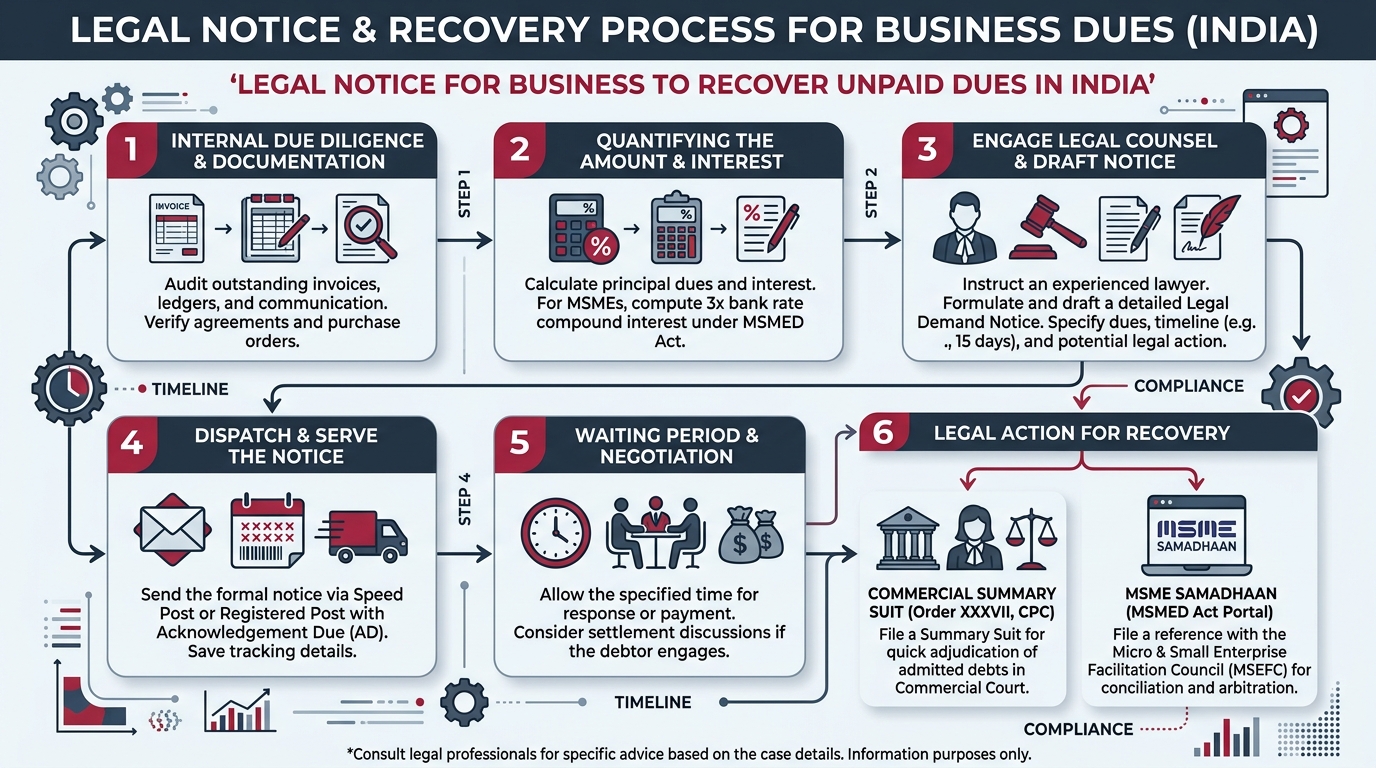
6. Step-by-Step Multi-Channel Bulk Recovery Workflow
Executing recovery across multiple commercial debtors requires a standardized, legally rigorous workflow to ensure every demand is bulletproof in court. Follow these sequential operational steps:
Consolidate Delinquent Ledger & Transaction Evidence
Aggregate unpaid GST tax invoices, signed purchase orders (POs), contracts, delivery challans, e-way bills, bank account statements, and debtor email admissions into a unified debt portfolio ledger.
Draft Advocate-Vetted Demand Notices with Statutory Interest
Draft individualized legal notices on an advocate's official letterhead, incorporating exact invoice breakdowns, interest computations under Section 16 MSMED Act or commercial contractual terms, and explicit pre-litigation warnings.
Dispatch Certified Digital Notices via Email & WhatsApp
Transmit electronic copies formatted as digitally signed PDFs to the corporate registered email addresses and mobile numbers of directors, immediately capturing transmission logs and read receipts.
Execute Concurrent India Post Speed Post / RPAD Delivery
Physically mail printed legal notices via India Post Speed Post or Registered Post with Acknowledgment Due to registered corporate offices, preserving official consignment tracking numbers.
Monitor 15-Day Ultimatum & Aggregate Service Proofs
Track the strict 15-day statutory compliance window from the date of confirmed delivery. In over 70% of commercial disputes, debtors initiate settlement dialogues during this critical window.
Escalate to MSME Samadhaan, Order 37 CPC Summary Suit, or Section 138 NI Act
If the debtor fails to settle within 15 days, assemble the complete evidentiary dossier (service certificates + postal receipts) and immediately initiate judicial filings before relevant tribunals and commercial courts.
7. Anatomy of an Enforceable Commercial Legal Notice
For a bulk commercial demand notice to carry decisive legal weight and preclude technical defenses in court, the drafting advocate must incorporate several non-negotiable structural elements:
- Advocate Letterhead & Enrolment Details: Issued on official advocate stationery with verified Bar Council enrollment credentials.
- Comprehensive Corporate Identification: Complete corporate identification of the debtor entity, including Corporate Identification Number (CIN), registered office address, and names of active directors or partners.
- Chronological Transactional Narrative: Unbroken timeline detailing contractual engagement, purchase order issuance, goods delivery dates, and tax invoice generation.
- Precise Financial Breakdown: Tabulated itemization of principal invoice sums, dates due, credit terms, and calculated penal interest.
- Statutory Invocations: Explicit statutory references to Section 15 & 16 of the MSMED Act, 2006, Order 37 CPC, Section 138 NI Act, or Section 8 IBC.
- Peremptory 15-Day Ultimatum: Clear declaration providing exactly 15 calendar days from receipt to remit funds to designated escrow or banking coordinates.
- Formal Warning of Litigation Costs: Explicit notice that failure to comply will compel civil litigation, criminal prosecution, and claims for legal damages and court fees.
8. Post-Notice Escalation & Judicial Enforcement Timelines
Understanding statutory deadlines is paramount for commercial creditors seeking the recovery of unpaid dues for business. Under Article 14 and Article 15 of the Limitation Act, 1963, the limitation period for filing a commercial money recovery suit is exactly three years from the date the invoice becomes overdue or goods are delivered.
Under Section 18 of the Limitation Act, any written acknowledgment of debt—including an email confirmation of balance, an audited ledger balance confirmation, or a partial payment deposited into the creditor's bank account under Section 19—resets the three-year limitation clock from the date of such acknowledgment. Serving a multi-channel legal notice often induces the debtor to request an extension or propose structured installments, creating fresh written acknowledgments that prevent claims from becoming time-barred.
When the 15-day ultimatum expires without settlement, legal counsel shifts directly to enforcement:
Day 1 to 15 (Notice Window): Notice delivered across Email, WhatsApp, and Speed Post. Debtor reviews legal exposure and assesses potential damage to business credit scores and corporate reputation.
Day 16 to 30 (Settlement or Filing): If amicable conciliation fails, advocate prepares Section 65B / Section 63 evidentiary affidavits and prepares formal plaint under Order 37 CPC or MSEFC conciliation petition.
Day 31 onwards (Judicial Action): Summary summons served upon the debtor. In summary proceedings, debtor must deposit security or demonstrate a genuine dispute before being allowed to defend the action.
9. Frequently Asked Questions
Statutory & Regulatory Authorities:
[1] The Code of Civil Procedure, 1908 (Order V Rule 9 & Order 37) - India Code
[2] The Micro, Small and Medium Enterprises Development Act, 2006 (Sections 15-18) - Ministry of MSME
[3] The Negotiable Instruments Act, 1881 (Section 138 & Section 141) - India Code
[4] Insolvency and Bankruptcy Code, 2016 (Sections 8 & 9) - IBBI
[5] The Limitation Act, 1963 (Articles 14, 15, and Section 18) - India Code
[7] The Bharatiya Sakshya Adhiniyam, 2023 (Section 63 Digital Evidence) - Gazette of India
Send Bulk Recovery Notice
Fast-track business dues recovery. Upload delinquent invoices, get advocate-vetted drafting, and dispatch simultaneous notices via Email, WhatsApp, and India Post Speed Post.
Fast turnaround • High Court panel advocates
Client Reviews
"We deployed Legal Recovery's bulk notice solution across 38 defaulting B2B vendors via WhatsApp, Email, and Speed Post. Within 18 days, over 70% of our unpaid commercial dues were settled without filing court cases."
More Consumer Protection Guides
Bulk Recovery Cases: Affordable Solutions
Complete legal handbook on handling multi-debtor defaults, MSME Samadhaan conciliation, and enterprise debt settlements.
Business Unpaid Dues Recovery
Understand the commercial rights and legal remedies for recovering pending B2B invoices and commercial defaults.
All Legal Notice Solutions
Explore our full suite of advocate-drafted statutory notices for recovery, employment, cheque bounce, and contract disputes.
Consumer Forum Complaint Filing
Step-by-step procedural manual for filing and fighting complaints before District and State Consumer Commissions.
Defective Product Delivery Notice
Enforce consumer rights and demand full refunds when e-commerce sellers deliver incorrect or defective merchandise.
E-Commerce Marketplace Disputes
How to hold online platforms accountable for rejected returns, fraudulent orders, and seller non-responsiveness.

Legal Recovery is India's trusted legal-tech platform for commercial debt recovery, consumer dispute resolution, and statutory legal notices. Founded in 2022 and headquartered in New Delhi, Legal Recovery has counselled over 15,000+ businesses and individuals, recovering more than ₹100 Crores in delinquent dues. We combine automated legal workflows with vetted high-court panel advocates to resolve commercial disputes swiftly without expensive, drawn-out litigation.